

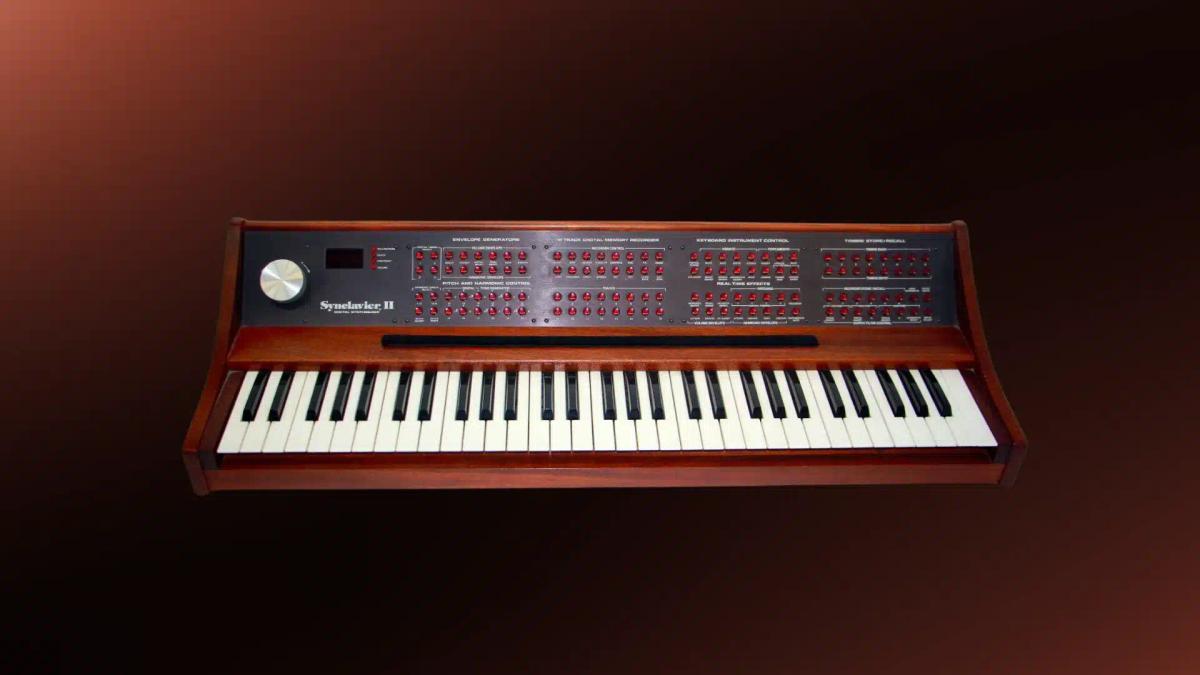
The New England Digital Synclavier II is a computer-based digital synthesizer unveiled at the AES show in May 1980 and built around a 16-bit minicomputer, a 61-key keyboard covered in illuminated buttons, and a sound engine that layered up to four “partial timbres” made from additive harmonics and FM. It began as a keyboard instrument for professional players, then absorbed 16-bit hard-disk sampling, sequencing, and notation as the decade went on. What makes it matter at a glance is that trajectory: the Synclavier II was the point where a university research project became a commercial instrument, and where that instrument started turning into a complete digital studio.
Table of Contents
Sound and character
The Synclavier II sounds clean, bright, and precisely tuned in a way that set it apart from the analog polysynths of its time. Its basic building block was additive: each partial timbre offered 24 individually adjustable harmonics, so a player could construct a tone from sine waves rather than carve it out of a buzzing oscillator with a filter. Its natural territory was glassy organ-like tones, bells, and sustained textures.
FM gave it a second, more metallic vocabulary. The FM section modulated the harmonic waveform with another sine wave, and non-integer ratios could push overtones into inharmonic territory. A 1983 review in Electronics & Music Maker noted that very subtle tuning was needed to avoid gong-like results, which is a useful clue to the machine’s personality: its gongs, bells, and clangorous attacks came easily, and they became some of its most recognizable sounds.
The real character, though, comes from layering. Up to four partials could sound per key, each with its own tuning, harmonic content, FM, volume envelope, harmonic envelope, vibrato, and portamento. Detuned layers or an FM attack over an additive body give the Synclavier II its signature: polished and controlled rather than warm or unstable. Purely additive tones could feel thin and suited steady sounds better than sharp transients, which is one reason NED later let users layer sampled attacks over synthesized bodies.
Features and architecture
- Manufacturer: New England Digital Corporation, Norwich, Vermont (later White River Junction)
- Year introduced: unveiled at the AES show in May 1980, with release usually given as summer 1980
- Production years: around 1980 to 1984 for the Synclavier II proper, after which the platform continued as the PSMT and the later 3200, 6400, and 9600 systems
- Synthesis type: digital additive synthesis with FM, combined through NED’s partial-timbre method; optional 16-bit Sample-to-Disk sampling from 1982
- Category: computer-based digital synthesizer system with keyboard, rack computer, and optional terminal
- Polyphony: 8 to 32 voices in standard configurations, added in eight-voice synthesizer cards; one note could use up to 8 voices with four chorused partials
- Original price: in UK pricing from early 1983, around £14,500 for a basic 8-voice keyboard system, £21,900 for 32 voices, and about £35,900 with terminal, music printing, and Sample-to-Disk; complete Synclavier systems across the decade are commonly cited from $25,000 to $200,000
- Current market price: no stable published price guide; see Market value
- Oscillators: per partial timbre, 24 adjustable harmonics with FM applied by a sine-wave modulator; up to 4 partial timbres per sound
- Filter: no conventional analog-style resonant filter; timbre changes come from the harmonic envelope and FM
- LFOs: vibrato with 10 waveshapes per partial
- Envelopes: a volume envelope and a harmonic envelope for each partial timbre
- Modulation system: per-partial FM, vibrato, portamento up to one minute in linear or logarithmic mode, fine tuning in 0.1 Hz steps, pitch bend up to two octaves via the control knob, and assignable pedals and footswitches
- Sequencer / arpeggiator: 16-track digital memory recorder holding up to 10,000 notes, with track merging and tempo change without pitch change; arpeggiate footswitch input
- Effects: none in the modern sense; chorus came from doubling voices per partial, and initial output was mono, with a stereo placement module planned for 1983
- Memory: timbres stored on floppy disk, with each 5.25-inch program disk holding 64 timbres plus sequence space; 8-inch drives were also offered
- Keyboard: 61-key Original Keyboard (ORK), not velocity sensitive; the weighted, velocity- and pressure-sensitive 76-key VPK came later, around 1984
- Interface: 128 illuminated selection buttons and a large spring-return control knob with a four-digit numeric readout
- Inputs / outputs: footswitch inputs for hold, repeat, portamento, sustain, and arpeggiate; headphone output; punch in/out; CV, gate, and trigger outputs; pitch-bend input
- MIDI / USB: no MIDI on early production systems; MIDI arrived later in the platform’s life and could be retrofitted only to some hardware revisions
- Display: four-digit LED readout on the panel; optional VDU terminal with the Timbre Display System
- Computer: NED’s own 16-bit ABLE computer in a 19-inch rack unit, programmed in Scientific XPL
- Dimensions / weight: keyboard unit about 25 lb, with the computer housed separately; a performance system packed into three flight cases
Strengths
- The partial-timbre architecture was a genuinely musical idea. Four independently tuned and enveloped layers per note let players build complex, evolving sounds that single-oscillator digital designs of the period could not easily match.
- The panel was fast for a computer instrument: with 128 dedicated buttons and one knob, most editing happened on the keyboard unit rather than through a terminal.
- Tuning precision was exceptional. Fine tuning in 0.1 Hz steps and an adjustable octave ratio made alternative tunings and controlled beating between partials practical.
- It was an expandable platform rather than a fixed product. Owners could add voices, a terminal, notation, and from 1982 the Sample-to-Disk option, so a system bought in 1980 could grow with the user.
- The integrated 16-track recorder put sequencing inside the Synclavier II itself.
Limitations
- The price placed it beyond almost all individual musicians. A basic 8-voice system was listed at around £14,500 in early 1983, and terminal and sampling options pushed it well past £35,000.
- The original ORK keyboard had no velocity sensitivity, a significant expressive limitation on an instrument this expensive until the VPK arrived.
- Early sampling was monophonic. The 1982 Sample-to-Disk system played samples from the keyboard one at a time, and polyphonic sample playback followed only a couple of years later.
- There was no MIDI at launch, and the Synclavier II’s original output was mono, which complicated integration into the studios that adopted it.
- It was a multi-component system of rack computer, keyboard, disk drives, and optional terminal, far from a self-contained keyboard.
Historical context
The Synclavier grew out of Dartmouth College in New Hampshire, where Professor Jon Appleton worked with engineer Sydney Alonso and student programmer Cameron Jones on digital synthesis in the 1970s. Alonso and Jones founded New England Digital in 1976, and the first Synclavier appeared in 1977. That earlier instrument was a modest commercial presence: only around 20 were built, mostly for universities.
The Synclavier II was the commercial turn. Oakland producer Denny Jaeger, who saw the Synclavier II’s potential for working musicians, is credited with pushing for four simultaneous voices per key press, which became the partial-timbre method. The result was unveiled in May 1980, and NED advertised it in 1981 as the most powerful synthesizer ever made. Its timing mattered: analog polysynths could not deliver the tuning stability, recall, and layered digital timbres it offered, and its main rival at the top of the market was the Australian Fairlight CMI.
The key shift came in September 1982 with Sample-to-Disk, a 16-bit system that recorded audio to a Winchester hard disk. From there the platform kept moving: polyphonic sampling, the VPK keyboard and PSMT systems around 1984, and the 3200, 6400, and 9600 systems later in the decade. By 1989, a core 3200 system was listed at around $57,000 and a 9600 at around $148,000 in European pricing. The Synclavier II sits at the hinge: still a synthesizer first, but already carrying the architecture of a tapeless production system.