

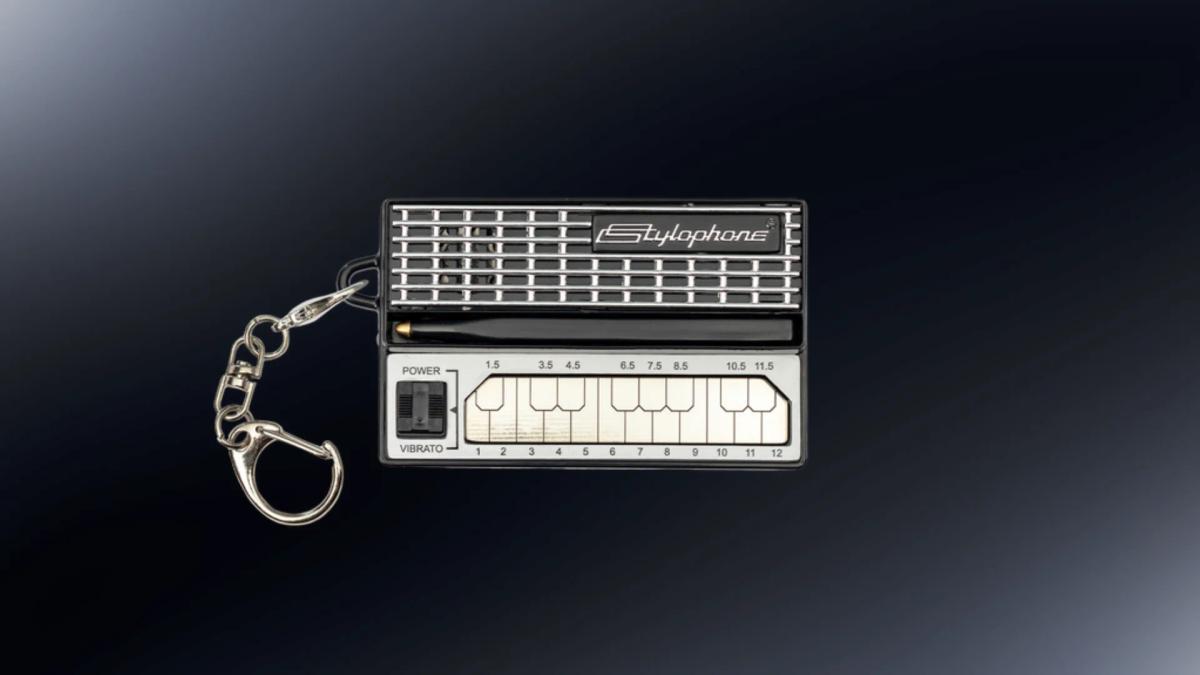
The Stylophone Mini is a keychain-sized, battery-powered stylus synthesizer from Stylophone, the instrument brand of the British company Dubreq. It was launched on October 8, 2026, and went on sale the same week through Stylophone’s own shop and dealers such as Thomann and Andertons. The design shrinks the 1968 original to pocket scale while keeping the parts that make a Stylophone playable: a miniature nickel-plated metal keyboard, an attached stylus, a built-in speaker and a vibrato function, plus a white LED light and automatic switch-off. There are no audio outputs, no MIDI and no sound controls beyond power and vibrato. Launch pricing is $29.95 in the US, £19.95 in the UK and €24.95 in Europe, in three finishes: Original (black), White and Pink. The Stylophone Mini matters less as a studio tool than as a statement: a fully playable instrument sold at the price of a novelty keyring.
Table of Contents
Stylophone Mini sound and character
The Stylophone Mini is played the way every Stylophone has been played since the late 1960s. The attached stylus is touched to, or slid across, a strip of metal keys, and each contact sounds a note through the onboard speaker. Adam Douglas of Gearnews described the keyboard as spanning one and three-quarter octaves, with the same layout as the full-size model, so melodies learned on an S-1 should transfer directly to the smaller surface.
The instrument is monophonic. Only one note sounds at a time, which follows from the single stylus, and Thomann’s listing gives the polyphony as one note. Expression comes from two places: the way the stylus moves between keys, which can be tapped for separate notes or dragged for a run of rapid steps, and a dedicated vibrato button that adds pitch modulation. Gearnews reported that this button also works as the on/off switch, while Synthtopia and Hypebeast describe power and vibrato as the only controls. There is no volume knob, tuning control, octave switch or choice of waveform documented for this model.
Sound leaves the Mini through its built-in speaker and nowhere else. Gearnews noted that the unit has no audio output of any kind, so recording it means placing a microphone in front of it. That limits its role in a studio, but it also defines the character of the thing: the Stylophone Mini is meant to be pulled out of a pocket and played immediately, without cables, apps or an amplifier, which is how Stylophone’s press material frames it.
Dubreq has not published details of the sound circuit. Thomann’s spec table classifies the sound generator as analog, but the manufacturer’s announcement and the launch coverage do not describe the oscillator design, so the engine is best treated as unspecified. The official launch video, titled “Stylophone Mini OUT NOW!” on Stylophone’s YouTube channel, and a hands-on clip from the channel Musical Miscellany & More, which MATRIXSYNTH shared, are the most direct ways to hear it so far.
Expectations are worth calibrating. Matt Mullen of MusicRadar wrote that the Mini is not a replacement for the Gen X-2, Stylophone’s more capable portable synth with CV and gate connections, and presented it instead as a fun, collectible piece of synth history and a possible stocking filler. No independent long-form review had been published by October 20, 2026, so judgments about tone, tuning stability and speaker volume rest on demo videos rather than tested measurements.
Features and architecture
- Manufacturer: Stylophone, a brand of Dubreq (United Kingdom)
- Year introduced: 2026 (launched October 8, 2026)
- Production years: 2026 to present
- Synthesis type: not specified by the manufacturer (Thomann lists the sound generator as analog)
- Category: miniature stylus-operated synthesizer in keychain format
- Polyphony: monophonic (one note)
- Multitimbrality: none
- Original price: $29.95 (US), £19.95 (UK), €24.95 (EU)
- Current market price: around £19.95 to £21.40 in the UK and €24.60 to €24.95 in Europe at launch dealers in October 2026
- Oscillators: not specified by the manufacturer; single fixed voice
- Filter: none
- LFO: none user-adjustable; a vibrato button applies fixed pitch modulation
- Envelopes: none
- Modulation system: vibrato button only
- Sequencer / arpeggiator: none
- Effects: none
- Memory: none
- Keyboard: miniature nickel-plated metal keyboard played with an attached stylus, about one and three-quarter octaves according to Gearnews
- Inputs / outputs: none; built-in speaker only
- MIDI / USB: none
- Display: none; a white LED light doubles as a small flashlight
- Dimensions / weight: 75 x 45 x 18 mm and 42 g according to Thomann; Hypebeast gives 10.4 x 7.9 x 2.3 cm
- Power: two button-cell batteries, included (Thomann and Andertons list CR2032; Synthtopia and Hypebeast list LR44), with automatic switch-off
Strengths
- It is a real, playable instrument. The stylus and metal keyboard work the same way as on full-size Stylophones, so it plays melodies rather than triggering canned sounds.
- It needs nothing else to make sound. The built-in speaker and included batteries mean it plays out of the box, with no cables, apps or amplifier.
- The price is very low. At $29.95, £19.95 or €24.95 it costs about the same as a decorative keyring, and well below the $50 VOICE sampler in the same pocket-sized family.
- The layout is familiar. Gearnews reported the same key layout as the full-size model, so tunes and techniques carry over between sizes.
- It is genuinely portable. At keychain size, with a loop and chain or clasp for keys and bags, it can be carried every day in a way a full-size S-1 cannot.
- Small practical touches help. The automatic switch-off saves battery life, and the white LED light gives the object a second everyday use as a flashlight.
Limitations
- There is no audio output. Recording or amplifying the Stylophone Mini requires a microphone, which Gearnews pointed out directly.
- Sound shaping is almost absent. Beyond vibrato there is no documented control over volume, tuning, octave or tone.
- It runs on disposable button cells. A Synthtopia reader criticized the battery choice in the comments, and no rechargeable or USB power option is listed.
- Published specifications disagree. Dealers and press list different battery types (CR2032 or LR44) and different dimensions, and Dubreq has not published a full technical sheet in the sources consulted.
- The range is narrow. About one and three-quarter octaves on a single monophonic voice limits it to simple melodies.
- Independent reviews are missing. As of October 20, 2026, coverage consists of launch news and short hands-on videos, with no tested review of sound quality or durability.
Historical context
The Stylophone story begins with Brian Jarvis, who invented the instrument in 1967. Dubreq began producing it in London in 1968, and around three million units were sold before production stopped in 1975. During that first run the company also made the larger 350S, with more notes and two styluses, along with accessories such as the Pianomate and the Mini-Amp. The Stylophone reached records quickly: David Bowie is credited with playing one on “Space Oddity” in 1969, and Kraftwerk featured it on “Pocket Calculator” in 1981.
Dubreq was re-formed in 2003 by Ben Jarvis, the inventor’s son, and in October 2007 the Stylophone returned as the S1, a digitally recreated version made with the toy company Re:creation. The modern catalog has since grown in two directions. On one side are serious instruments: the Gen X-1 portable analog synth announced in 2017, the GEN R-8 released in a limited run of 500 in 2019, the Stylophone Theremin in 2024, the CPM DS-2 drone synth and the Gen X-2 in 2025, and the VOICE sampler announced in January 2026. On the other are affordable reinterpretations of the original, including the Analog Sound S1 of 2020, built around a 555 timer oscillator, and the cassette-shaped Stylosette of 2024.