

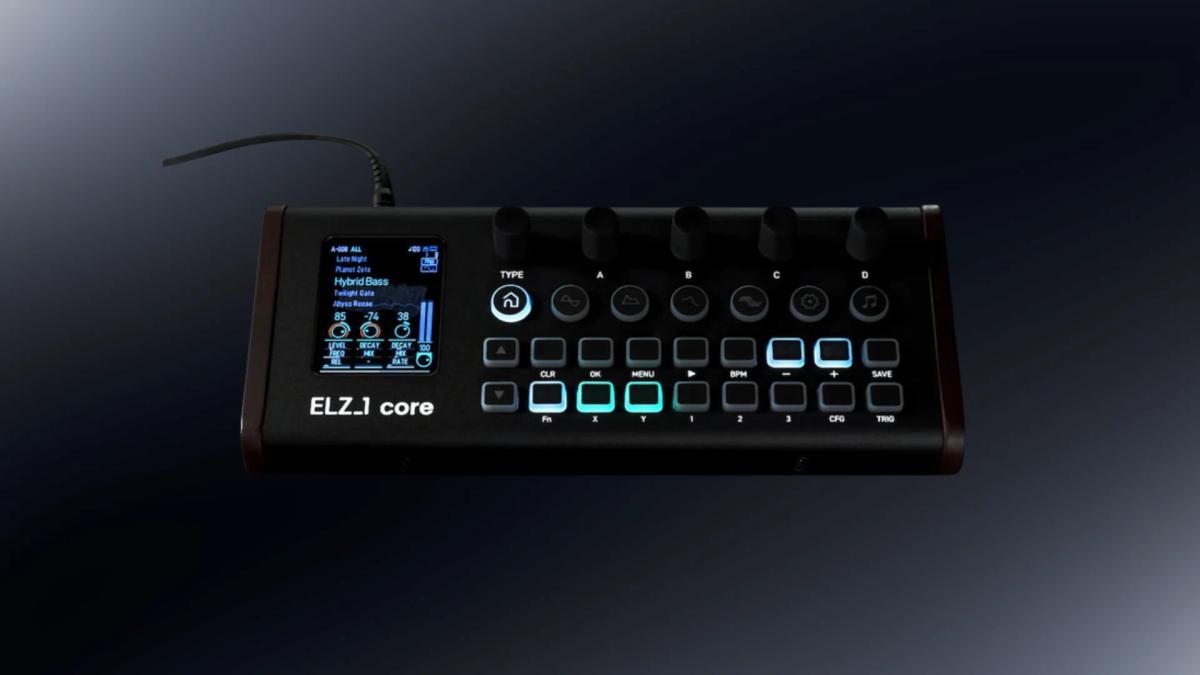
The Sonicware ELZ_1 core is a compact digital desktop synthesizer from Sonicware, the Tokyo company behind the ELZ_1 and LIVEN instruments. Announced on September 16, 2026, it takes the sound architecture of the keyboard-equipped ELZ_1 play and places it in a small walnut-sided box with no keys, no speakers and no looper. Each sound can stack up to three oscillators drawn from 18 synthesis engines, among them wavetable, four-operator FM, granular, Karplus-Strong and physical modeling types, with 16 licensed Waldorf wavetables from the PPG and Microwave and support for importing Serum wavetables. Sonicware quotes up to 20 voices depending on the engine, nine filter and EQ types, 49 effect types and a 128-step sequencer. The price is $499, £449 or €539, sold only through Sonicware’s own webshop in made-to-order batches. The Sonicware ELZ_1 core matters because it turns a niche handheld instrument into a module meant to sit beside an existing keyboard, controller or DAW.
Table of Contents
Sonicware ELZ_1 core sound and character
The Sonicware ELZ_1 core is not a new engine. Every launch report, from Si Truss at MusicRadar to Adam Douglas at Gearnews, describes it as the ELZ_1 play’s synthesis architecture in a module format, and Sonicware released firmware V3 for both instruments on the same day. What the core offers, then, is the sound of a synth that has grown steadily since 2018: an engine collection that started with 8-bit wave memory, low-bit oscillators, four-operator FM and the SiGRINDER granular engine, and has since gained wavetable, physical modeling and super oscillator types.
The engine list is broad rather than deep in any single method. MATRIXSYNTH’s reproduction of the launch material names wavetable, four-operator FM, Karplus-Strong plucked string synthesis, the sample-based DNA EXPLORER and SiGRINDER engines, granular, low-bit, wave memory and super oscillators, with physical modeling also mentioned. DNA EXPLORER extracts and generates waveforms from recorded audio, which Synthtopia noted when the original ELZ_1 was shown at NAMM in 2018, so the instrument can build oscillators from material fed into its stereo input.
Layering is the key to the current sound. Since the ELZ_1 play V2 update in October 2025, a patch can stack up to three oscillators, and on the Sonicware ELZ_1 core each of those layers can use a different engine. A granular texture can sit under an FM tine and a wavetable pad in a single patch, then pass through one of nine filter and EQ types and four envelope types. Polyphony is quoted at up to 20 voices, with the exact figure depending on which oscillator types are in use, so dense three-layer patches will leave fewer notes available.
The wavetable engine carries the most recognizable sounds. It was added in the V2 update through an official collaboration with Waldorf, whose CSO Joachim Flor described it to Synth Anatomy as bringing Waldorf heritage to more affordable instruments. Sixteen wavetables from the PPG and Microwave are built in, and wavetables made in Xfer Serum can be imported, which links the hardware to a large library of user-made material. Synth Anatomy reported 32 wavetable slots for the engine on the ELZ_1 play.
Effects play a large part in the character. The core offers 49 effect types across four modules, labeled INSERT, EFX I, EFX II and MASTER, which cover both insert and send duties. On the ELZ_1 play, the V2 update brought granular processors, formant, compressor and isolator effects, while an earlier firmware added ambient room, hall and infinite reverbs. The sound can therefore move from dry, lo-fi 8-bit tones to washed-out ambient beds within the same instrument.
The control surface is small but direct. A 2.4-inch color LCD shows a redesigned Edit interface, five rotary encoders handle parameter changes, and 25 full-color LED buttons cover navigation and step entry. Three Performance Macros let each of three encoders move up to three parameters at once across oscillators, filters and effects. Without a keyboard, the core relies on external control: a USB-A host port accepts and powers a USB MIDI controller, and a TRIG function fires chords or drum sounds from the panel. Starsky Carr titled his video review of the Sonicware ELZ_1 core with the claim that losing the keyboard, speaker and looper makes it better, a framing that captures what the module is meant to be.
Features and architecture
- Manufacturer: Sonicware (Tokyo, Japan)
- Year introduced: 2026 (announced September 16, 2026)
- Production years: 2026 to present, in made-to-order batches
- Synthesis type: Digital multi-engine synthesis; 18 engines including wavetable, four-operator FM, granular, Karplus-Strong, physical modeling, wave memory, low-bit and super oscillators
- Category: Desktop synthesizer module
- Polyphony: Up to 20 voices, depending on oscillator type
- Multitimbrality: Not specified by the manufacturer; the sequencer is single-track
- Original price: $499, £449, €539 (Sonicware webshop)
- Current market price: Sold new only through Sonicware’s webshop at the launch price; no dealer or used listings found as of October 2026
- Oscillators: Up to three oscillators (layers) per sound, each selectable from 18 engines; 16 Waldorf PPG and Microwave wavetables built in; Serum wavetable import
- Filter: Nine filter and EQ types
- LFO: Not specified in Sonicware’s launch specifications
- Envelopes: Four envelope generator types
- Modulation system: Three Performance Macros, each controlling up to three parameters across oscillators, filters and effects
- Sequencer / arpeggiator: Single-track step sequencer with up to 128 steps per pattern and 128 patterns; step and real-time recording with MicroTiming REC for unquantized input; 12-mode arpeggiator; TRIG function for chords or drum sounds
- Effects: 49 effect types across four modules (INSERT, EFX I, EFX II, MASTER)
- Memory: 512 sound memories including 256 presets; Patch Tag search, Favorite and Shortcut functions; 32 GB storage card included with preset wavetables
- Keyboard: None
- Inputs / outputs: 3.5 mm stereo input; two 1/4-inch line outputs per the launch specifications (Bonedo lists mini-jack outputs); 3.5 mm stereo headphone output
- MIDI / USB: 5-pin DIN MIDI in and out; USB-C with MIDI, mass storage and 2-in/2-out audio at 48 kHz/16-bit; USB-A MIDI host with bus power for connected controllers
- Display: 2.4-inch full-color LCD
- Dimensions / weight: 234 × 103 × 57 mm (9.21 × 4.06 × 2.24 in); 0.97 kg (2.14 lb)
- Power: DC 9 V AC adapter (included)
Strengths
- The engine range is unusually wide for the price. Eighteen engines covering wavetable, FM, granular and physical modeling give the core a palette that most single-method synths at $499 cannot match.
- Layering three engines per patch opens hybrid sounds. Different synthesis methods can be combined in one patch, which is the clearest change since the ELZ_1 play first shipped.
- Licensed Waldorf wavetables add a pedigree. The 16 PPG and Microwave tables come from an official collaboration, and Serum import extends the library well beyond the factory set.
- It fits into existing setups easily. DIN MIDI, USB audio and MIDI, and a powered USB host port let it work with a DAW, a hardware sequencer or a bare USB keyboard without a computer.
- The footprint is small and the build is distinctive. At 234 mm wide and under a kilogram, with solid walnut side panels, the module takes little space on a desk or in a live rig.
- Firmware has a strong track record. Sonicware has added engines, effects and workflow features to the ELZ_1 family over several years, and V3 shipped for the core and the play at the same time.
Limitations
- Availability is restricted. The core is made to order and sold only through Sonicware’s webshop, and the first batch was limited to 50 units scheduled to ship in mid-October 2026.
- Independent written reviews are not yet available. Launch coverage is based on Sonicware’s announcement, and the published hands-on material so far consists mainly of video demos.
- Polyphony depends on the patch. The 20-voice figure is a maximum that varies by oscillator type, so heavily layered sounds will reduce the voice count.
- The sequencer covers one track. A single-track sequencer and no stated multitimbral mode make it a voice for a larger setup rather than a self-contained groovebox.
- Some specifications are not published. Sonicware’s launch material does not give LFO counts, and sources disagree on whether the line outputs are 1/4-inch or mini-jack.
- It gives up the play’s portability. There is no keyboard, speaker, looper or battery operation, so the core needs external power, monitoring and a controller.
Historical context
Sonicware was founded in Tokyo in 2004 by Dr Yu Endo, who was its CEO at the time of a 2020 Attack Magazine profile by Adam Douglas. For roughly 15 years the company wrote software for other instrument makers before releasing hardware of its own. Endo told Attack that the brand’s founding rule was to avoid PCM sample playback and build a digital instrument with a new sound, an idea that runs through the whole ELZ_1 line.