

Home›Articles›Shrub: Steve Duda’s mini Serum wavetable firmware…
Articles

Shrub: Steve Duda’s mini Serum wavetable firmware for the M-VAVE FM-1 is still in private testing

Shrub firmware is Steve Duda’s wavetable synth for the M-VAVE FM-1. What is confirmed, what is not, and why the private alpha is worth watching.

Bernardo de Azevedo
Bernardo de Azevedo
· Updated
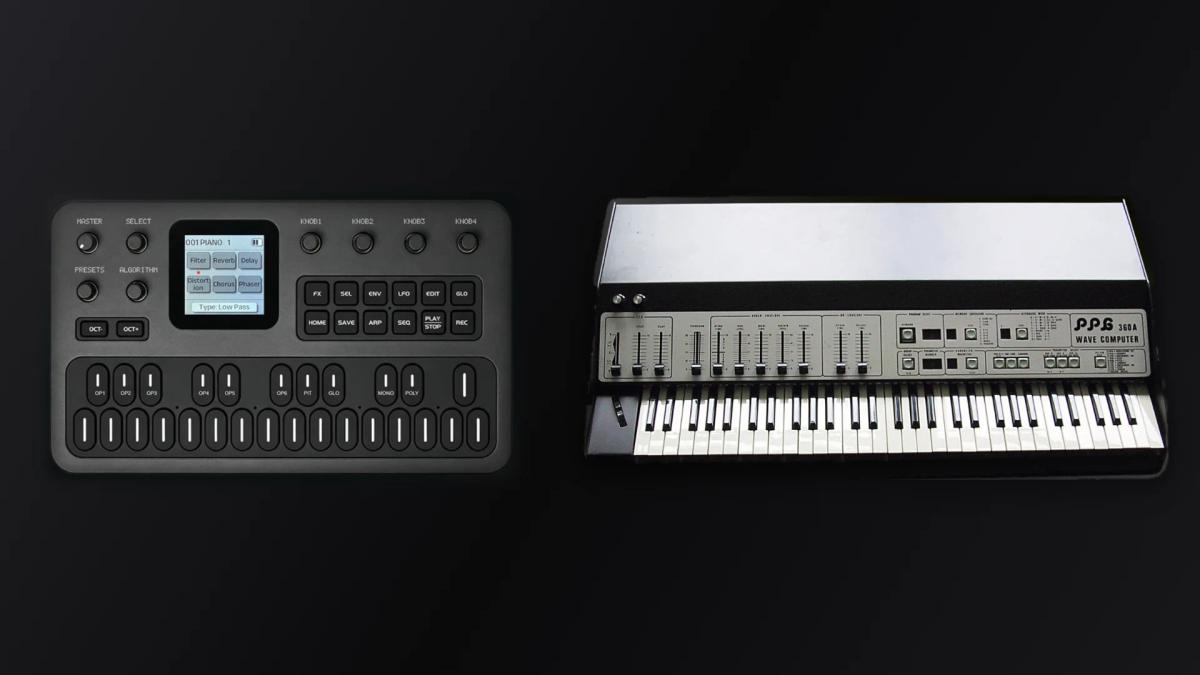
Shrub firmware: M-VAVE FM-1 pocket synthesizer beside the PPG Wavecomputer 360

Shrub firmware is a wavetable synthesizer that Steve Duda, the developer behind the Serum plugin and co-founder of Xfer Records, is building for the M-VAVE FM-1. Duda calls it a “mini Serum” port, for a pocket synth that was designed around six-operator FM. The project is in private alpha or beta testing, and almost everything public about it comes from a single news report and a forum post that repeats it. This article separates what has been stated from what remains open, and asks whether a wavetable engine suits this hardware.

Table of Contents

What Shrub firmware is, and what is on record

The main source is a report published by Synth Anatomy on 24 October 2026. It presents Shrub as a free wavetable firmware for the FM-1 that contains only the synthesizer, with no groovebox or song features. The article describes it as a stripped-down port of the Serum idea rather than an adaptation of an existing FM-1 firmware.

Duda’s own announcement was a post on Reddit, which Synth Anatomy quotes and summarises. That post could not be checked directly, so Duda’s words here are as reported by Synth Anatomy. The same day, a forum member named Hoshin shared the report in the long-running FM-1 thread on Elektronauts. That post only links the report and repeats its headline claim that Duda is developing a stripped-down version of Serum for the FM-1, so it adds nothing beyond it and the account rests on a single secondary source.

No repository, release page or install guide for Shrub had been published at the time of writing, and the Xfer Records website did not mention the Shrub firmware either. No coverage by other synthesizer outlets was found.

The feature set reported so far

According to Synth Anatomy, the oscillator section uses three-dimensional wavetables. The filter is described as being derived from Serum 2 and offers several modes. There are two ADSR envelopes and two LFOs, and the LFOs can use multiple waveforms.

The effects section is reported to have five processors: distortion, chorus, delay, an OTT-style effect and reverb. An algorithmic arpeggiator is included, along with an eight-lane motion sequencer for animating parameters. Built-in scales are mentioned. The voice section is limited to the number of voices and a tuning and pan amount for each voice.

These descriptions are second-hand. The report gives no figures for polyphony, wavetable count or memory use, and no audio or interface footage was available at the time of writing to check against the list. The feature set should be treated as a statement of intent from an unreleased project, since the report itself says testers are being asked for feedback before the design settles.

A single filter, and what that implies

The most specific design detail concerns the filter. Synth Anatomy reports that Shrub has no per-voice filters. All voices pass through one shared stereo filter, and the most recently played voice is the one that modulates it. Duda is reported to have called this a compromise between polyphony and quality.

The practical consequence is easy to predict, although it has not been demonstrated publicly. With a shared filter, envelope movement on a held chord will follow the latest note instead of each note separately, which changes the behaviour of plucks, overlapping pads and fast arpeggios compared with a conventional polyphonic synth. Whether this matters in practice depends on the patches, and nobody outside the testing group has reported on it.

The Shrub firmware report quotes Duda on sound quality: “The quality is reduced but I am aiming for it still being great.” That sentence is a fair summary of the position. The FM-1 is a roughly $70 pocket instrument, and a plugin-class wavetable engine has to be reduced to run on it. The open question is where the reductions fall, and no recordings had been shared at the time of writing.

Who is behind it, and how it is being tested

Duda is credited by Wikipedia as the creator of Serum, released in 2014, and of Serum 2, released in 2025. He co-founded Xfer Records in 2007, initially as a label for music released under the name BSOD. A March 2025 Sonicstate piece on a conversation with Duda about Serum 2 says the discussion covers the decision to make it a free update for owners of the first version, which is a small indication of his approach to distribution, though it says nothing directly about Shrub.

The Synth Anatomy report says that Duda asked for a few experienced testers who are not afraid of bricking the device and who can give feedback. He is reported as warning that, because the project is not a fork of other firmware, bricking is a real possibility, and testers are offered no compensation. Interested people were told to respond on the dedicated Reddit community or to email him, and the report says more information would follow on the Xfer Records website and Reddit.

That warning matters more than usual. Many community firmwares for the FM-1 reuse shared platform code such as Felucca, and why the device accepts this kind of software is covered in Inside the M-VAVE FM-1. A project written independently of those foundations gives up part of that shared experience, and the author says so openly.

Release status, price and licence

Three points are worth stating plainly. The release date has not been announced. The price is stated as free, with the report saying the firmware will be free to download, though no licence has been given, so it is not known whether the source will be published, whether redistribution will be allowed, or whether the firmware will be open or closed. The status is private testing, and there is no public download.

Readers who want to try Shrub firmware should wait for an official announcement from Xfer Records or Duda. When any custom firmware does become available, the site’s safe install and recovery guide explains the general precautions, and the project’s own warnings should be read before anything is flashed. Nothing in this article is a substitute for those instructions, and none are given here for Shrub because none exist publicly.

Where Shrub firmware fits among FM-1 projects

The FM-1 has accumulated a sizeable group of alternative firmwares since July. A Synthtopia overview from early October lists Felucca with nine engines, BAUDGIRL with a new virtual analog engine, a groovebox called Groove OS, the Lunar Modulator with five sound engines, SLOOP as a four-track groovebox, and X0X as a standalone groovebox with TR-909, TR-808, TB-303 and breakbeat engines. Several of these are sequencer-led, with synthesis as one component.

Shrub firmware appears to take the opposite approach. It is reported as synth-only, with the arpeggiator and motion sequencer serving the sound design instead of structuring a song. That positions it closer to a single-purpose instrument than to a workstation, and arguably nearer to the BAUDGIRL virtual analog build, which Sonicstate covered on 29 September, than to the groovebox projects.

The official side is also moving. On 20 October MatrixSynth reported the release of FM1 Open, a GPLv3 firmware with an SDK linking exception, which includes six sound engines named DX7, 808 KIT, 303 BASS, PLUCK, PSG and SAMPLER. Whether Shrub will use that SDK is not stated in any available source. The Synth Anatomy report also notes that the M-VAVE team upgraded the FM-1 that week with multitimbrality and 20 voices, but it does not say whether that update relates to Shrub.

Open questions

Several basic matters about the Shrub firmware are unanswered and should not be assumed. How many voices Shrub can play at once is unknown. The number of wavetables, their source and whether users can load their own are unknown. Whether the firmware shares storage with other firmware, or replaces the FM-1’s internal engines entirely, is not stated. The effect of the single filter on the FM-1’s CPU budget, and the audio quality at its default settings, cannot be judged without audio.

Pricing of the FM-1 itself is not addressed in the Shrub report either, so the cost of entry is simply that of the hardware. There is also no public statement about maintenance after testing. A firmware from a well-known plugin developer carries expectations of polish, but the available reports describe a private test, and small changes of direction are common at that stage.

Final perspective

Shrub firmware is notable mainly for who is behind it. Duda built one of the most widely used wavetable synthesizers in music production, and an interest in the FM-1 from that quarter suggests the device’s scene is being watched by people outside the hardware hobby. The single-filter compromise and the candid bricking warning suggest a project aware of its limits.

At this stage the evidence on the Shrub firmware is thin. One article, a forum post that repeats it and a call for testers do not establish what the firmware sounds like or when it will arrive. The reasonable stance is to follow announcements from Xfer Records, treat the feature list as provisional, and avoid forming a view of the sound until audio from the testers is public. This article will need updating once a build is released.

Sources

  1. Xfer Records Shrub: Serum for M-VAVE FM-1, Synth Anatomy
  2. M-vave fm-1, forum thread, page 27, Elektronauts
  3. Steve Duda, Wikipedia
  4. Xfer Records, Xfer Records
  5. Steve Duda on Serum 2, Sonicstate
  6. M-VAVE FM1 Open V14, official open firmware, MatrixSynth
  7. Free Custom Firmware for Mvave FM-1, Sonicstate
  8. Alt Firmware Options For The M-Wave FM-1 Pocket Synthesizer, Synthtopia
Bernardo de Azevedo
Written by
Bernardo de AzevedoFounder & Editor

His connection with music began at age 6, in the 1980s, when his father introduced him to Jean-Michel Jarre's Rendez-Vous on vinyl. He works professionally in the legal field, while synthesizers became his space for abstraction and creative exploration. Founder of The Synth Source.