

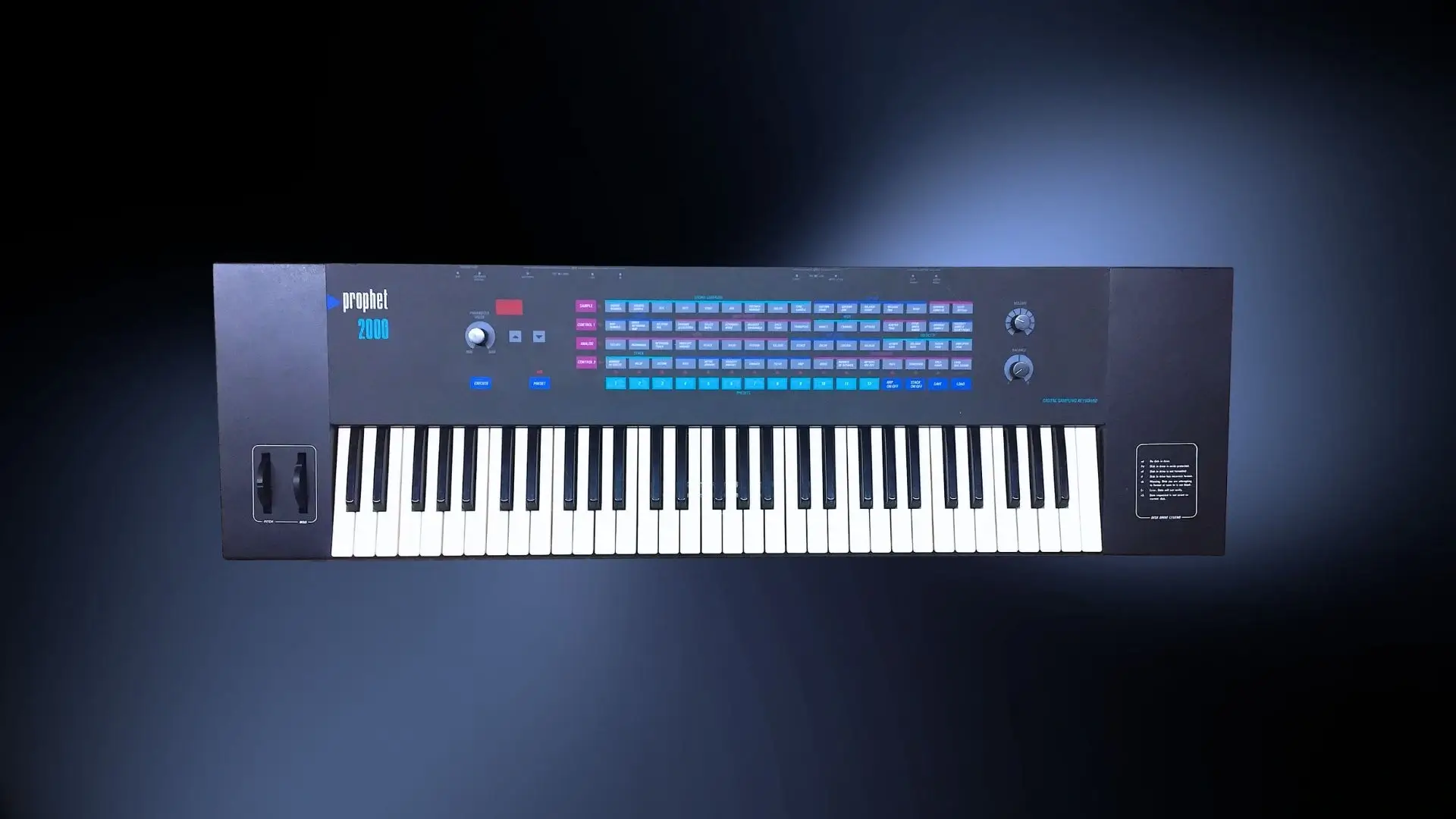
The Sequential Circuits Prophet 2000 is a 61-key digital sampling keyboard introduced in 1985, at a moment when sampling was moving from elite studio technology into the reach of working musicians. It combined 12-bit sampling, eight-voice polyphony, velocity response, MIDI, floppy-disk storage, and analog filtering in a format that still felt like a performance instrument rather than a laboratory machine. It was not simply a sampler with the Prophet name attached; it was Sequential’s attempt to translate its synthesizer identity into the new culture of sampled sound.
Table of Contents
Sequential Circuits Prophet 2000 sound and character
The Sequential Circuits Prophet 2000 sounds like an early digital sampler that has not fully abandoned the habits of analog synthesis. Its character comes from the tension between limited digital memory and analog post-processing: samples enter the machine through a 12-bit digital system, but they are shaped afterward by analog VCF and VCA circuitry. That combination gives the Sequential Circuits Prophet 2000 a tone that can be clearer and more present than earlier 8-bit samplers, yet still grainy, compact, and unmistakably mid-1980s.
It excels at sounds that benefit from a slight rough edge: synthetic choirs, strings, vocal fragments, short orchestral attacks, analog-synth samples, metallic percussion, tape-sourced textures, and atmospheric one-shots. It is not the right machine for transparent realism by modern standards. Its value lies elsewhere: in the way it turns samples into playable, filtered, velocity-sensitive musical material.
The higher sampling rates allow brighter captures, while the lower rates stretch limited memory and push the sound toward a narrower, more characterful bandwidth. The analog filters matter because they allow sampled material to behave more like a synthesizer voice. A sampled brass stab, string tone, or vocal sound can be softened, darkened, articulated, or made more expressive through filter and amplifier envelopes. In that sense, the Sequential Circuits Prophet 2000 belongs to the period before samplers became neutral playback devices. It treats sampling as a form of synthesis.
Features and architecture
- Manufacturer: Sequential Circuits.
- Year introduced: 1985.
- Production years: commonly listed as 1985–1987.
- Synthesis type: digital sampling with analog signal processing.
- Category: keyboard sampler / hybrid sample-based synthesizer.
- Polyphony: 8 voices.
- Original price signal: contemporary UK sources placed it around £2,000, with one 1986 price listing at £2,199 including VAT.
- Current market price signal: recent used-listing signals commonly appear below the price of flagship vintage analog polysynths, with visible examples around the mid-hundreds of US dollars depending on condition, expansion, storage, and service status.
- Oscillators / sound sources: no conventional VCO architecture; the main sound source is sampled audio, with internal ROM-based synth sounds also available.
- Sampling resolution and rates: 12-bit sampling, with rates commonly cited around 16 kHz, 31.25 kHz, and 42 kHz.
- Filter: analog VCF per voice.
- VCA: analog VCA per voice.
- LFOs: one LFO, with programmable modulation functions.
- Envelopes: ADSR-style control for loudness and brightness/filter behavior, with alternate release behavior available through footswitch use.
- Modulation system: velocity can affect envelope behavior, modulation depth, brightness, loudness, and sample-start behavior; pitch and modulation wheels are available.
- Sequencer / arpeggiator: arpeggiator included; no full onboard polyphonic sequencer.
- Effects: no modern onboard effects processor documented; the arpeggiator is the main performance utility often listed in effects/performance summaries.
- Memory: 256K sample memory, expandable to 512K.
- Sample storage: 3.5-inch floppy disk.
- Keyboard: 61 keys with velocity response; the keyboard does not generate aftertouch.
- Performance modes: split, layer, velocity switching, velocity crossfade, positional crossfade, merge-style mapping, and MIDI-based multitimbral use.
- Inputs / outputs: switchable mic/line sample input, stereo left/right audio outputs, and footswitch connections.
- MIDI / USB: MIDI in, out, and thru; no USB.
- Display: small two-digit LED-style display with membrane-switch function access.
- Dimensions / weight: not included here because reliable published figures were not confidently verified from accessible sources.
- Power: not included here because a reliable published power specification was not confidently verified from accessible sources.
Strengths
- It gives early digital sampling an analog finishing stage, which makes samples feel more playable and more “instrument-like” than a purely static playback system.
- Its 12-bit sampling was a serious step up from lower-resolution affordable samplers of the period, especially when used at the higher sample-rate setting.
- The analog VCF/VCA structure gives the machine a strong identity: it can turn ordinary samples into darker, punchier, more animated performance patches.
- Its mapping system supports splits, layers, velocity switching, velocity crossfades, and positional crossfades, making it more flexible than its modest display suggests.
- The expandable memory gave the Sequential Circuits Prophet 2000 a longer practical life, especially once users could move from 256K to 512K.
- The 61-key format made it a real keyboard instrument, not merely a studio module or sample player.
- MIDI implementation gave it a place in increasingly computer- and sequencer-based studios of the mid-1980s.
- Its limitations are musically useful today: the bandwidth, conversion, memory, and analog filtering create a texture that modern clean samplers often need to imitate deliberately.
Limitations
- The interface is constrained by a small display and a membrane-based control system, which makes deeper editing less immediate than on machines with larger screens or graphical editors.
- Memory is extremely limited by modern standards, even when expanded.
- The machine is not designed for transparent, high-fidelity multisampling in the modern sense.
- The mapping system is powerful but can be confusing, especially compared with later samplers that offered clearer visual feedback.
- There are only two main audio outputs, which limits separate processing of individual samples in multitimbral arrangements.
- The keyboard does not generate aftertouch, even though the system can respond to some MIDI pressure data.
- Disk loading and vintage storage maintenance are real ownership issues.
- Condition matters heavily on the used market because floppy drives, displays, buttons, power components, memory expansions, and operating-system versions can affect practical usability.
- It is not a replacement for a modern sampler; it is a character instrument for people who specifically want the sound and workflow of early sampling.
Historical context
The Sequential Circuits Prophet 2000 appeared at a decisive point in sampler history. By the mid-1980s, sampling was no longer restricted to the Fairlight, Synclavier, or the most expensive E-mu systems, but it still carried an aura of studio privilege. Affordable sampling was beginning to matter culturally because it changed who could work with recorded sound as a playable instrument.
Sequential Circuits had already helped define the programmable polyphonic synthesizer era with the Prophet-5 and had played a major role in the MIDI revolution. The Sequential Circuits Prophet 2000 therefore arrived from a company whose reputation was built on performance-oriented electronic instruments, not on laboratory sampling systems. That mattered. The Sequential Circuits Prophet 2000 was designed as a keyboardist’s sampler: it had wheels, velocity, analog-style envelopes, filters, keyboard mapping, and MIDI performance behavior.
Its direct context included instruments such as the Ensoniq Mirage, E-mu Emulator II, Roland S-series samplers, and Akai’s emerging sampler line. The Mirage made sampling much cheaper, but the Sequential Circuits Prophet 2000 offered a more refined combination of 12-bit sound, higher sampling rates, analog processing, and performance-oriented mapping. It was more expensive than the Mirage, but far less expensive than high-end sampling systems that had defined the earlier part of the decade.
The Sequential Circuits Prophet 2000 also led to the Prophet 2002 rack version, which preserved the core sampling architecture in a keyboardless format. In retrospect, the 2000/2002 family sits near the end of Sequential’s original 1980s run, before the company’s financial decline and Yamaha’s acquisition of the brand. That gives the Sequential Circuits Prophet 2000 a slightly bittersweet place in the timeline: it was innovative, musically useful, and forward-looking, but it arrived just as the sampler market was becoming brutally competitive.
Legacy and significance
The Sequential Circuits Prophet 2000 matters because it shows how sampling was interpreted by a synthesizer company rather than by a purely digital-instrument manufacturer. It did not treat recorded sound as finished material. It treated a sample as an oscillator-like object that could be mapped, filtered, shaped, layered, crossfaded, and performed.