

Home›Synths›Sequential Circuits Prelude: The Siel-built orchestral …
Synths

Sequential Circuits Prelude: The Siel-built orchestral synth behind an odd Sequential detour

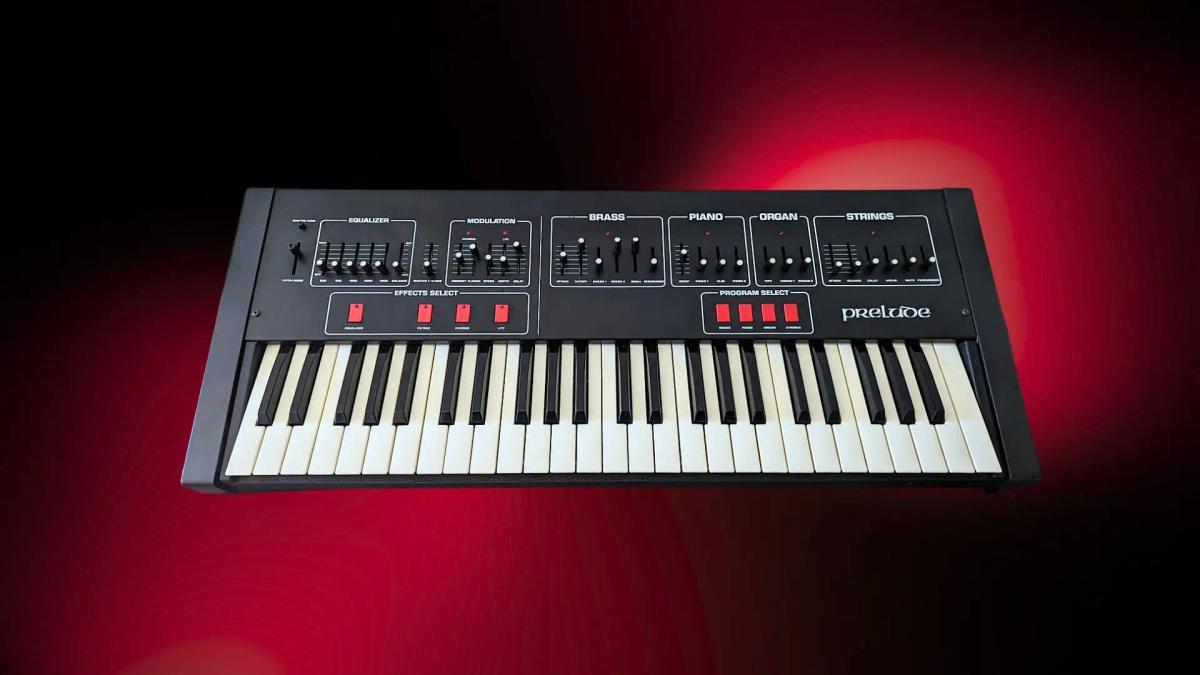
The Sequential Circuits Prelude is a 49-key analog orchestral/string synthesizer marketed by Sequential Circuits in the early 1980s, with documented advertising in 1983. It was not a Prophet-line polysynth and should not be understood as a major Dave Smith design statement.

Bernardo de Azevedo
Bernardo de Azevedo
· Updated
Sequential Circuits Prelude: The Siel-built orchestral synth behind an odd Sequential detour

The Sequential Circuits Prelude is a 49-key analog orchestral/string synthesizer marketed by Sequential Circuits in the early 1980s, with documented advertising in 1983. It was not a Prophet-line polysynth and should not be understood as a major Dave Smith design statement. Instead, it was a private-branded version of the Siel Orchestra 2, also known as the OR400, adapted for Sequential’s product line at a moment when the company was broadening its catalog beyond its better-known programmable synthesizers. Its significance lies precisely in that tension: it carried the Sequential name, but its musical identity came from the Italian divide-down orchestral-keyboard tradition.

Table of Contents

Sequential Circuits Prelude sound and character

The Sequential Circuits Prelude sounds less like a programmable analog polysynth and more like a refined late-period string/orchestral machine. Its basic architecture is built around preset families rather than open-ended patch construction: brass, strings, organ/reed-type colors, and piano-style tones. The character is immediate, slightly theatrical, and very much rooted in the pre-sampler idea of “orchestral” synthesis, where realism is less important than stylized ensemble color.

Its strongest territory is the string and ensemble side. The divide-down architecture gives it the practical advantage of full-keyboard polyphony, while the Animator/flange-type modulation and graphic equalizer allow the sound to become wider, thicker, and more animated than the raw presets suggest. The strings can sit in the familiar family of 1970s and early-1980s ensemble keyboards, but the Sequential Circuits Prelude has enough tone-shaping to feel less static than a purely fixed-preset string machine.

The brass section is important because it gives the Sequential Circuits Prelude some of its synthesizer credibility. Cutoff and resonance controls move it away from mere imitation and toward synthetic ensemble color. It is not a machine for aggressive modulation, patch memory, or evolving modern sound design. Its personality is restrained, slightly fragile, and strongly period-specific: a keyboard made for pads, brass swells, pseudo-acoustic layers, and vintage ensemble textures rather than complex electronic programming.

Features and architecture

  • Manufacturer: Sequential Circuits branding; built/private-branded from Siel design lineage.
  • Year: Marketed in 1983 under the Sequential Circuits Prelude name.
  • Production years: Closely associated with the Siel Orchestra 2 period, documented as 1983–1986 in available sources.
  • Synthesis type: Analog divide-down / subtractive orchestral synthesis.
  • Category: Orchestral synthesizer, string synth, preset ensemble keyboard.
  • Polyphony: 49-note full polyphony.
  • Original price: Advertised list price of $795 in a 1983 Sequential Circuits listing.
  • Current market price: Sparse and condition-dependent; recent visible used-market signals place functioning examples roughly around the low-to-mid four-figure range, with serviced or rare examples sometimes higher.
  • Oscillators / tone generation: Divide-down tone generation using preset tone families rather than independent VCO voices.
  • Filter: Low-pass filtering with resonance control available in the brass section.
  • LFOs: Simple LFO with controls for speed, depth, and delay.
  • Envelopes: Section-level contour controls, including attack/sustain or attack/release-style shaping depending on the sound family.
  • Modulation system: Limited performance and section-level modulation; not a programmable modulation-matrix instrument.
  • Sequencer / arpeggiator: None verified.
  • Effects: Animator/flange-type effect, chorus/flanger-style modulation, and built-in graphic equalizer.
  • Memory: Preset-based operation; no user patch memory.
  • Keyboard: 49-key C-to-C keyboard.
  • Inputs / outputs: Main output, external audio input, tape interface, volume pedal input, and decay footswitch input documented in available sources.
  • MIDI / USB: No MIDI or USB.
  • Display: None.
  • Dimensions / weight: Not confidently verified in the sources consulted.
  • Power: Not confidently verified in the sources consulted.

Strengths

  • Full 49-note polyphony makes the Sequential Circuits Prelude more generous for pads, held chords, and ensemble playing than many voice-limited polysynths of the period.
  • The string section is the musical center of the Sequential Circuits Prelude, especially when thickened by the onboard modulation and equalizer.
  • The brass section’s cutoff and resonance controls give the keyboard a more explicitly synthetic dimension than many simple preset ensemble machines.
  • The interface is immediate: sliders, buttons, and section-based controls encourage performance-level shaping rather than menu navigation or abstract programming.
  • Its Siel lineage gives it a distinct Italian ensemble-synth character, different from the more familiar American Sequential Prophet sound.
  • The external input adds a useful processing angle, allowing other signals to pass through the onboard EQ and modulation path.

Limitations

  • It is not a fully programmable polysynth, and buyers expecting Prophet-style sound design will misunderstand the Sequential Circuits Prelude.
  • The preset-family architecture limits deep synthesis; the Sequential Circuits Prelude is about variation and layering, not total voice construction.
  • No MIDI, no USB, and no CV/Gate make integration with modern studios less direct without modification or external workarounds.
  • There is no user patch memory, so repeatability depends on manual control positions and preset selections.
  • Piano and organ-style tones are more historically interesting than convincingly acoustic by modern standards.
  • Service documentation and parts support can be more complicated than for more famous Sequential models.
  • Its market value is harder to stabilize because it is rare, but not universally recognized as a major Sequential classic.

Historical context

The Sequential Circuits Prelude appeared during a strange and revealing moment in Sequential Circuits history. By the early 1980s, Sequential had already established itself with the Prophet-5 and was involved in the transition toward MIDI-era electronic instruments. Against that background, the Sequential Circuits Prelude feels almost anomalous: an Italian-made orchestral preset keyboard carrying the Sequential name.

That anomaly makes sense commercially. Sequential was still a relatively small company compared with larger Japanese manufacturers, and private-branding an existing Siel design allowed the company to expand its product line without developing an entirely new instrument internally. The Sequential Circuits Prelude therefore belongs less to the Prophet lineage than to a broader early-1980s market strategy: fill catalog gaps, offer more accessible keyboard products, and compete in categories where string machines, ensemble keyboards, and compact performance instruments still had real demand.

The timing is also important because the Sequential Circuits Prelude arrived just as programmable polysynths, MIDI, and affordable Japanese instruments were changing expectations. A keyboard without MIDI or patch memory could already feel slightly old-fashioned by 1983. Yet that is part of its historical identity. It stands at the edge of one era while wearing the badge of a company helping to define the next.

Legacy and significance

The Sequential Circuits Prelude matters because it complicates the simplified story of Sequential Circuits. The brand is often reduced to the Prophet-5, Pro-One, Prophet-600, DrumTraks, and Prophet VS: instruments tied to programmability, MIDI, analog innovation, or hybrid digital design. The Sequential Circuits Prelude does not fit that heroic narrative. It is instead a document of practical business, distribution strategy, and the porous boundaries between manufacturers in the early-1980s keyboard market.

Musically, it matters as part of the orchestral synth tradition rather than as a revolutionary instrument. It shows how ensemble keyboards remained useful even after the rise of programmable polyphony. A fully polyphonic string/brass machine could still offer something a five-voice polysynth could not: broad, immediate chordal density with a distinct animated texture.

Its significance is therefore modest but real. It did not redefine synthesis. It did not shape Sequential’s long-term sonic identity. But it preserves a fascinating side road: the moment when Sequential’s name briefly intersected with Siel’s Italian orchestral-synth architecture.

Artists, users, and curiosities

The Sequential Circuits Prelude is more often discussed among collectors, vintage-synth demonstrators, and restorers than in famous artist rig histories. That absence is itself revealing. Unlike the Prophet-5 or Pro-One, it did not become a widely cited signature instrument on major records. Its appeal today comes from its sound, rarity, and odd place in the Sequential catalog.

A useful curiosity is the private-branding story. Dave Smith later explained that Sequential’s sales and marketing team wanted additional products in the line and contacted Siel about private-branding keyboards. The resulting instruments were close or identical to existing Siel products, essentially repainted and rebadged for Sequential distribution. That makes the Sequential Circuits Prelude historically honest only if it is treated as a Sequential-branded Siel instrument, not as a hidden Prophet cousin.

Another curiosity is the mismatch between brand expectation and feature set. Sequential was associated with technologically forward instruments, yet the Sequential Circuits Prelude had no MIDI and no CV/Gate. In 1983, that was not a small omission. It makes the Sequential Circuits Prelude feel less like a future-facing Sequential product and more like a late orchestral keyboard wearing a prestigious American badge.

Market value

  • Current market position: Rare, niche, and collector-oriented, but not as universally prized as the major Prophet-line instruments.
  • New price signal: The documented 1983 list price was $795.
  • Used market signal: Recent visible examples suggest a broad low-to-mid four-figure range for working units, with condition, servicing, and regional availability strongly affecting price.
  • Availability: Hard to find; active listings are often absent or sporadic.
  • Buyer notes: Condition matters more than branding. Check keyboard contacts, modulation/effect noise, sliders, switches, power supply health, and whether all sections function correctly.
  • Support ecosystem: More limited than for famous Sequential synths; Siel-family knowledge is valuable.
  • Ease of finding one: Difficult, especially in serviced condition.
  • Long-term position: Overlooked but increasingly interesting to collectors who want unusual Sequential-branded instruments outside the Prophet canon.

Conclusion

The Sequential Circuits Prelude represents a minor but revealing branch of Sequential history. It is not important because it advanced synthesis technology, and it should not be inflated into something it was not. Its value lies in its particular mixture of Siel orchestral architecture, full polyphony, hands-on ensemble control, and Sequential-era branding. It matters as a reminder that synth history is not only made by flagships and breakthroughs, but also by transitional instruments that expose the business, compromises, and stylistic overlaps of their time.


Sequential Circuits Fugue

Title Option 1: Sequential Circuits Fugue: The Siel Cruise Rebrand That Put Mono and Poly in One Keyboard
Score: 9/10 ★★★★★

Title Option 2: Sequential Circuits Fugue: The Rare Italian Mono/Poly Synth Behind a Sequential Detour
Score: 8.5/10 ★★★★☆

Title Option 3: Sequential Circuits Fugue: Sequential’s Siel-Built Hybrid of String Machine and Monosynth
Score: 9/10 ★★★★★

Best Title: Sequential Circuits Fugue: Sequential’s Siel-Built Hybrid of String Machine and Monosynth
Reason: It is the most specific and musically descriptive title, clearly identifying the Sequential name, Siel origin, and the Sequential Circuits Prelude’s hybrid architecture.

Sequential Circuits Fugue: Sequential’s Siel-Built Hybrid of String Machine and Monosynth

The Sequential Circuits Fugue is a rare early-1980s analog mono/poly synthesizer sold under the Sequential Circuits name as the American version of the Siel Cruise. It combines a full-polyphonic orchestral/string section with an independent monophonic synthesizer section, effectively placing two performance instruments in one 49-key keyboard. Like the Sequential Circuits Prelude, it is historically important not because it represents the central Sequential design language, but because it shows Sequential briefly using Siel’s Italian instrument architecture to occupy a market space adjacent to, but very different from, the Prophet line.

Sound and character

The Fugue has a broader sonic range than the Sequential Circuits Prelude because it is not merely an orchestral preset keyboard. Its polyphonic side delivers the expected late-1970s/early-1980s ensemble colors: strings, brass, reed/organ textures, and piano-derived tones. These sounds are not realistic in a modern sampled sense, but they have the animated, slightly synthetic charm that makes vintage string and ensemble machines musically durable.

The monophonic section changes the character of the Sequential Circuits Prelude. It gives the Fugue a lead and bass voice that can operate separately from the poly section, with preset waveforms, a low-pass filter, resonance, ADSR shaping, vibrato, and performance controls. It does not have the depth or authority of a dedicated American monosynth such as a Pro-One, but it gives the Sequential Circuits Prelude a useful split personality: one side can provide pads or chordal beds while the other supplies a lead, bass, or melodic line.

Its sound is therefore best understood as hybrid, theatrical, and performance-oriented. It is not polished in the later digital-workstation sense, nor is it aggressively modular or experimental. It belongs to the world of compact live keyboards that tried to cover several musical roles at once: strings, brass, organ-like color, piano-ish attacks, bass, and solo lines. The result is sometimes idiosyncratic, but that idiosyncrasy is the point.

Features and architecture

  • Manufacturer: Sequential Circuits branding; built from the Siel Cruise design lineage.
  • Year: Documented by Polynominal as 1982.
  • Production years: Exact U.S. Sequential production window not confidently verified; the Siel Cruise was already available in continental Europe before its 1984 UK review.
  • Synthesis type: Analog subtractive synthesis with divide-down polyphonic generation and an independent monophonic synth section.
  • Category: Mono/poly performance synthesizer, string/orchestral synth, hybrid preset synth.
  • Polyphony: One monophonic section plus a 49-note polyphonic section.
  • Original price: U.S. Sequential list price not confidently verified; the related Siel Cruise carried a UK RRP of £469 including VAT in 1984.
  • Current market price: Sparse and inconsistent; visible market signals for Siel Cruise/Fugue-family instruments cluster around roughly $1,000 in some listings, with condition and servicing strongly affecting value.
  • Oscillators: Monophonic DCO-style section with sawtooth/square-type generation and octave footage settings; polyphonic section based on polyphonic waveform generation/divider architecture.
  • Filter: Monophonic low-pass VCF with cutoff and resonance; brass/poly section includes filter-related tone control.
  • LFOs: Single modulator/vibrato source with rate and depth control.
  • Envelopes: Monophonic ADSR envelope; section-level envelope controls for polyphonic sounds.
  • Modulation system: Limited but hands-on; preset/free operation, vibrato, filter control, and performance sliders rather than deep patch modulation.
  • Sequencer / arpeggiator: None verified.
  • Effects: Analog Animator/chorus-style effect.
  • Memory: Preset-based operation; no user patch memory verified.
  • Keyboard: 49 keys, no velocity.
  • Inputs / outputs: Main audio output, separate mono output, separate poly output, volume swell pedal input, sustain footswitch for piano, and decay footswitch for the polyphonic section.
  • MIDI / USB: No MIDI or USB.
  • Display: None.
  • Dimensions / weight: Weight documented at approximately 7 kg; dimensions not confidently verified.
  • Power: Not confidently verified in the sources consulted.

Strengths

  • The combination of independent mono and poly sections makes the Fugue more flexible than a conventional string machine.
  • Separate mono and poly outputs give it practical studio value, allowing the two sections to be processed independently.
  • The split-keyboard concept supports genuine performance use, with bass or lead on one side and ensemble textures on the other.
  • The poly section can create dense vintage ensemble layers without voice stealing in the way a limited-voice polysynth would.
  • The monophonic filter and ADSR controls add a more explicitly synthesizer-like voice to an otherwise preset-oriented architecture.
  • Its sound has a distinctive Italian character: less famous than American and Japanese classics, but often more unusual and texturally specific.
  • The interface is immediate and visually instructive, with many controls dedicated to performance-level shaping.

Limitations

  • The monophonic section is useful but not a substitute for a deeper dedicated monosynth.
  • No MIDI, USB, CV/Gate, arpeggiator, or sequencer limits modern integration.
  • No user patch memory makes recall imprecise.
  • The preset architecture restricts deep sound design, especially in the polyphonic section.
  • Some tones can sound dated, thin, or stylized if judged by modern acoustic-emulation standards.
  • The keyboard split is useful, but dividing a 49-key keyboard gives each side limited range.
  • Rarity can make servicing, documentation, and parts sourcing more difficult than with more common vintage instruments.
  • Market pricing is inconsistent because buyers often compare the same family under different names: Siel Cruise, Sequential Fugue, Siel Orchestra, and related ARP-branded variants.

Historical context

The Fugue belongs to the same broader private-branding context as the Sequential Circuits Prelude, but it is the more ambitious instrument. Where the Sequential Circuits Prelude is essentially an orchestral/string keyboard, the Fugue combines the Siel Orchestra concept with a monophonic synthesizer section. In Europe, the Sequential Circuits Prelude was known as the Siel Cruise; under Sequential branding, it became the Fugue.

This placement matters because the early 1980s were a transitional period. Manufacturers were moving toward programmability, MIDI, digitally controlled interfaces, and more affordable Japanese polysynths. The Fugue, by contrast, reflects an older performance-keyboard logic: give the player multiple usable sections, direct controls, split functionality, and a compact stage instrument capable of covering ensemble and solo roles.

For Sequential, that made the Fugue an outlier. The company’s historical reputation rests on programmable synthesizers and the development of MIDI-era workflows. The Fugue had neither MIDI nor patch memory. Yet it filled a practical catalog space: a compact mono/poly keyboard that Sequential could offer without designing an equivalent from scratch.

Legacy and significance

The Fugue matters because it is one of the clearest examples of Sequential Circuits stepping outside the mythology of the Prophet. It is easy to treat the company’s history as a straight line from Prophet-5 innovation to MIDI and hybrid synthesis, but the Fugue interrupts that narrative. It shows a business trying to broaden its reach, respond to market categories, and use external manufacturing relationships to fill gaps.

Musically, the Fugue’s significance is also stronger than its obscurity suggests. The idea of combining a string/orchestral section with a monosynth section was practical and performance-minded. It acknowledged the real needs of keyboard players who wanted pads, brass, organ-like colors, leads, and basses without carrying several instruments.

Its legacy is not one of mass influence. It did not become a standard, and it did not define Sequential’s future. But it remains a compelling artifact of hybrid thinking before the workstation era: not a workstation, not a flagship polysynth, not a simple string machine, but a compact multi-role analog keyboard with its own awkward coherence.

Artists, users, and curiosities

The Fugue is more often encountered under its Siel Cruise identity than under the Sequential name. That matters when tracing artistic associations, because some uses and references attach to the Siel Orchestra/Cruise family rather than to the American Sequential badge.

The strongest curiosity is its Portishead-adjacent legacy through the Siel Orchestra family. Adrian Utley and Portishead used Siel Orchestra sounds during the making of Third, including the John Carpenter-like synth character associated with “Machine Gun” and the laboriously constructed arpeggio-like part in “The Rip.” Strictly speaking, that points to the Siel Orchestra lineage rather than a confirmed Sequential-badged Fugue, but it is relevant because the Fugue’s polyphonic side comes from the same family of Siel ensemble architecture.

Another curiosity is that the Fugue’s identity changes depending on geography and branding. In Europe, it is usually discussed as the Siel Cruise. In the United States, it appears as the Sequential Circuits Fugue. To collectors, that makes it less a single-name classic than a rebadged node in a small web of Italian-made instruments distributed under better-known names.

Market value

  • Current market position: Rare, niche, and somewhat undervalued compared with more famous analog polysynths and monosynths.
  • New price signal: The related Siel Cruise was reviewed in the UK with an RRP of £469 including VAT in 1984; a confirmed U.S. Sequential Fugue list price was not found in reliable sources.
  • Used market signal: Visible listings for the Siel Cruise/Fugue family often sit around the $1,000 range, though condition, servicing, region, and accessories can move prices substantially.
  • Availability: Uncommon; examples appear irregularly and often under the Siel Cruise name rather than Sequential Fugue.
  • Buyer notes: Verify both mono and poly sections, separate outputs, chorus/Animator circuit, keyboard contacts, switches, sliders, and footswitch/pedal functions.
  • Support ecosystem: Limited and more Siel-centered than Sequential-centered.
  • Ease of finding one: Hard, especially under the Sequential Fugue name.
  • Long-term position: Overlooked but interesting; its value may rise with broader interest in unusual Italian analog keyboards and non-Prophet Sequential-branded instruments.

Conclusion

The Sequential Circuits Fugue is not a lost Prophet and should not be forced into that story. Its importance is stranger and more specific. It is a Siel-built, Sequential-branded mono/poly performance keyboard that combines ensemble density with a usable monophonic voice. Historically, it reveals Sequential’s pragmatic catalog expansion; musically, it offers a distinctive intersection of string machine, preset synth, and compact lead/bass instrument. It matters because it preserves a less tidy but more interesting corner of early-1980s synth history.

Bernardo de Azevedo
Written by
Bernardo de AzevedoFounder & Editor

His connection with music began at age 6, in the 1980s, when his father introduced him to Jean-Michel Jarre's Rendez-Vous on vinyl. He works professionally in the legal field, while synthesizers became his space for abstraction and creative exploration. Founder of The Synth Source.