

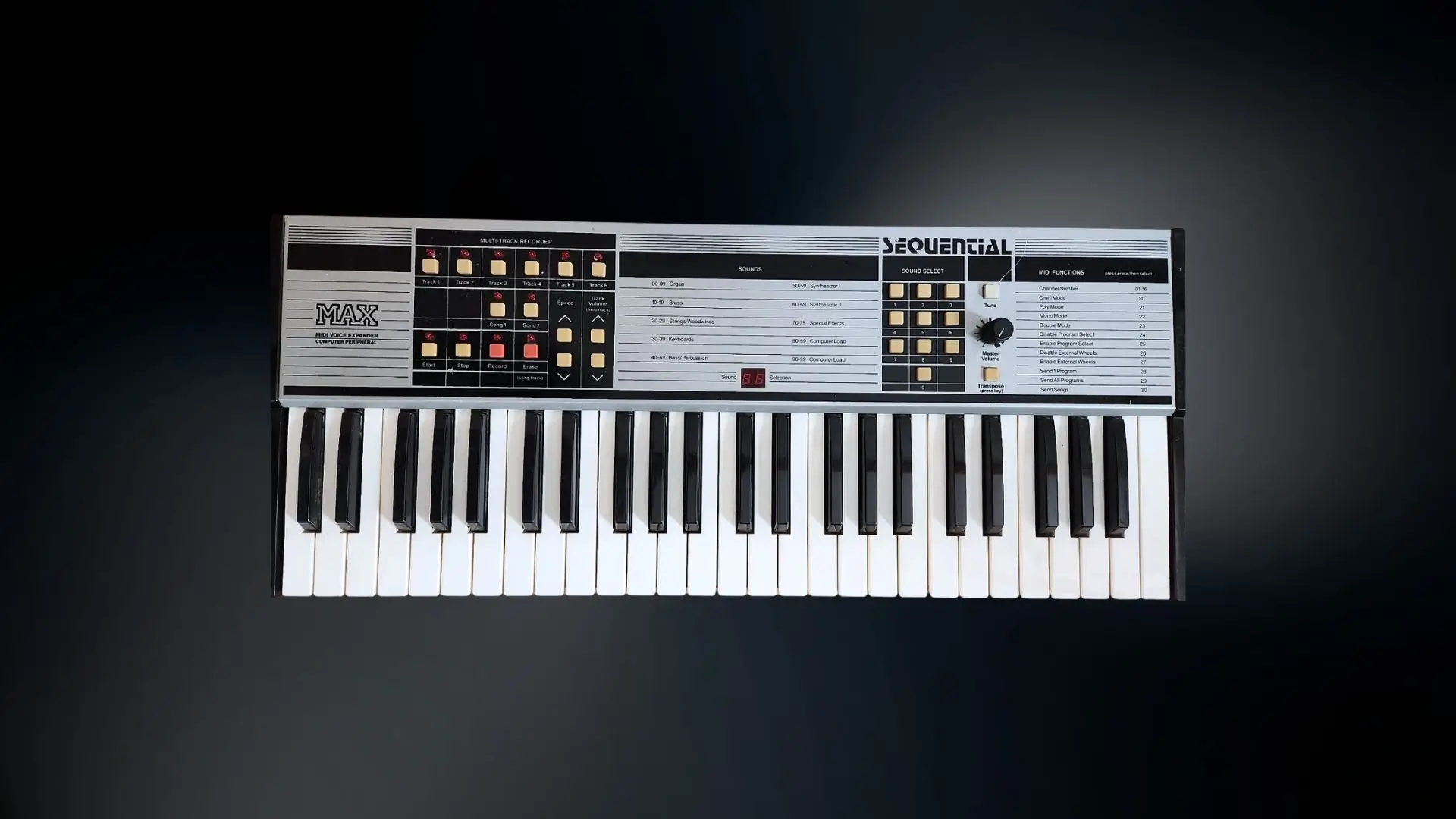
The Sequential Circuits Max is a six-voice analog polysynth introduced in 1984 as a preset keyboard, MIDI voice expander, and computer-oriented companion to Sequential’s mid-1980s multitimbral instruments. It shares much of its conceptual territory with the Six-Trak, but removes most of the direct programming interface in favor of presets, MIDI control, and external software editing. That decision made the Sequential Circuits Max one of Sequential’s strangest instruments: technically capable, historically revealing, and musically useful in specific contexts, but compromised as a self-contained performance synthesizer.
Table of Contents
Sequential Circuits Max sound and character
The Sequential Circuits Max has the dry, compact, slightly wiry character associated with Sequential’s CEM-based mid-1980s architecture rather than the broader, more luxurious sound world of the Prophet-5. Its voice structure gives it real analog substance: six voices, each with its own oscillator and filter path, allow the instrument to produce brass, strings, synthetic percussion, basses, organ-like patches, and special effects with more body than its preset-oriented surface might suggest.
Its strongest sounds are not the most realistic ones. Period reviews were already skeptical of some conventional imitative patches, especially piano and certain string sounds, but they found more character in the brass, bass, synth-clav, percussive, and special-effect material. That distinction matters. The Sequential Circuits Max is not best understood as a library keyboard competing with digital instruments such as the DX7; it is more convincing as an analog tone generator that happens to be trapped inside a preset product strategy.
The absence of onboard performance controls also shapes the sound in practice. Without pitch and modulation wheels, the instrument feels less animated from its own panel than a Six-Trak or a more conventional performance synth. When controlled externally over MIDI, however, it becomes more interesting: the Sequential Circuits Max can act as a compact analog expander, using its multitimbral design to layer or sequence different patches across MIDI channels. In that role, its personality becomes less about expressive hands-on playing and more about arrangement, doubling, and MIDI-era studio integration.
Features and architecture
- Manufacturer: Sequential Circuits.
- Year introduced: 1984.
- Production years: commonly listed as 1984–1986.
- Synthesis type: analog subtractive synthesis.
- Category: preset analog polysynth, keyboard synth, MIDI voice expander, and computer peripheral.
- Polyphony: 6 voices.
- Original price: UK reviews listed the Sequential Circuits Max at £725 including VAT.
- Current market price: used pricing is inconsistent; available signals range from budget-level used listings to higher prices for untested or parts units, and condition is unusually important.
- Oscillators: 6 VCOs, one per voice, with saw, triangle, and pulse waveforms.
- Filter: 6 low-pass VCFs, one per voice, described as 24 dB/octave four-pole filters.
- LFOs: 1 LFO with triangle and square waveforms, assignable to pitch, filter, VCA-related modulation, or pulse-width modulation depending on use and control method.
- Envelopes: separate envelope control for key voice elements; sources describe dedicated ADSR behavior for the VCO, VCF, and VCA sections, with period reviews emphasizing filter and amplifier envelope shaping.
- Modulation system: limited from the front panel; deeper sound editing and parameter control require MIDI, a Six-Trak, software, or external control.
- Sequencer / recorder: built-in six-track real-time recorder/sequencer with up to 500 notes, two songs, track muting, track-volume control, and MIDI sync capability.
- Arpeggiator: no arpeggiator verified in the reviewed period sources.
- Effects: no onboard effects verified in the reviewed documentation.
- Memory: 80 factory presets plus 20 user locations; user sounds require external programming and storage is limited without software or modification.
- Keyboard: 49-key, four-octave keyboard; no onboard velocity or aftertouch response from the keybed.
- Inputs / outputs: main/headphone output and stereo phono outputs; no individual voice outputs.
- MIDI / USB: MIDI In and Out are present; period reviews specifically criticize the lack of MIDI Thru. USB is not part of the original instrument.
- Display: no conventional display; operation is based around numeric selection, panel legends, switches, and indicator LEDs.
- Dimensions / weight: not included here because I could not verify a reliable figure from the sources checked.
- Power: external AC power supply; period UK review material identifies an 8V AC requirement.
Strengths
- Genuine six-voice analog architecture: The Sequential Circuits Max is limited as an interface, but not as a sound generator. Six analog voices with individual oscillator and filter paths give it more substance than its preset-keyboard image suggests.
- Multitimbral design: Its ability to assign voices in a multitimbral MIDI/sequencing context is the real reason it exists. This made it forward-looking in an era when MIDI was still new and many instruments remained monotimbral.
- Useful as an expander: Controlled from another MIDI keyboard, sequencer, or computer, the Sequential Circuits Max becomes more logical. Its weaknesses as a standalone keyboard are less severe when it is treated as an analog MIDI module with keys attached.
- Strong synthetic and percussive patches: Brass, bass, synth-clav, percussion, and effects sounds are more convincing than its attempts at broad realism. The instrument’s personality appears most clearly when it stops pretending to be a general-purpose preset keyboard.
- Historically interesting computer integration: The requirement for external programming through software or another Sequential instrument is frustrating, but it also places the Sequential Circuits Max in an important transitional moment between hardware synthesizers and computer-mediated music production.
- Compact Sequential character: It gives access to a particular mid-1980s Sequential voice architecture without the cost or size of the better-known Prophet instruments.
Limitations
- No direct sound programming from the panel: This is the defining limitation. Without external software, a compatible editor, or another MIDI control source, the user is largely confined to factory presets and whatever sits in the user locations.
- Only 20 user patch slots: The balance between 80 factory presets and 20 user locations makes the instrument feel restrictive for anyone who wants to build a personal sound library.
- No pitch or modulation wheels: As a live performance keyboard, the Sequential Circuits Max is under-equipped. Expressive gestures must come from external control rather than the instrument itself.
- No velocity or aftertouch from the onboard keyboard: The sound engine can respond to external MIDI dynamics, but the built-in keyboard does not provide modern expressive control.
- No MIDI Thru: For an instrument marketed around MIDI expansion, the absence of MIDI Thru is a significant practical weakness.
- Volatile sequence and user-memory constraints: Period reviews noted that sequence storage and sound RAM limitations made external dumping or computer support important for serious use.
- Preset identity works against the engine: The analog circuitry is more capable than the interface implies, but the product design hides too much of that capability.
- Build and switch feel were criticized at the time: Contemporary reviews objected to the button feel and construction choices, which remain relevant for buyers of surviving units.
- Support and parts require care: Like many vintage Sequential instruments, ownership depends on condition, available parts, technician familiarity, and the shrinking specialist-support ecosystem.
Historical context
The Max appeared during a transitional phase for Sequential Circuits. The company had already defined much of the late-1970s and early-1980s analog polysynth market through the Prophet-5 and its descendants, but by 1984 the industry had changed. MIDI had arrived, digital synthesizers were reshaping expectations, and affordable multitimbral instruments were becoming increasingly important.
In that context, the Sequential Circuits Max was not a flagship statement. It was a cost-conscious, MIDI-oriented extension of the Six-Trak idea. It borrowed the logic of a six-voice, one-oscillator-per-voice analog polysynth and reframed it as a preset instrument that could live inside a broader MIDI system. Sequential seemed to be asking a practical question: what if the analog polysynth became a peripheral, not just a keyboard?
That question was timely, but the answer was awkward. The Sequential Circuits Max was too capable to be dismissed as a simple preset board, yet too constrained to satisfy players who expected direct programming. It sat between three worlds: the traditional analog polysynth, the MIDI expander, and the home-computer music system. That in-between status is exactly what makes it historically interesting.