

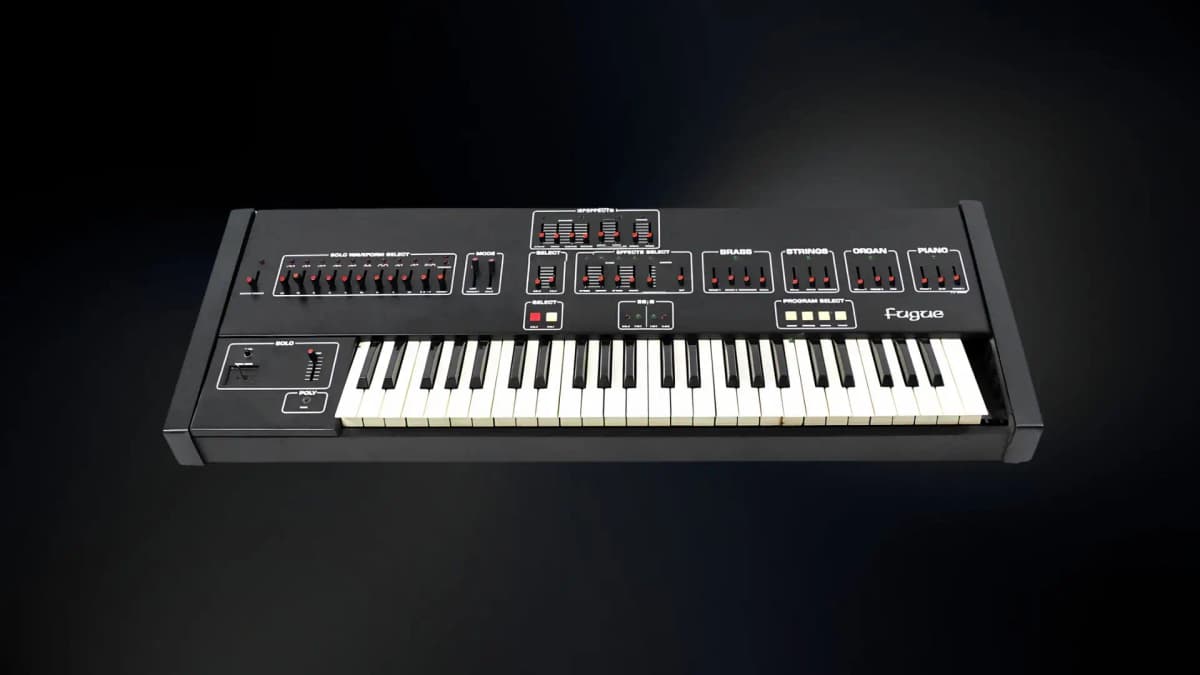
The Sequential Circuits Fugue is a rare early-1980s analog mono/poly performance keyboard built for Sequential Circuits by the Italian manufacturer Siel and sold in Europe as the Siel Cruise. It is not a Prophet-family synthesizer in design philosophy or circuitry. Instead, it combines two instrument ideas in one compact keyboard: a fully polyphonic preset string/orchestral section and a separate monophonic synth section. That makes the Sequential Circuits Fugue historically interesting less as a flagship Sequential invention than as a revealing side road: a moment when Sequential’s brand identity briefly crossed paths with the Italian ensemble-synth tradition.
Table of Contents
Sequential Circuits Fugue sound and character
The Sequential Circuits Fugue’s sound belongs more to the string-machine and preset-orchestra world than to the programmable American polysynth lineage associated with the Prophet-5. Its polyphonic section is built around preset families such as brass, strings, reed/organ-type sounds, and piano-style tones, with limited but useful shaping. The result is not a broad programmable palette in the modern sense, but a set of characterful colors that can be combined, split, and layered.
Its strongest identity comes from contrast. The poly section gives the instrument its wide, nostalgic, ensemble-like body: strings, reeds, organ colors, and synthetic brass textures that sit closer to late-1970s performance keyboards than to later MIDI-era workstations. The mono section adds a simpler lead or bass voice, based around saw and square waveforms, octave footage choices, vibrato, portamento, and a resonant low-pass filter. Used together, the two sections create the central appeal of the instrument: left-hand chords or sustained ensemble textures with a right-hand mono line, or the reverse.
The Fugue does not sound polished in the later Japanese digital sense, nor does it have the aggressive modulation depth of a dedicated monosynth like the Sequential Pro-One. Its character is narrower, more theatrical, and more period-specific. The strings and ensemble colors are where its age becomes musically productive: slightly synthetic, somewhat fragile, and capable of a hazy atmosphere that can feel more cinematic than technically impressive. The mono section is comparatively plain, but it gives the instrument a performative dimension that many basic string machines lack.
Features and architecture
- Manufacturer: Sequential Circuits branding, built by Siel in Italy.
- Year: early 1980s; published sources identify the Sequential Circuits Fugue around 1981–1982.
- Production years: commonly listed as 1981–1985 for the Sequential Circuits Fugue; the related Siel Cruise is also listed in some sources with a range extending to 1986.
- Synthesis type: analog subtractive, combining a monophonic DCO-based synth section with a polyphonic divide-down/string-machine-style section.
- Category: mono/poly performance keyboard, preset orchestral/string synthesizer with independent mono synth section.
- Polyphony: one monophonic voice plus full 49-note polyphonic operation in the poly section.
- Original price and current market price: no confidently verified original U.S. Fugue price found; a 1984 UK review listed the Siel Cruise at £469 including VAT. Current used-market signals for the Siel Cruise/Fugue family commonly appear around the low four figures in U.S. dollars, but Fugue-branded units are too rare for a stable price guide.
- Oscillators: mono section based around one DCO with saw and square waveforms; poly section based on polyphonic waveform/divide-down generation.
- Filter: mono section has a resonant low-pass VCF; poly section includes filter control for brass-type sounds.
- LFOs: mono vibrato modulation with rate and depth; animation/chorus speed control in the poly/ensemble side.
- Envelopes: mono section has ADSR control; poly section offers simpler envelope controls for brass, strings, reed, and piano-style families.
- Modulation system: limited performance-oriented modulation rather than a deep matrix; vibrato, portamento, filter control, and ensemble animation are the practical tools.
- Sequencer / arpeggiator: none.
- Effects: analog animation/chorus-type ensemble effect; mono portamento/glide.
- Memory: no user patch memory; preset-based architecture with editable performance controls.
- Keyboard: 49 keys, non-velocity, with split functionality.
- Inputs / outputs: main output, separate outputs for mono and poly sections, volume/expression pedal input, and footswitch inputs depending on version/reference.
- MIDI / USB: no MIDI, no USB; no CV/Gate listed for the Sequential Circuits Fugue/Cruise.
- Display: none.
- Dimensions / weight: weight is listed around 7 kg in one specialist source; dimensions were not confidently verified.
- Power: not confidently verified from reliable sources.
Strengths
- The split mono/poly concept gives the Sequential Circuits Fugue a practical live-performance identity: it can behave like a compact two-instrument rig rather than a single narrow preset keyboard.
- The poly section’s mixable preset families are more musically useful than the word “preset” suggests, because the instrument invites layering rather than isolated patch selection.
- The separate mono and poly outputs make the two sections easier to process independently in a studio, which matters because the mono voice and ensemble section benefit from different external treatment.
- The hands-on sliders and switches make the instrument immediate; it is not deeply programmable, but it is physically legible.
- Its rarity and Siel-built architecture give it a character distinct from better-known Sequential instruments, making it attractive to collectors who want the stranger corners of the brand’s history.
- The string and ensemble colors can occupy a nostalgic, cinematic space that modern polysynths often imitate with more complexity but less period-specific personality.
Limitations
- It is not a Prophet-style programmable polysynth, so buyers expecting classic Sequential voice architecture may be disappointed.
- The mono section is useful but limited, with a relatively simple oscillator/filter/envelope structure.
- There is no MIDI, no USB, no sequencer, and no arpeggiator, which limits direct integration with modern setups unless external conversion or audio-only workflow is acceptable.
- There is no user patch memory, so repeatability depends on panel positions and presets rather than stored programs.
- The preset architecture narrows the range of possible sounds compared with fully programmable analog polysynths from the same decade.
- Vintage condition is a serious issue: sliders, switches, plastic construction, key contacts, and the polyphonic section require careful inspection.
- True Fugue-branded units are rare, so market pricing can be inconsistent and replacement parts may require looking at Siel Cruise compatibility rather than Sequential-specific support.
Historical context
The Sequential Circuits Fugue appeared during a transitional period for Sequential Circuits. The company had already changed synthesizer history with the Prophet-5 in 1978 and had introduced the Pro-One in 1981, but the Fugue came from a different logic: it was not a new internal Sequential platform, but a Siel-built instrument rebadged for the American market.
That matters because it complicates the usual Sequential narrative. Sequential is often remembered through programmable analog polysynths, MIDI, the Prophet lineage, and Dave Smith’s engineering influence. The Sequential Circuits Fugue sits outside that heroic arc. It shows the company responding to a practical market opportunity: adding a compact mono/poly performance keyboard without developing the entire instrument internally.
The timing is also revealing. By the early 1980s, the synthesizer market was moving quickly toward programmability, digital control, MIDI, and Japanese competition. The Sequential Circuits Fugue, by contrast, still belongs to the ensemble-keyboard tradition: immediate, preset-heavy, split-friendly, and designed around live play rather than memory-based studio programming. In that sense, it already looked backward while the market was moving forward.