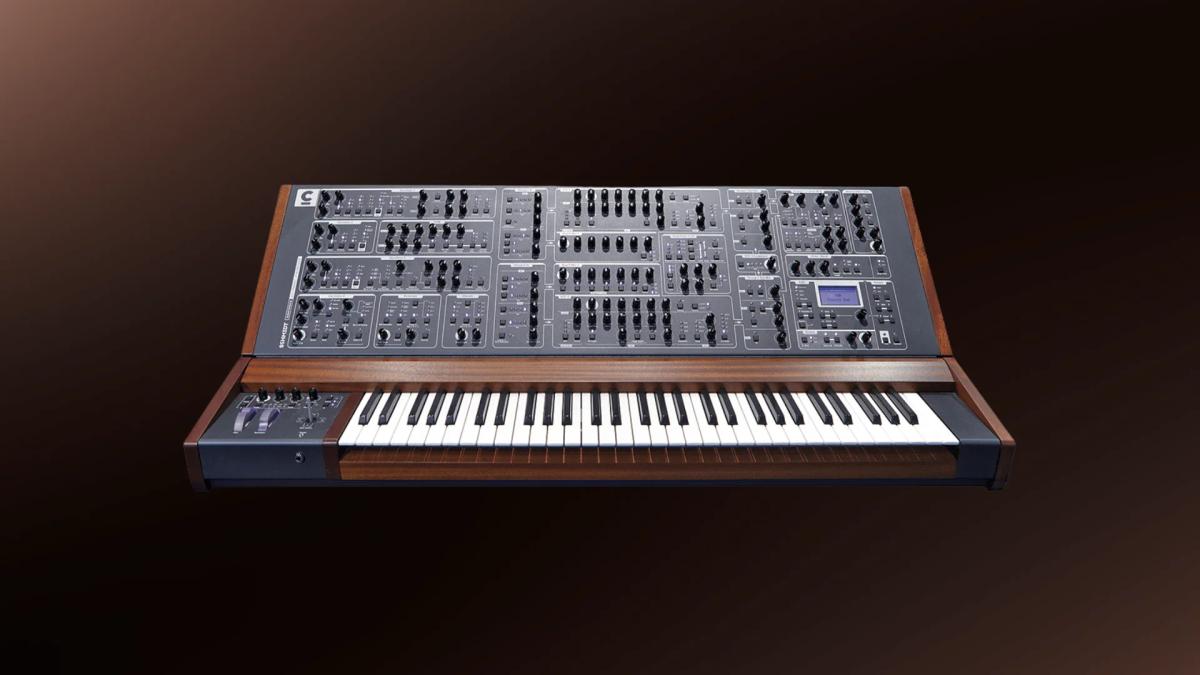
Schmidt Eightvoice: The hand-built analog polysynth sold in batches of 25
The Schmidt Eightvoice, usually called simply the Schmidt Eightvoice or the Schmidt Eightvoice Synthesizer, is an eight-voice analog polyphonic keyboard designed by Stefan Schmidt in Germany, first shown as a prototype at Musikmesse 2011 and built in small batches with the…
The Schmidt Eightvoice, usually called simply the Schmidt Eightvoice or the Schmidt Eightvoice Synthesizer, is an eight-voice analog polyphonic keyboard designed by Stefan Schmidt in Germany, first shown as a prototype at Musikmesse 2011 and built in small batches with the distributor e:m:c (electronic music components) of Langenau.
Each voice uses discrete circuitry rather than synth chips, with four oscillators, several ring modulators, two parallel filter paths and dedicated LFOs and envelopes in every section, all under digital control with preset memory. It has a 61-key Fatar keyboard with velocity and aftertouch and a hinged panel styled by Axel Hartmann. At around €20,000 to €26,000 new, it stands as one of the most expensive production analog polysynths, and one of the most complex.
The Schmidt Eightvoice sounds dense, wide and deliberately precise. Bonedo’s 2023 test described a very thick low end with a creamy, Moog-influenced low-pass character that the reviewer found more refined than a Minimoog, and singled out basses, drones, pads, strings and choir-like textures as particular strengths. That weight comes from sheer quantity of sound sources: four oscillators per voice, two of them with additional square sub-oscillators, multiple pulse-width modulation in which oscillator 1 stacks several pulses, multi-saw shapes, sync on oscillators 2 and 3, FM and noise modulation on each oscillator.
Oscillator 4 is the unusual part. It feeds six pulse waves of different widths into a chain of five ring modulators, which produces colder, harmonically complex tones that several sources compare to wavetable sounds. Axel Hartmann recalls that Schmidt disliked soft, undefined analog sounds and set out to build an analog synthesizer that could produce convincing digital-style timbres. The Schmidt Eightvoice therefore covers both the warm and the glassy ends of analog synthesis, and its most characteristic patches often combine them.
Stereo movement is its other signature. The filters are arranged in two parallel groups, one feeding the left channel and one the right, each with its own modulation, so a single patch can drift and animate across the stereo field. Descriptions of the filter set vary: Synth Anatomy lists a 24dB Moog-style ladder filter and two 12dB multimode filters plus a third VCF, while Bonedo counts five filters per voice, including two continuously variable 4-pole low-pass to high-pass filters that do not self-oscillate and a dedicated low-pass stage for extra bass.
Its weakness is the flip side of its depth. Harshness is rare, but Bonedo noted that the dual filters can clip when resonance and internal levels are pushed, and at least one reader of that review heard the filters as harsh and the result as less impressive than the demo videos. It sits firmly in the modern, high-end analog category, closer in spirit to a large modular than to a classic eight-voice polysynth.
Features and architecture
Manufacturer: Schmidt-Synthesizer, designed by Stefan Schmidt; production and distribution by e:m:c (electronic music components), Langenau, Germany
Year introduced: 2011 (prototype shown at Musikmesse in Frankfurt); production instruments followed in small batches, with the company describing the Schmidt Eightvoice in 2026 as on the market for about 12 years
Production years: batch production from the early 2010s; batches of 25 (the second ran to 27 units), a fourth batch shipping from December 2020 and a fifth scheduled for 2022; Bonedo estimated in 2023 that not many more than 125 had been made
Synthesis type: analog subtractive with discrete circuitry, digitally controlled
Category: high-end analog polyphonic keyboard synthesizer
Polyphony: 8 voices, with unison and dual modes
Multitimbrality: 8-part multimode, with per-part preset, voice allocation, keyboard mapping, MIDI channel, tuning, volume, panning and output routing
Original price: €19,900 including VAT (black) and €20,900 (white) for the 2016 and 2017 batches, or €16,900 excluding VAT outside the EU; the fourth batch rose to €21,900 and €22,900
Current market price: Bonedo quoted a street price of about €25,942 in 2023, and 2026 press coverage gives roughly $25,000; a mint used unit was listed on Reverb in 2024 at $20,000
Oscillators: 4 per voice, two with additional square sub-oscillators; sawtooth, pulse, multi-PWM (several pulses in oscillator 1), multi-saw, sync on oscillators 2 and 3, FM and noise modulation; oscillator 4 is a chain of five ring modulators fed by six pulse waves
Filter: two parallel filter groups (left and right); described as a 24dB ladder-style filter and two 12dB multimode filters plus a third VCF, or by Bonedo as two 4-pole continuously variable low-pass to high-pass filters, two multi-state dual filters and a fifth low-pass stage
LFOs: dedicated LFOs in each section, including separate PWM LFOs for oscillators 1 to 3
Envelopes: master envelope for the VCA plus four further envelopes for pitch, noise and vibrato, with a repeat function; ramp generators
Modulation system: no modulation matrix; direct, section-by-section modulation with extensive velocity amounts and a four-part vibrato section
Sequencer / arpeggiator: none at launch; firmware 3.6 (2020) added a polyphonic step sequencer of 40 steps with up to six notes per step and an arpeggiator
Effects: none onboard
Memory: 1,028 single presets and 256 multi presets as published by e:m:c (Bonedo counts 1,024 singles in 8 banks of 128); LED colors can be assigned per preset
Keyboard: 61 semi-weighted Fatar keys with velocity and channel aftertouch; polyphonic aftertouch received over MIDI
Controllers: pitch wheel, mod wheel, joystick, aftertouch, four footswitch and four expression pedal inputs, all programmable per preset; roughly 120 to 130 knobs, about 150 buttons and some 300 multicolor LEDs
Inputs / outputs: stereo summing output, individual output for each voice, headphone output, pedal inputs
MIDI / USB: MIDI via 5-pin DIN and USB
Display: large LCD with changeable background color
Dimensions / weight: about 48 kg without case, according to Bonedo; around 114 x 60 cm folded, 13 cm high without knobs; supplied with a flight case
Power: internal universal power supply, IEC mains socket
Strengths
The sound engine is enormous. Four oscillators per voice, sub-oscillators, multi-PWM and multi-saw shapes give it a density few polysynths can match, especially for basses, drones and pads.
Oscillator 4’s ring modulator chain gives it a voice of its own. Six pulse waves through five ring modulators produce cold, complex timbres that extend analog synthesis toward wavetable territory.
The two parallel filter groups create real stereo motion. Separate left and right filter paths, each with its own modulation, make patches move in a way single-path polysynths cannot.
Every parameter has a dedicated control. With well over a hundred knobs and no menu-based routing matrix, programming happens on the panel, with presets for recall.
It is a serious multitimbral instrument. Eight parts with independent routing and individual voice outputs make it useful as a studio sound source as well as a single big keyboard.
Construction and support reflect the price: discrete through-hole circuitry, a high-grade Fatar keybed, wood and metal casework, a flight case and ongoing firmware development.
Limitations
The price puts it out of reach of almost every musician, and Bonedo’s otherwise perfect review named cost as its only real drawback.
It is very heavy and large. At about 48 kg it needs a flight case and two people to move, which makes it a studio instrument rather than a touring one.
The learning curve is steep. Bonedo described it as demanding, requiring the manual throughout and a player willing to commit to deep sound design.
There are no onboard effects, so reverb, delay and chorus have to come from external processing.
There is no modulation matrix. Section-by-section modulation is fast, but it limits cross-routing compared with matrix-based designs.
The filters can clip at high resonance and internal levels, and opinion on how harsh they sound is divided.
Supply is irregular. Batches depend on scarce through-hole components, delivery has taken around a year from order, and published production figures are incomplete.
Historical context
Stefan Schmidt, a Nuremberg-based hardware and software designer, began the project as a small bass synthesizer and expanded it over several years into the eight-voice instrument he had always wanted. When the circuitry was finished, Stefan Hund, president of e:m:c and Moog’s German distributor, funded the project and asked industrial designer Axel Hartmann of designbox to design the case.
Hartmann’s first idea, a Fairlight-like expandable rack with a choice of keyboards and a slim remote panel connected by LAN, proved too complex, and the final design used a Fatar keybed, a Minimoog-style hinged panel, real wood and lit controls that fade through the full color range. Matthias Nagorni is credited with the software.
The prototype debuted at Musikmesse 2011, then crossed to NAMM in 2012 and 2013, where Synthtopia called it a muscle car of a synth and MusicTech noted that rumors of proper production persisted at around $25,000. The prototype was later demonstrated to Hans Zimmer in Santa Monica. A first build-to-order batch of 25 sold out, and in March 2016 e:m:c announced a second and supposedly final run of 25 at €19,900 including VAT, with a 50% deposit and delivery in about a year.
The final run was not final. Extra components produced 27 units in that batch, which sold out within 14 months, and in September 2017 product manager Axel Fischer opened a third batch in black or white, explaining that rising prices of old through-hole components had been judged acceptable. A fourth batch shipped from December 2020 after parts shortages, with prices up about 10%, eleven knobs changed to grey and firmware 3.6 adding a sequencer and arpeggiator. A fifth run was scheduled for 2022, and the company was still exhibiting at Superbooth in 2026.
Legacy and significance
The Schmidt Eightvoice matters as proof that a boutique maker could still build a no-compromise analog polysynth in the 2010s, at a time when most new analog designs were going smaller and cheaper. Its discrete, multi-oscillator voices and dual filter paths took ideas usually confined to large modular systems and fixed them into a playable, programmable eight-voice instrument with full recall.
The Schmidt Eightvoice also helped define a new tier of the market. Alongside other high-end analog instruments, the Schmidt Eightvoice showed that there was a small but real clientele of film composers, studios and collectors willing to pay five-figure prices for a hand-built synthesizer, and its repeated batches, each announced as possibly the last, became a story in themselves in the Schmidt Eightvoice press.
Its reach is now extending to software. In May 2026, ahead of Superbooth, Schmidt Synthesizer and UJAM announced Schmidt Vi, a software version of the Schmidt Eightvoice that the company describes as sonically on par with the hardware, together with Schmidt Deck, a simpler player for sounds created on the Schmidt Eightvoice with Minimoog-style controls. Both were announced for mid-2026 in VST3, AU and AAX formats, with pricing to follow.
Artists, users, and curiosities
Hans Zimmer is the best-documented owner: the prototype was demonstrated at his Santa Monica studio, and later reports describe a Schmidt in his studio. Jean-Michel Jarre bought one in 2017 and posted a video of his first impressions, in which, according to Synth Anatomy, he praised its combination of modular-style analog architecture and modern thinking. Muse’s Matthew Bellamy has reportedly been filmed playing a white Schmidt, and the composer Firechild has shown one in his studio.
The curiosities start with the name. The Schmidt Eightvoice is marketed both as the Schmidt Eightvoice and simply as the Schmidt Eightvoice, and it is unrelated to the 1970s Oberheim Eight Voice covered separately on this site. Its designer reportedly started out to build a bass synth, and Hartmann has written that the illuminated controls, which most owners set to their own colors, looked cheesy at first sight but work well in practice. Firmware has continued to grow the Schmidt Eightvoice: Bonedo credits a customer, Dr. Robert Skerjanc, with the arpeggiator and step sequencer added through the menu, and the 2023 test reported that a polyphonic aftertouch keyboard was being planned.
Market value
Current market position: an ultra-high-end, low-volume analog polysynth, positioned as a studio centerpiece for composers, producers and collectors
New price signal: about €19,900 to €20,900 including VAT in 2016 and 2017, €21,900 to €22,900 for the 2020 batch, a street price of about €25,942 in Bonedo’s 2023 test, and roughly $25,000 cited in 2026 press coverage
Used market signal: very thin; a mint unit was listed on Reverb in July 2024 at $20,000 after a reduction from $21,500, and a listing for an early serial number asked $24,995
Availability: extremely limited; new units come only in batches through e:m:c and selected dealers, and used units surface a few times a year, often through specialist dealers
Buyer notes: confirm firmware version (3.6 or later adds the sequencer and arpeggiator), check the keybed, LEDs, display and all voice boards, and budget for freight shipping in the flight case; ask about the batch and warranty status
Support ecosystem: support comes from the maker and e:m:c, with continuing firmware updates; the discrete through-hole design is serviceable but depends on the maker’s documentation and spares
Market character: a luxury instrument whose value is anchored to the price of new batches rather than to scarcity alone
Long-term position: likely to remain a collectible reference for boutique analog polysynths, with the Schmidt Vi software broadening awareness of the sound without directly replacing the hardware
Conclusion
The Schmidt Eightvoice is a reminder that analog synthesis can still be pursued at maximum scale. Stefan Schmidt’s design treats each of its eight voices as a small modular system, with four oscillators, a ring modulator chain, two filter groups and dedicated modulation everywhere, and then makes it all programmable and playable from a single panel. Its price, weight and complexity limit it to a small circle of owners, and its production history has been as irregular as its components are scarce. What it offers in return is a sound that is both very warm and very precise, and a level of hands-on depth few polyphonic instruments have ever matched.
His connection with music began at age 6, in the 1980s, when his father introduced him to Jean-Michel Jarre's Rendez-Vous on vinyl. He works professionally in the legal field, while synthesizers became his space for abstraction and creative exploration. Founder of The Synth Source.