Home›Synths›Roland XP-30: The 1999 performance synth that put the J…
Synths

Roland XP-30: The 1999 performance synth that put the JV sound and three expansion boards in one keyboard

The Roland XP-30 is a 61-key PCM synthesizer that Roland introduced in 1999 and built until around 2002. It took the 64-voice, 16-part sound engine of the JV-1080 and JV-2080 modules and the sound set of the XP-80 workstation, then added the waveforms and patches of three…

Bernardo de Azevedo
Bernardo de Azevedo
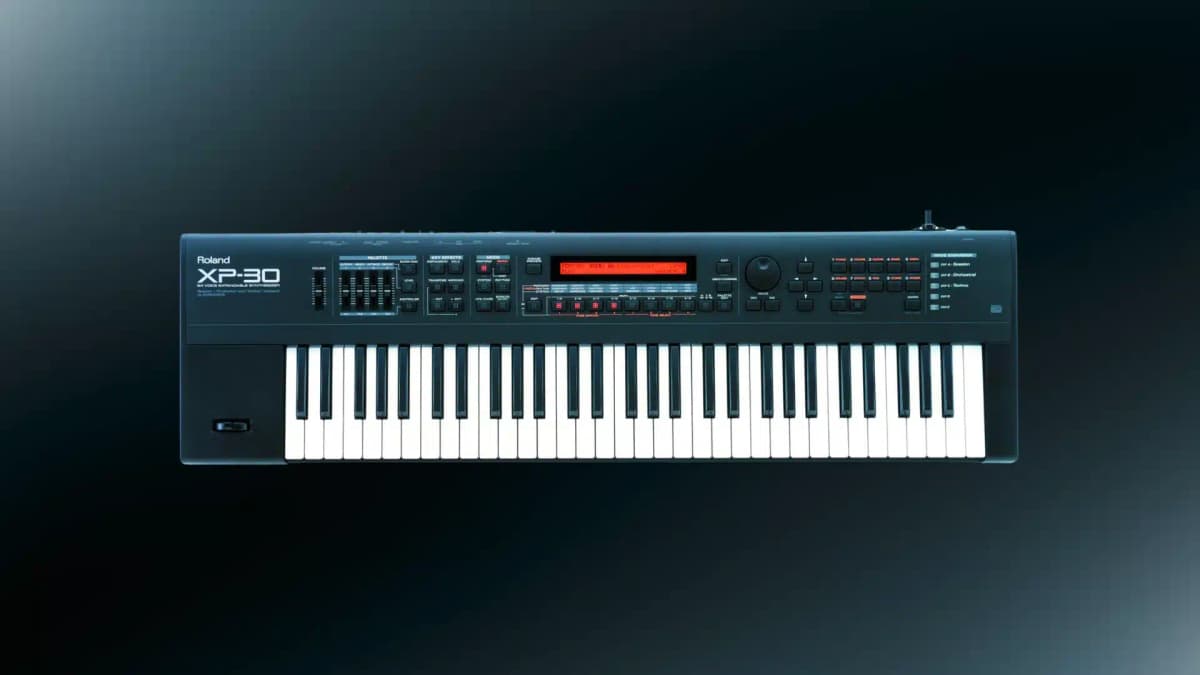
Roland XP-30 synthesizer, top view

The Roland XP-30 is a 61-key PCM synthesizer that Roland introduced in 1999 and built until around 2002. It took the 64-voice, 16-part sound engine of the JV-1080 and JV-2080 modules and the sound set of the XP-80 workstation, then added the waveforms and patches of three SR-JV80 expansion boards (Session, Orchestral and Techno Collection) as permanent internal memory, for 1,406 patches out of the box.

To reach a lower price, Roland removed the XP workstations’ sequencer and kept the arpeggiator, four assignable sliders and two free expansion slots. What makes it matter at a glance is value: it was the most heavily loaded keyboard of the JV and XP family, sold for well under the price of the instruments it borrowed from.

Roland XP-30 sound and character

The Roland XP-30 sounds like the late JV era because it is the late JV era. Each patch stacks up to four tones, each built from a ROM waveform passed through Roland’s TVF filter and TVA amplifier, with their own envelopes and two LFOs per tone.

The result is the polished, slightly bright and effects-friendly tone that defined Roland’s 1990s romplers: tight acoustic pianos, airy pads, glassy electric pianos, punchy synth basses and the dense layered splits that were common on records and stages at the end of the decade. Owners on zZounds and Audiofanzine most often praise the presets for being immediately usable, and SOS reviewer Paul Farrer called the Roland XP-30 a top-flight piece of studio gear.

The three built-in boards widen the palette in specific directions. The Orchestral board, one of the most respected in the SR-JV80 series according to Reverb’s buying guide, is known above all for its lush strings; Session, as its name suggests, adds band-oriented instruments for session work; and Techno Collection brings TR-808, TR-909 and TR-606 drums, analog-style basses, grainy loops, vocoder phrases and scratches. Farrer described the Techno patches as crammed with retro analog insanity, and singled out effects such as the step flanger and enhancer/flanger as well suited to dance pads.

Its weaknesses are those of sample playback from a fixed ROM. The waveforms are short and looped by modern standards, the filter is a clean digital design that does not behave like an analog ladder under resonance, and one Audiofanzine owner found that synth leads were harder to program convincingly than orchestral sounds. The effects section is also thinner than on the JV-2080: Sonic State’s user notes point out that the Roland XP-30 lacks the module’s two extra insert processors, so complex multitimbral setups share a single insert effect plus reverb and chorus.

In character it sits firmly on the clean, modern-for-its-time side of the line. It is not a vintage instrument in the analog sense, but a well-preserved snapshot of the sound that dominated pop, dance, worship and session work around 2000.

Features and architecture

  • Manufacturer: Roland Corporation
  • Year introduced: 1999; Sound On Sound reviewed it in its August 1999 issue
  • Production years: 1999 to 2002, according to Vintage Synth Explorer and Wikipedia
  • Synthesis type: PCM sample playback with subtractive processing (Roland JV architecture)
  • Category: 61-key performance synthesizer without sequencer, derived from the XP workstation line
  • Polyphony: 64 voices
  • Multitimbrality: 16 parts
  • Original price: $1,395 US list price according to soundprogramming.net; £999 in the UK, which Sound On Sound described as just under a grand
  • Current market price: Equipboard’s tracking of Reverb listings puts the average used price at about $495 in October 2026
  • Oscillators: up to four tones per patch, drawing on 512 internal waveforms plus the waveforms of the three built-in Session, Orchestral and Techno Collection boards
  • Filter: one TVF per tone with low-pass, band-pass, high-pass and peaking modes, cutoff, resonance, key follow and velocity sensitivity
  • LFOs: two per tone, syncable to MIDI clock
  • Envelopes: pitch, filter and amplitude envelopes per tone
  • Modulation system: Roland’s JV control matrix, with velocity, aftertouch, wheel, pedal and slider routings
  • Sequencer / arpeggiator: no sequencer; arpeggiator derived from the XP-60 and XP-80 with 43 styles, accent and octave settings and external clock sync
  • Effects: 40 multi-effect types (one insert effect at a time), plus dedicated chorus and an eight-type reverb
  • Memory: 1,406 preset patches (640 internal plus 766 from the three built-in boards), 128 user patches, 32 user performances, 26 factory rhythm sets and 2 user rhythm sets
  • Expansion: two slots for SR-JV80 series boards; the three factory boards are hardwired and cannot be removed
  • Storage: SmartMedia card slot (5V cards only)
  • Keyboard: 61 keys with velocity and channel aftertouch; Wikipedia describes the action as semi-weighted, while owners generally describe it as a standard synth action
  • Controllers: pitch/modulation lever, four Sound Palette sliders (cutoff, resonance, attack and decay, tone levels or assignable parameters), large value dial
  • Inputs / outputs: one stereo output pair (L/Mono and R), headphones, hold and control pedal jacks; no audio inputs
  • MIDI / USB: MIDI In, Out and Thru, plus a serial computer port switchable between Mac and PC modes; no USB
  • Display: 40-character, two-line backlit LCD with eight soft keys
  • Dimensions / weight: 1,011 x 289 x 88 mm and 7.8 kg according to soundprogramming.net
  • Power: internal power supply, about 10 W consumption

Strengths

  • It offered an enormous library for the money. With 1,406 patches including three full expansion boards, it gave buyers more sounds than a JV-1080 or JV-2080 module, plus a keyboard, at a lower combined price.
  • The sound engine was proven. It used the same architecture that powered Roland’s best-selling modules, so its pianos, pads and basses already sat comfortably in mixes and on stage.
  • The arpeggiator is unusually accessible. Sound On Sound praised the quick-access menu for tempo, style, accent and octave, which made a feature often buried in menus easy to use live.
  • The Sound Palette sliders make fast tweaks practical. Cutoff, resonance, envelope times or tone levels can be adjusted in real time, and the moves are transmitted as MIDI controllers.
  • It is light and robust. At under 8 kg it is easy to carry, and Audiofanzine owners report years of use without failures.
  • Two free SR-JV80 slots keep it expandable, so boards such as Vintage Synth or Orchestral II can extend it further.

Limitations

  • There is no sequencer. Roland removed the XP workstations’ 16-track recorder to reach the price, so the Roland XP-30 needs an external sequencer or computer for composition.
  • It has a single stereo output. Sound On Sound listed this as a drawback, since the JV-1080 offered six outputs for separate processing of parts.
  • Only one insert effect is available at a time, which limits multitimbral arrangements compared with the three inserts of the JV-2080.
  • The built-in boards occupy expansion space permanently. Farrer noted that the hardwired Session, Orchestral and Techno content left only two real slots, and buyers who already owned those boards gained less.
  • SmartMedia storage has aged badly. The slot only accepts 5V cards, which are now scarce, and card data must be loaded into user memory before use.
  • Editing through a two-line display is slow. The bundled Emagic Sound Diver software helped at the time, but modern computer editing requires legacy serial or MIDI workarounds.
  • Its waveforms are compact by later standards, so long sustained acoustic sounds and detailed pianos reveal their loops.

Historical context

By the late 1990s Roland’s JV architecture had become one of the most widely used synth engines in professional music. It began with the JV-80 keyboard, covered separately on this site, reached its widest audience with the JV-1080 module in 1994 and was refined in the JV-2080 of 1997, which Wikipedia describes as an updated JV-1080. On the Roland XP-30 side, Roland built the XP line around it: the XP-10 in 1994, the XP-50 workstation in 1995 and the XP-60 and XP-80 in 1996. These competed with workstations from Korg and Yamaha, where onboard sequencing was a central selling point.

The Roland XP-30 went in the opposite direction. Released in 1999, it dropped the XP sequencer and instead put more sounds into the box than any previous Roland keyboard of the family. Sound On Sound framed it as roughly £750 worth of expansion boards plus a keyboard for about £250, and a Sonic State user calculated that it cost little more than a JV-1080 module while adding a keyboard and three boards. Its arpeggiator came from the XP-60 and XP-80, and its LCD and patch layout followed the JV-1080 more than the JV-2080.

Production ran to about 2002. By then Roland had moved its flagship sound generation to the XV architecture, first in the XV-5080 module of 2000 and then in the Fantom keyboard of 2001, with the SRX board format replacing SR-JV80. The Roland XP-30 had no direct successor of the same name, and later Roland keyboards built on the XV engine took over its role as a stage instrument full of ready-made sounds.

Legacy and significance

The Roland XP-30 matters less as an innovation than as the final, most complete statement of the JV keyboard formula. It collected the sounds that Roland had sold as separate products over most of a decade and bundled them into one affordable instrument, which is why Wikipedia describes it as considered the best value for money of all the JV and XP synthesizers. For many working keyboardists of the early 2000s, it was the Roland XP-30 that covered a whole set list.

Its sound world has proven durable. The JV engine has been reissued in software through Roland Cloud: Gearnews reported in December 2017 that Roland’s JV-1080 plug-in expanded the original’s waveforms from 448 to over 1,000, and Roland later added the XV-5080. Reverb’s buying guide to the JV series and SR-JV80 boards links the family to artists such as Kevin Parker of Tame Impala, Depeche Mode and Bruno Mars, while sample packs such as Legowelt’s JV-2080 collection reflect the appeal of its late-1990s tone to newer producers.

In the category of romplers it occupies a clear place: not the deepest or most flexible JV instrument, but the one that most efficiently delivered the JV library to players. Its decision to drop the sequencer also anticipated how many musicians actually worked by 1999, with the computer as the recorder and the Roland XP-30 as a sound source.

Artists, users, and curiosities

Documented high-profile users are fewer than for the JV-1080, largely because the Roland XP-30’s sounds were shared with Roland modules that dominated studio credits. Equipboard lists Röyksopp, noting that the Norwegian duo can be seen using several XP-30s in a video, and also lists Oliver Wakeman, Coen Janssen of Epica and Darren Wharton of Dare among reported users. Sonic State’s user pages report that the synthpop band Monolithic used it as the primary instrument on Power Undiminished, which won an American Synthpop Award for best album of 2001.

Among the curiosities, the three internal boards are not boards at all. Sound On Sound explained that the Session, Orchestral and Techno content was supplied as sound data chips wired directly to the main processor, which is why they could not be removed or swapped. The Techno Collection itself, SR-JV80-11, became the replacement for the short-lived SR-JV80-06 Dance board, which according to Zoë Blade’s notes was withdrawn soon after release, possibly over a copyright issue.

Wikipedia credits many of the factory patches to Eric Persing, Roland’s long-time sound designer, who later founded Spectrasonics. The Roland XP-30 also came bundled with Emagic’s Sound Diver editor and librarian, and its serial port allowed a direct computer connection without a separate MIDI interface, a common feature on Roland gear of the period.

Market value

  • Current market position: an inexpensive, practical used rompler, valued mainly by gigging keyboardists and producers who want the late JV sound in a light keyboard
  • New price signal: none for the hardware; Roland Cloud’s JV-1080 and XV-5080 software instruments are the only new route to closely related sounds
  • Used market signal: Equipboard’s tracking of Reverb puts the average used price at about $495 in October 2026; Audiofanzine owners reported paying between $400 and $1,000 over the years
  • Availability: common; Equipboard counted around ten units listed on Reverb in October 2026, with further examples on eBay and in secondhand stores
  • Buyer notes: check all keys for velocity response, the pitch lever (a Vintage Synth Explorer forum thread reports pitch-bend faults), the display backlight, sliders and the SmartMedia slot; ask whether any SR-JV80 boards are installed
  • Support ecosystem: Roland still hosts the manual and product page; SR-JV80 boards remain available used, and community editors and librarians exist for the JV architecture
  • Market character: a working instrument rather than a collectible, priced on utility and condition
  • Long-term position: likely to stay affordable, with modest upside driven by renewed interest in late-1990s Roland ROM sounds and SR-JV80 boards

Conclusion

The Roland XP-30 is Roland’s JV era gathered into one keyboard. It did not introduce a new engine or a new way to work, but it combined the JV-2080’s architecture, the XP-80’s sound set and three of the best-known SR-JV80 boards in a light instrument that sold for little more than a module. Dropping the sequencer cost it some appeal as a workstation, yet it suited the computer-based studios and the gigging players of 1999 well. Today it remains one of the simplest ways to own that late-1990s Roland sound in hardware, at a used price that reflects function rather than fashion.

Sources

  1. Roland XP30, Sound On Sound
  2. Roland XP-30, Vintage Synth Explorer
  3. XP-30 product page, Roland
  4. Roland XP-30, Wikipedia
  5. Roland XP-30, soundprogramming.net
  6. Roland XP-30 Synthesizer, Equipboard
  7. Röyksopp’s gear, Equipboard
  8. Roland XP-30 user reviews and market value, Audiofanzine
  9. Synth Site: Roland XP-30, Sonic State
  10. Roland XP30 64-Voice Expandable Synthesizer reviews, zZounds
  11. Roland JV Series Synthesizers and Expansion Cards Buying Guide, Reverb
  12. Roland JV-2080, Polynominal
  13. Roland JV-2080, Wikipedia
  14. SR-JV80 series, Zoë Blade’s notebook
  15. Roland recreates famous JV-1080 sound module in plug-in format, Gearnews
  16. Roland XV-5080 now available in Roland Cloud, Roland press release
  17. Juno-G vs XP-30, Musicplayer forum
Bernardo de Azevedo
Written by
Bernardo de AzevedoFounder & Editor

His connection with music began at age 6, in the 1980s, when his father introduced him to Jean-Michel Jarre's Rendez-Vous on vinyl. He works professionally in the legal field, while synthesizers became his space for abstraction and creative exploration. Founder of The Synth Source.