

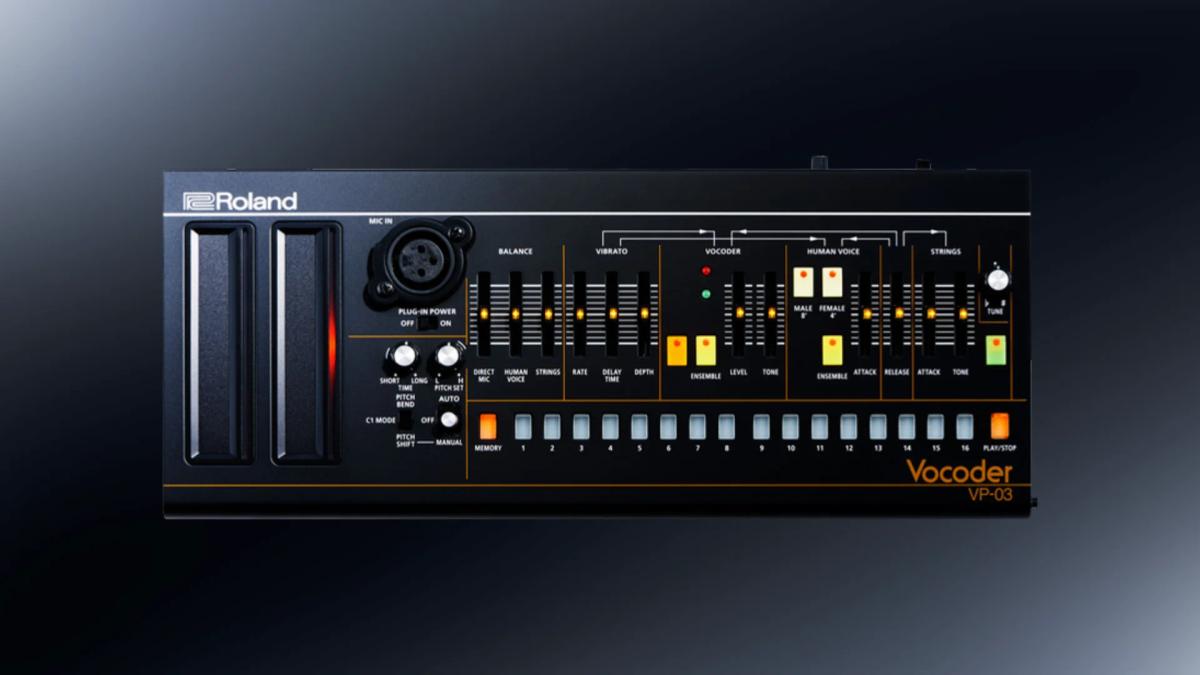
The Roland VP-03 is a compact vocoder and string-and-choir module in the Roland Boutique series, modeled on the 1979 VP-330 Vocoder Plus. Roland announced it on September 9, 2016, during its 909 Day event alongside the TR-09 and TB-03, and declared it available on October 5, 2016, at a US street price of $349. Its three sound sources, Vocoder, Human Voice and Strings, are recreated digitally with Roland’s Analog Circuit Behavior (ACB) modeling and mixed with a balance section, then thickened by an Ensemble chorus. Roland added features the original never had: a 16-step Voice Step Sequencer that can hold short samples from the microphone, 16 chord memories, MIDI, and a USB audio interface. A gooseneck XLR microphone comes in the box. The VP-03 matters because it put the sound of a rare, expensive vintage vocoder into a battery-powered desktop unit at a fraction of the cost.
Table of Contents
Roland VP-03 sound and character
The VP-03 is built around the same three voices as the Roland VP-330 Vocoder Plus, and the panel is laid out to make them easy to blend. A Balance section sets the levels of the direct microphone signal, the Human Voice section and the Strings section, while the vocoder has its own on/off switch, level and tone controls. Human Voice offers Male 8′ and Female 4′ switches with an attack slider, Strings has its own attack and tone, and a single release slider is shared. The Ensemble chorus can be switched on for the vocoder and Human Voice, and it is the effect that gives the instrument most of its width. Writing for Sound On Sound, Gordon Reid found that the Strings and Human Voice sounds came very close to the original, and Dan Goldman at MusicRadar described the vocoder’s diction as clear and precise, with a lush ensemble and natural-sounding vibrato.
Reviewers were less unanimous about warmth. Goldman judged the VP-03 faithful to the VP-330 but a little less warm, and Tom Gatza at the German site Bonedo heard a vocoder that clearly recalls the original while lacking some low end and analog body. Gatza found the Human Voice section midrange-heavy and fairly aggressive, and the Strings convincingly Roland but light in the bass. Dave Gale at MusicTech was more positive, praising the harmonic richness of both the vocoder and the string and voice sounds. All three agreed that the built-in speaker is useful for checking that the unit is working and little more, and that the sound improves considerably through headphones or monitors.
The most technical criticism came from Reid, who owned and knew the original well. The VP-330 derived its notes with divide-down technology, so the octaves were phase-locked to each other. On the VP-03 he heard phase cancellation in the Strings and Human Voice, which produced shifting, vowel-like changes when the same note was played repeatedly, and in his testing one note even sounded an octave too high. He also noted artifacts from the ensemble at the very top of the Strings range. Reviewers also reported a six-note limit, where the original was fully paraphonic, and Gale noticed it cutting off decaying string tails when chords overlapped.
Performance controls carry over much of the VP-330’s expressive vocabulary. A vibrato section with rate, delay time and depth affects the vocoder and Human Voice but, as on the original, not the Strings. A Pitch Shift section recreates the VP-330’s pitch slur, with time and pitch set knobs and a switch for auto, off or manual operation; in auto mode it bends the pitch when a new note is played after the previous ones have been released. Two ribbon controllers handle bending, modulation and other assignable roles. Through system settings the vocoder’s formant character can be moved from very deep to very high, and Reid built choir-like textures by layering several recordings made with different formant settings.
The output is close to silent, and earlier Boutique modules’ noise parameter is gone. Reid recommended treating the VP-03 as a dry source and adding external tape echo, chorus or phasers, which suits the sound well, since the unit has no delay or reverb of its own. With the levels, tone and contours set carefully, he found the vocoder very capable of the classic robotic and choral vocal sounds the VP-330 was known for.
Features and architecture
- Manufacturer: Roland Corporation
- Year introduced: 2016 (announced September 9, 2016; announced as available October 5, 2016)
- Production years: 2016 to an undocumented date; Roland issued a system program update for production reasons in January 2019, and the model is now listed as discontinued
- Synthesis type: digital ACB (Analog Circuit Behavior) modeling of the VP-330’s vocoder, Human Voice and Strings sections
- Category: desktop vocoder and string-and-choir module (Roland Boutique series)
- Polyphony: six notes, as reported by MusicTech and Bonedo (Sound On Sound cites six notes for sequencer and chord playback); Roland’s specification sheet does not list a figure
- Multitimbrality: none; the vocoder, Human Voice and Strings sections are layered and mixed rather than played as separate parts
- Original price: $349 (US street); £329 in the UK (Sound On Sound listed £330)
- Current market price: discontinued; used units roughly $180 to $310, with remaining new stock and some used listings asking far more (October 2026)
- Oscillators: modeled tone sources for Human Voice (Male 8′ and Female 4′) and Strings, plus the vocoder’s internal carrier; no user-selectable waveforms
- Filter: tone controls for the vocoder and Strings sections; no conventional resonant filter; vocoder band count not published by Roland
- LFO: vibrato with rate, delay time and depth (applies to vocoder and Human Voice, not Strings)
- Envelopes: attack for Human Voice and for Strings, a shared release, and a Pitch Shift section with time and pitch set controls
- Modulation system: vibrato, Pitch Shift (auto, off or manual), two ribbon controllers (C1 and C2) with a C1 mode switch, and system-level formant adjustment
- Sequencer / arpeggiator: Voice Step Sequencer with 16 steps and 16 patterns, up to six notes per step, and 100 ms voice sampling per step; MIDI clock sync; no arpeggiator
- Effects: Ensemble chorus only
- Memory: no patch memory; 16 chord memory locations and 16 sequencer patterns, with backup and restore over USB
- Keyboard: none; designed for the optional K-25m 25-key keyboard unit or DK-01 dock
- Inputs / outputs: XLR microphone input with plug-in power switch, stereo mini-jack output, stereo mini-jack headphone output, built-in mini speaker; no analog carrier input
- MIDI / USB: 5-pin MIDI In and Out; Micro-B USB for MIDI and audio, working as an audio interface (24-bit per Roland’s announcement)
- Display: none; peak and signal LEDs
- Dimensions / weight: 300 × 128 × 46 mm; 940 g with batteries
- Power: four AA batteries (alkaline or Ni-MH) or USB bus power (500 mA); about six hours of continuous use on Ni-MH batteries
Strengths
- The VP-330 character is largely intact. Sound On Sound, MusicRadar and MusicTech all found the vocoder, choir and string voices close to the original, with an ensemble and vibrato that behave as expected.
- It works out of the box. The included gooseneck XLR microphone, battery power and built-in speaker mean the unit can be vocoding within minutes, without a mixer or preamp.
- The sequencer adds something genuinely new. Peter Kirn at CDM singled out the combination of 100 ms voice samples and the step sequencer as one of the most inventive ideas in the Boutique range.
- It integrates cleanly with a computer. USB carries MIDI and multichannel audio, all controls send and receive MIDI CCs, and the sequencer syncs to MIDI clock, so settings can be automated and recalled from a DAW.
- The output is very quiet. Reid noted that the VP-03 is nearly noise-free, an advantage over an aging original in the studio.
- Chord memory makes it an easy pad source. Sixteen stored chords can be triggered from single keys or step buttons and backed up over USB.
- The cost of entry was low. At launch it cost less than a fifth of a typical vintage VP-330, by Reid’s estimate.
Limitations
- There is no analog carrier input. An external synth or other source can only be vocoded by routing it through specific USB audio channels from a computer, which Reid described as complicated and limiting.
- Polyphony is capped at six notes. Bonedo and MusicTech both saw this as a real constraint for wide string and choir pads, where the original was fully paraphonic.
- The modeled oscillators are not phase-locked. Reid heard phase cancellation and occasional pitch errors that the divide-down VP-330 does not produce.
- There is no patch memory. Every sound has to be set up by hand on the panel or recalled through MIDI CCs from external software.
- Power and connections are lightweight. There is no dedicated power input, outputs are on mini-jacks, and Reid would not trust the connectors on stage.
- The supplied microphone is a compromise. MusicRadar found the gooseneck too short, Bonedo found that it distorts quickly, and Reid suggested a different microphone with a compressor for better results.
- Sequencer editing is indirect. With no dedicated sequencer controls, programming relies on combinations of the Play/Stop, memory and step buttons and the ribbons.
Historical context
Roland introduced the VP-330 Vocoder Plus in 1979 at a US price of $2,695. It combined a ten-band vocoder with a string section and a Human Voice choir section, all derived from a divide-down master oscillator and thickened by a stereo ensemble built from bucket-brigade delay lines. Reid has described the late-1970s vocoder market as split between expensive, rare units from Moog, EMS and Sennheiser and cheaper, lower-quality designs, and Roland’s instrument was quickly adopted across genres. Wikipedia lists Laurie Anderson’s “O Superman” and Vangelis’s soundtracks for Chariots of Fire and Blade Runner among its documented uses. Roland also built a rack-mounted relative, the SVC-350, designed to accept external inputs.