

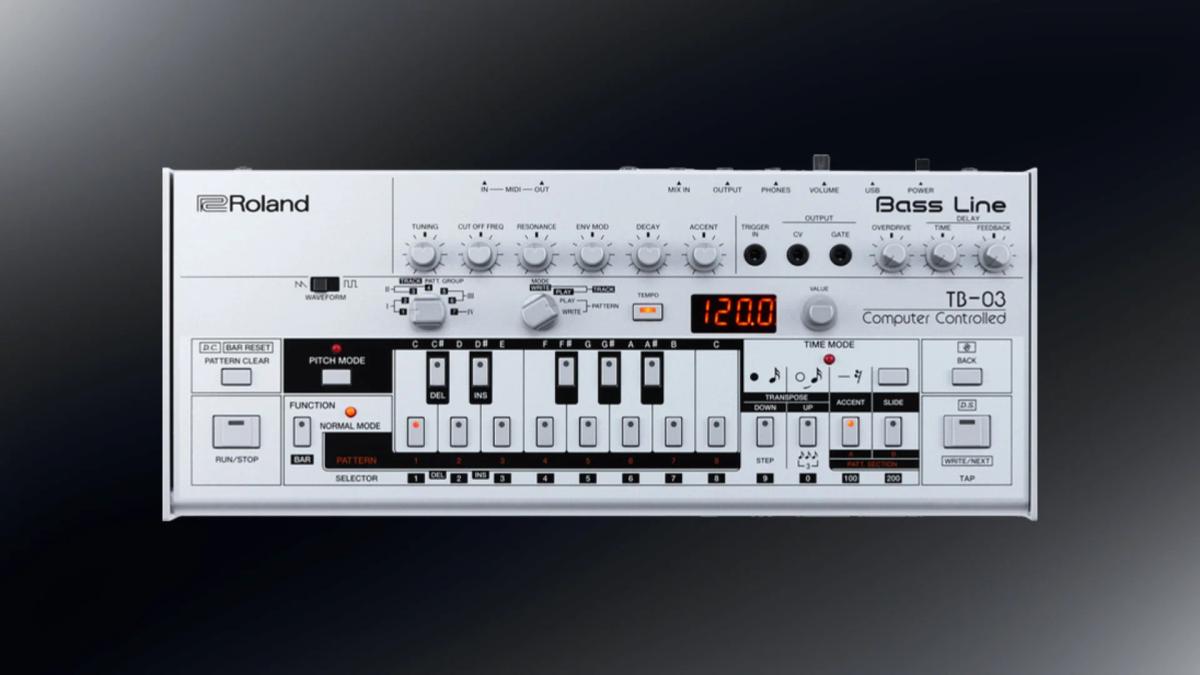
The Roland TB-03 is a compact, battery-powered bass line synthesizer that recreates the 1981 Roland TB-303 in the Boutique format. Roland announced it on September 9, 2016, as part of its 909 Day releases alongside the TR-09 and VP-03, at a US price of $349, with shipping expected that October. Instead of analog circuitry, the TB-03 uses Analog Circuit Behavior (ACB), the component-level modeling technology Roland developed for its AIRA range. It reproduces a single-oscillator monosynth with sawtooth and square waves, a resonant low-pass filter, a decay envelope, accent, and slide. Around that familiar engine Roland added what the original never had: a four-digit LED display, a step-entry mode, overdrive and delay/reverb effects, MIDI, USB audio, CV/Gate outputs, and a trigger input. Its appeal was simple: the 303’s layout and programming logic at a fraction of an original’s secondhand price.
Table of Contents
Roland TB-03 sound and character
The TB-03 is built around the same short signal path as the instrument it imitates: one oscillator with a switch between sawtooth and square, a resonant low-pass filter, and an envelope whose length is set by a single Decay knob. Cutoff, Resonance, Env Mod, and Accent do most of the expressive work, and per-step accent and slide give a pattern its rhythmic push and its gliding pitch. MusicRadar’s Bruce Aisher noted that the original’s filter is a 24dB/octave, four-stage diode ladder design, and that the TB-03 keeps the whole oscillator, filter, and envelope arrangement intact. The result is a narrow but very specific palette: rubbery basses with the filter mostly closed, and the familiar squelch once resonance and envelope depth are pushed up.
Reviewers broadly agreed that it sounds like a 303, while disagreeing on how close it gets. Aisher found that it sometimes lacked the original’s character, yet at other moments came very close to the classic squelch and hollow tones. MusicTech’s Dave Gale compared it side by side with a vintage unit and heard it as slightly less punchy, a gap he felt was easily closed with EQ in a DAW, and he described the overall sound as remarkably close for the money. At Resident Advisor, Mark Smith wrote that most listeners without long experience on an original would accept it as a 303, but that seasoned users might notice differences in glide, resonance, accent, and filter response.
The more critical assessments focused on low-end weight and harshness. Gearnews writer Marcus Schmahl found sawtooth filter sweeps harsher than on the original, and a Bonedo colleague comparing the two heard a slightly punchier attack on the vintage machine, along with clicks that add to its character. Bonedo’s Felix Klostermann judged the TB-03 less punchy than a fully analog alternative and reported internal distortion at certain settings, which he linked partly to an asymmetrical waveform. Smith heard a band-pass-like quality in the resonance that suits mid-range lines better than deep bass, though he singled out the square wave with a closed filter and boosted envelope as a strong, punchy bass sound.
The built-in effects change the instrument’s practical character more than its core tone. The overdrive section offers three flavors, covering overdrive and distortion, and the delay section offers tape echo, digital delay, or reverb, with dedicated knobs for delay time and feedback. Gale was surprised by how aggressive the drive was, calling it “bright and rips”, and Aisher counted it among the unit’s highlights, since so many classic 303 tracks rely on heavy distortion. Klostermann was less impressed and rated the effect quality as mediocre, while Smith, who would normally use plug-ins in the studio, found the delay and reverb genuinely useful in a live setup.
The sequencer is part of the sound as much as the filter is. Because the original Pitch and Time write modes enter notes and rhythm in separate passes, results are often slightly unpredictable, and Smith found that working without a piano-roll view frequently produced more interesting lines than he had planned. Gale pointed out that glide between steps can be programmed directly on the unit, and Roland notes that patterns keep playing while the player switches modes, so edits to cutoff, accent, or the pattern itself can be made without stopping. The decay, accent, and slide interplay that defines acid lines therefore stays hands-on, even with the newer Step mode available for more deliberate entry.
Features and architecture
- Manufacturer: Roland Corporation
- Year introduced: 2016 (announced September 9, 2016; shipping was expected in October 2016)
- Production years: 2016 to about 2026; Roland now lists it among its legacy Boutique instruments
- Synthesis type: digital modeling of analog subtractive synthesis, using Roland’s ACB (Analog Circuit Behavior) technology
- Category: Boutique-format bass line synthesizer module with built-in sequencer
- Polyphony: 1 voice (monophonic)
- Multitimbrality: none; monotimbral
- Original price: $349 (US); £329 (UK) at launch
- Current market price: discontinued at major US retailers; used units roughly $290–$400, remaining new stock up to about $480
- Oscillators: one oscillator with switchable sawtooth or square waveform; Tuning control
- Filter: resonant low-pass modeled on the TB-303’s 24dB/octave diode ladder; Cutoff, Resonance, and Env Mod knobs
- LFO: none listed in Roland’s specifications
- Envelopes: one envelope shaped by the Decay knob, with Env Mod depth; no ADSR controls
- Modulation system: fixed; envelope to filter, plus per-step Accent (with Accent knob) and Slide
- Sequencer / arpeggiator: 303-style pattern sequencer with Pitch and Time write modes, a new Step mode, tap entry, shuffle, transpose, and fine tempo (e.g., 125.5 BPM); patterns up to 16 steps; no arpeggiator
- Effects: overdrive/distortion (three types); delay section with tape echo, digital delay, or reverb
- Memory: 96 patterns (4 groups × 3 sections × 8 patterns) and 7 tracks; backup over USB
- Keyboard: none; one-octave button keyboard (C to C) for note entry; compatible with the optional K-25m Keyboard Unit
- Inputs / outputs: output, headphones, and mix in (stereo mini jacks); trigger in, CV out, and gate out (mono mini jacks)
- MIDI / USB: MIDI In and Out (5-pin DIN); USB Micro-B for MIDI and audio, with the unit acting as an audio interface (driver required)
- Display: 4-character, 7-segment LED, plus pitch, normal, and time mode indicators
- Dimensions / weight: 308 × 130 × 52 mm (12-1/8 × 5-1/8 × 2-1/16 in); 940 g (2 lb 2 oz)
- Power: 4 × AA batteries (alkaline or Ni-MH, about 5 hours on Ni-MH) or USB bus power (500 mA); no dedicated power adapter jack
Strengths
- The panel follows the original closely. Owners of a TB-303 recognize the knobs, the button keyboard, and the Pitch and Time programming logic, so classic techniques carry over directly.
- Step mode makes programming far less abstract. Notes, rests, accents, and slides can be entered one step at a time, which several reviewers found easier than the original’s separate pitch and timing passes.
- Drive and delay are built in. The overdrive and delay/reverb section covers the pedals 303 users traditionally added, which makes the unit self-contained for sketching and live sets.
- Connectivity is broad for the size. MIDI In/Out, USB MIDI and audio, CV/Gate outputs, and a trigger input let it sit in a DAW setup, a vintage rig, or a Eurorack case.
- It is genuinely portable. Battery power, a built-in speaker, and a slim metal-faced chassis made it easy to carry, as Resident Advisor noted it fits in carry-on luggage.
- Pattern storage and backup are modern. With 96 patterns, seven tracks, and USB backup of settings and patterns, work can be archived on a computer instead of living only inside the unit.
Limitations
- It is not analog. Buyers who want discrete circuitry were directed elsewhere by MusicRadar, and the point dominated reader reactions at launch.
- The low end can feel light. Reviewers and users described a mid-focused or tinny bottom compared with an original or an analog clone.
- The sequencer stays close to 1981. There is no real-time recording mode and no parameter automation, and some functions still require button combinations on a small display.
- Controls are small and crowded. MusicTech wished for larger, more widely spaced knobs, a common trade-off of the Boutique format.
- Connectors and power are compromises. Audio uses 3.5 mm mini jacks, USB is Micro-B, and there is no dedicated power supply input, which Gearnews and Bonedo both criticized.
- USB audio needs care. Bonedo found it was not class-compliant, supported only 44.1 kHz and 96 kHz, and could clip over USB because the rear volume knob affects only the analog output.
- The reverb is hidden. Resident Advisor noted that reverb sits inside a menu rather than on the panel, so it is easy to overlook.
Historical context
The TB-303 that the TB-03 copies was released in 1981, designed by Tadao Kikumoto and sold at $395 as a bass accompaniment machine. It was discontinued in 1984, and only later found its purpose when Chicago’s Phuture manipulated its knobs in real time on “Acid Tracks” (1987), a record widely credited as the first acid house track. From then on, the 303’s squelch became part of club music’s vocabulary, and secondhand prices climbed; MusicRadar put a used original at more than £2,000 by the time the TB-03 arrived.