

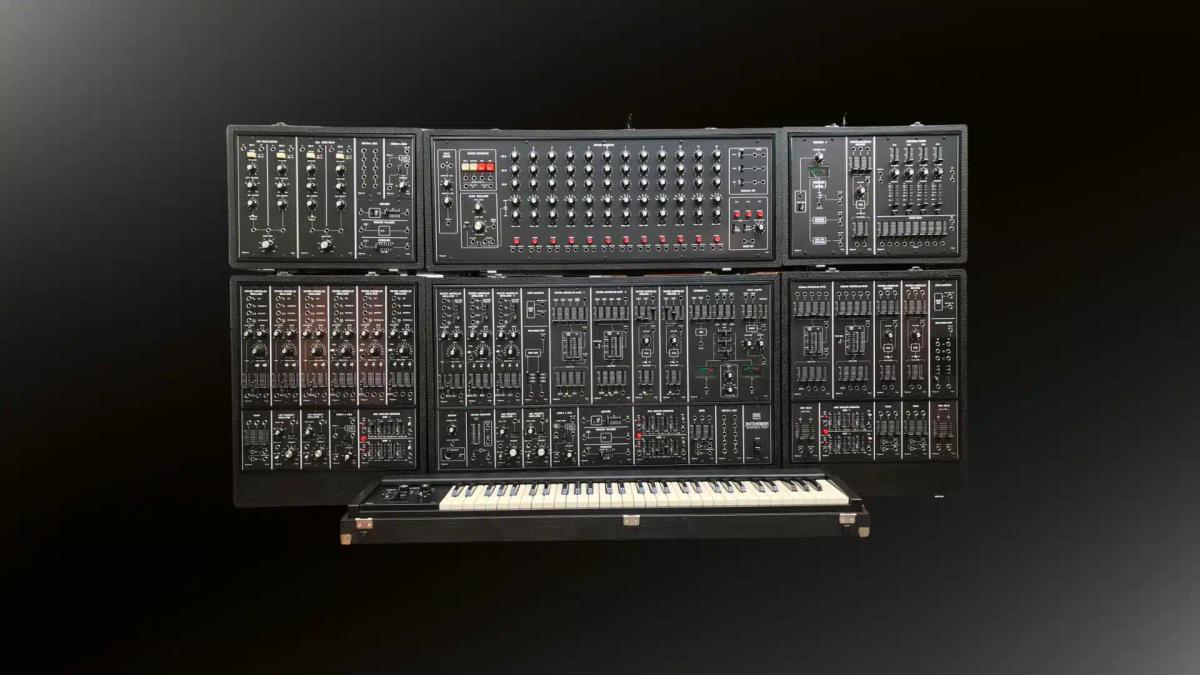
The Roland System-700 is a large analog modular synthesizer introduced in 1976 and built around a main console, a 61-key two-voice keyboard controller (the 701A), and a series of optional expansion cabinets. Competing against the big American modulars from Moog and ARP, it was Roland’s most ambitious synthesizer of the 1970s, and Roland itself describes it as Japan’s first large-scale modular synthesizer system. Few were sold, but the Roland System-700 matters because it showed that a Japanese manufacturer could build a modular on the scale of the American flagships, and because it found its way onto records by Isao Tomita and Japan.
Table of Contents
Sound and character
The Roland System-700 sounds like a large 1970s analog modular with plenty of parallel signal paths. The main console alone lets a patch stack detuned oscillators through separate filters and amplifiers rather than one voice path, and that parallelism is the key to its character. The synthesist Alex Ball, demonstrating a borrowed system, built a bass by running one oscillator at 32′ and two at 16′ through their own filters and VCAs, then spreading them left, centre and right through the output module for what he called a true stereo bass sound.
The output module, with spring reverb, phase shifter and panning, lets the system produce spatial, moving textures without external processing. Sync, ring modulation, sample and hold and an envelope follower push the palette toward the experimental as much as the orchestral: Ball’s lead used sync on one channel and ring modulation on the other.
The keyboard adds a distinctive quirk. The 701A sends two control voltages, which makes the system duophonic, and Ball found that a third oscillator still tracking the keyboard with low-note priority could be tuned a fifth up to add an extra note to two-note shapes, with intervals he noted were “not equally tempered”.
In the hands of Richard Barbieri, the Roland System-700 produced the discordant, unsettled sounds that open Japan’s “Ghosts”, a patch he later said he could not recreate even from his own notes, describing it as one note “triggering off all kind of things”. That combination of depth and unpredictability, more than any single filter colour, is the Roland System-700’s sonic identity.
Features and architecture
- Manufacturer: Roland Corporation
- Year introduced: 1976
- Production years: commonly listed as 1976 to 1982; Sound On Sound dates Roland’s decision to curtail production of the line to 1983
- Synthesis type: analog subtractive modular synthesis with patch cables
- Category: large modular system with dedicated keyboard controller
- Polyphony: monophonic voice architecture; the 701A keyboard sends two control voltages, allowing duophonic playing
- Original price: no reliable launch price has been documented; Gearnews describes it as carrying “a price to rival luxury cars”
- Current market price: rare and expensive; listings have run from just under $18,000 for a partial system to £70,000 for a fully restored seven-block system
- Oscillators: 3 VCOs in the main console (702A, 702B, 702C); the optional VCO bank adds 6 more, for 9 in a full system
- Filter: 2 VCFs in the main console, a low-pass filter and a multimode low-pass/band-pass/high-pass filter; the VCF/VCA bank adds 2 more, for 4 in a full system; the 715A combines a multimode filter with an audio mixer
- LFOs: 2 LFOs (706A, 706B) in the main console, with further LFOs in expansion blocks
- Envelopes: dual ADSR envelope generator (705A) in the main console, with additional dual ADSRs in expansion blocks; envelope follower in the 707A
- Modulation system: free patching via patch cables, plus the most common power, CV and gate connections made internally in the main console; noise generator and ring modulator (708A), sample and hold (709A), voltage processor (712A), integrator, gate delay (713A), multiples and an analog switch (723A)
- Sequencer / arpeggiator: optional 717A analog sequencer with three channels of 12 steps, large enough to fill its own expansion cabinet; no arpeggiator
- Effects: output module (711A) with spring reverb, phase shifter, panning, stereo VU meters and test tone; optional 720B two-channel phase shifter and a two-channel audio delay
- Memory: none; sounds exist only as patches on the panel
- Keyboard: 701A controller, 61 keys (5 octaves), two-voice, with portamento and pitch bend
- Inputs / outputs: patch points throughout; the interface/mixer block adds a frequency-to-voltage converter, envelope follower and gate generator for processing external audio
- MIDI / USB: none; CV and gate only
- Display: none beyond the output module’s VU meters
- Dimensions / weight: configuration-dependent; each block is a separate cabinet, and the 701A keyboard is a stand-alone unit
- Power: dedicated 718A power supply module
Strengths
- The main console is a complete instrument on its own. Three VCOs, two filters, two VCAs, two envelopes, two LFOs, utilities and a built-in output section with reverb, phasing and panning mean a single cabinet can deliver finished, stereo results.
- Parallel resources encourage layered sound design. With separate filters and amplifiers for each oscillator, players can build stereo basses, split leads and evolving textures that are hard to achieve on fixed-architecture monosynths of the same era.
- The 701A keyboard broadens what a modular can play. Duophonic CV output, portamento and pitch bend give the system a more performable front end than a bare cabinet of modules.
- The system is unusually open to external sound. The interface block and envelope followers let guitars, tapes and other sources drive and be processed by the modular, a feature Barbieri used by running cassettes straight into the system on Japan’s Tin Drum.
- It scales from one cabinet to a full studio installation, growing to nine oscillators and four filters with optional blocks for sequencing, mixing and effects.
Limitations
- The price put it out of reach of almost everyone. Gearnews compares its cost to a luxury car and notes that few were sold, and Sonic State calls it a monster synth with “a monster price tag”.
- It is physically enormous. A full system spreads across a main console, wing cabinets and a separate keyboard, and its sequencer alone occupies a whole cabinet.
- The main console is partly hardwired. The most common power, CV and gate connections are made internally, which speeds up patching but fixes part of the signal flow in the base cabinet.
- There is no patch memory, MIDI or polyphony. Every sound must be repatched by hand, and integrating a Roland System-700 into a modern setup requires CV/gate conversion.
- Survivors need specialist care. Working systems are scarce, and the restored examples offered by dealers have typically been through specialist technicians first.
Historical context
The Roland System-700 appeared in 1976 as a deliberate step up for Roland: a full modular environment intended for professional studios, competing against the Moog modulars and the ARP 2500 and 2600. Roland’s own company history notes that it was bought by organisations such as the Japanese broadcaster NHK and the BBC. The same period also brought the smaller System-100, a patchable but not modular, more affordable approach that already has its own article on this site.
The timing mattered. In the mid-1970s the large modular was still the prestige centrepiece of a serious electronic studio, and a domestic modular on that scale gave Roland a kind of credibility that smaller instruments could not.
By 1979 Roland had launched the System-100M, a compact modular format that undercut the Roland System-700 and found a much wider following. In 1983, the year Yamaha released the DX7, Ikutaro Kakehashi curtailed production of lines such as the Roland System-700 so that Roland could concentrate on smaller, more affordable products. The flagship modular had become a relic of a studio culture that the industry was leaving behind.