

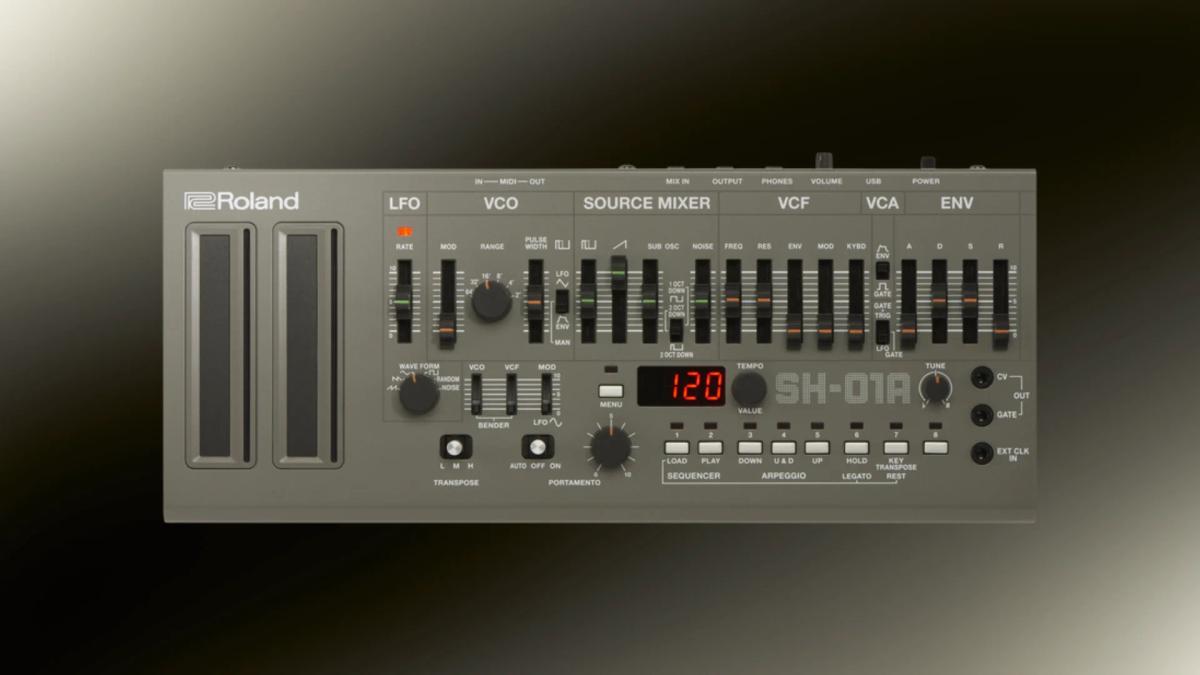
The Roland SH-01A is a compact desktop synthesizer in the Roland Boutique series that recreates the Roland SH-101, the portable monophonic analog synth Roland built from 1982 to 1986. Roland announced it on August 8, 2017, alongside the TR-08, and the major magazine reviews followed in spring 2018. Instead of analog circuitry it runs on Analog Circuit Behavior (ACB), Roland’s component-level digital modeling of the original oscillator, filter and envelope. The signal path stays close to the original: one oscillator with simultaneous sawtooth, pulse and sub-oscillator, a resonant low-pass filter, one ADSR envelope, an LFO, an arpeggiator and a 100-step sequencer. What sets it apart is a four-voice engine with Mono, Unison, Chord and Poly modes, plus 64 patch memories, 64 sequence patterns and CV/gate outputs. It came in gray, with limited red and blue versions echoing the SH-101’s colors.
Table of Contents
Roland SH-01A sound and character
The central question for any SH-101 recreation is whether it sounds like the original, and the two most detailed reviews broadly agree that the SH-01A does. Gordon Reid, testing it against a vintage SH-101 for Sound On Sound, found he could usually make the two indistinguishable across leads, basses, orchestral-style patches and effects. The differences he heard were small: aliasing at the very top of the pitch range, slightly different contour shapes, and minor timing variations. Dave Gale, writing for MusicTech, likewise found the waveforms and envelopes effectively identical to the original, with one caveat: to his ears the filter carries a little more high-end fizz than the hardware it models.
The raw material is the SH-101’s single oscillator, which produces sawtooth, pulse and a sub-oscillator at the same time and blends them in a source mixer. Pulse width can be set by hand, swept by the LFO or driven by the envelope, which is where much of the classic SH-101 bass and lead character comes from. The sub-oscillator offers a square one octave down, a square two octaves down, or a narrow pulse two octaves down. According to Sound On Sound, the SH-01A extends the oscillator range downward to 32′ and 64′ footages, beyond the original’s 16′ to 2′, and adds a second noise type alongside the original noise. The 24dB/octave resonant low-pass filter, which Reid describes as modeled on the IR3109 design Roland also used in the Juno-6 and Juno-60, can track the keyboard at 100%, so a self-oscillating filter can be played as a sine-like tone source.
The four-voice engine is what changes the instrument’s personality. In Mono mode the SH-01A behaves as an SH-101. Unison stacks all four voices on a single key, which Reid found effective even though there are no detune or panning controls to spread them. Chord mode assigns voices to fixed intervals, shiftable in semitone steps, so a single key plays a chord; used with a fifth or an octave, it turns the unit into what Reid called a four-oscillator monosynth with a sub-oscillator, although all voices share the same waveform settings and their levels cannot be balanced individually. Poly mode makes it a four-voice, single-timbre polysynth, and here Reid found it came very close to a Roland Juno-60 on many sounds, including organ-like patches.
Modulation adds a few new colors. The LFO gains sawtooth and ramp shapes for six waveforms in total, and an Advanced mode pushes its rate into the audio range for FM-style tones and amplitude-modulation sidebands. Because the LFO cannot track the keyboard, those audio-rate effects are harder to use melodically. Sound On Sound also noted audible stepping in filter and pitch when sweeping or bending, so long, slow filter moves are not perfectly smooth. There are no built-in effects, and Reid suggested that even a basic chorus and delay would have helped; in practice the SH-01A’s sound is the dry SH-101 voice, which many users pair with external processing.
Features and architecture
- Manufacturer: Roland Corporation
- Year introduced: 2017 (announced August 8, 2017; Wikipedia dates the release to 2018, when the main reviews appeared)
- Production years: from 2017–2018 (exact first ship date not documented) to an unpublished end date; Roland now lists it among its legacy Boutique instruments, and major retailers list it as no longer available
- Synthesis type: virtual analog subtractive, using Roland’s Analog Circuit Behavior (ACB) modeling of the SH-101 circuits
- Category: Roland Boutique desktop sound module (keyboardless; optional 25-key K-25m keyboard unit)
- Polyphony: 4 voices; assign modes Mono, Unison, Poly and Chord, stored per patch; no chain mode or MIDI overflow for adding voices
- Multitimbrality: none (monotimbral)
- Original price: US $349.99; £349 in the UK
- Current market price: new listings at about $494.99 in the US where stock remains; used units from roughly $270 on Reverb
- Oscillators: one oscillator per voice with simultaneous sawtooth, pulse (manual, LFO or envelope pulse-width modulation) and sub-oscillator (square -1 octave, square -2 octaves, pulse -2 octaves); footages from 64′ to 2′; noise with Original and Variation types
- Filter: 24dB/octave resonant low-pass with envelope, LFO and keyboard-tracking amounts; keyboard tracking up to 100% for a playable self-oscillating filter
- LFO: one LFO with six waveforms (four from the original plus sawtooth and ramp); Original and Advanced modes, the latter reaching audio rates; does not sync to MIDI clock; a separate sine vibrato is controlled from the modulation ribbon
- Envelopes: one ADSR contour generator for filter and pulse width; the VCA follows either the gate or the envelope; trigger options are gate, gate plus retrigger, or gate plus LFO
- Modulation system: fixed SH-101 routing on sliders and switches (LFO to pitch, pulse width and filter; envelope to pulse width and filter); two ribbon controllers for pitch bend and modulation, with sliders setting bend depth for pitch and cutoff; portamento with Auto, Off and On settings
- Sequencer / arpeggiator: 100-step sequencer with rests and ties, four-note polyphonic in Poly mode, 64 pattern memories switchable during playback, swing and clock scale; arpeggiator with Up, Down and Up & Down modes, 1- or 2-octave range, Hold and a three-position transpose switch
- Effects: none
- Memory: 64 user patches and 64 sequencer patterns; backup and restore via USB mass storage
- Keyboard: none built in; compatible with the optional K-25m (25 velocity-sensitive mini keys) and the DK-01 Boutique Dock
- Inputs / outputs: 3.5 mm mini jacks for Output, Phones, Mix In, CV Out, Gate Out and Ext Clk In; no CV or gate inputs; built-in speaker
- MIDI / USB: 5-pin MIDI In and Out; USB Micro-B for MIDI and audio; panel controls sent and received as MIDI control changes; clock from internal, MIDI, USB, LFO or external trigger
- Display: 4-character, 7-segment LED
- Dimensions / weight: 300 × 128 × 46 mm (11-13/16 × 5-1/16 × 1-13/16 in); 965 g (2 lb 3 oz) with batteries
- Power: four AA batteries (alkaline or Ni-MH, about six hours with Ni-MH) or USB bus power at 500 mA; no DC power socket
Strengths
- The emulation is unusually close. In side-by-side tests Sound On Sound could usually make it indistinguishable from a vintage SH-101, and MusicTech found the waveforms and envelopes effectively identical.
- Four voices broaden the instrument. Unison, Chord and Poly modes let the same panel produce fat stacked leads, interval-based monosynth patches and simple four-voice pads, none of which the original could do.
- The sequencer is more capable than the original’s. It keeps the SH-101’s 100-step, step-entry workflow but adds 64 stored patterns, swing, clock scaling and four-note polyphony in Poly mode.
- Patch memory removes a major vintage limitation. The SH-101 had no patch storage, while the SH-01A stores 64 sounds, each with its voice mode and arpeggiator settings.
- It integrates easily into modern and modular setups. MIDI DIN, USB audio and MIDI, CV and gate outputs, and an analog clock input let it act as a sound source, a sequencer for other gear or a basic MIDI-to-CV converter.
- It is genuinely portable. Battery power, a built-in speaker and a weight under one kilogram make it usable away from a studio desk.
Limitations
- It cannot be chained for more polyphony. Unlike the JP-08, JU-06 and JX-03, the SH-01A has no MIDI overflow, so four voices is the ceiling.
- The connections are small and limited. All audio, CV and clock jacks are 3.5 mm, there are no CV or gate inputs, and the single audio output carries the same mono signal on both channels.
- Power options are restricted to USB and batteries. There is no DC socket, which made Sound On Sound’s reviewer hesitant about relying on it on stage.
- The compact panel invites mistakes. MusicTech noted that the noise level slider sits right beside filter cutoff, and the pitch and modulation ribbons are awkward to reach without a stand, which is not included.
- Deeper settings are buried in menus. Noise type, LFO mode, MIDI, velocity, CV, clock settings and tuning scales sit behind an unlabeled menu system, and the printed documentation was little more than a crib sheet.
- There are no effects and no velocity response. The engine transmits velocity over MIDI but does not respond to it internally, and any chorus, delay or reverb has to come from outside.
Historical context
The SH-101 entered production in November 1982 at US $495 (£249 in the UK) as a light, battery-capable monosynth with a 32-note keyboard, a built-in sequencer and arpeggiator, and an optional modulation grip that turned it into a shoulder-strapped instrument. Alongside the standard gray model, Roland offered limited red and blue versions. Production ended in 1986, and the synth went on to appear in the setups of a long list of electronic artists, from Vince Clarke and Aphex Twin to Orbital and Boards of Canada. Roland had already modeled it with ACB in 2014, as an SH-101 plug-out for the AIRA System-1, three years before a dedicated Boutique version.
The Boutique line itself was announced on October 1, 2015, with the JP-08, JU-06 and JX-03, described by Roland as limited-edition compact sound modules. They ran on ACB, could be powered by USB or batteries, included small speakers, and used a chain mode to link two units of the same type for more voices. The optional K-25m keyboard gave each module 25 velocity-sensitive keys. On August 8, 2017, Roland’s 808 Day, the company introduced the TR-08 and SH-01A together; Resident Advisor reported a US price of $349 for each, and Synthtopia reported a street price of about $350 with availability expected in September. Gearnews’ Robin Vincent welcomed the long-requested SH-101 reissue but admitted mild disappointment that it was modeled rather than analog, coming after the analog SE-02.