

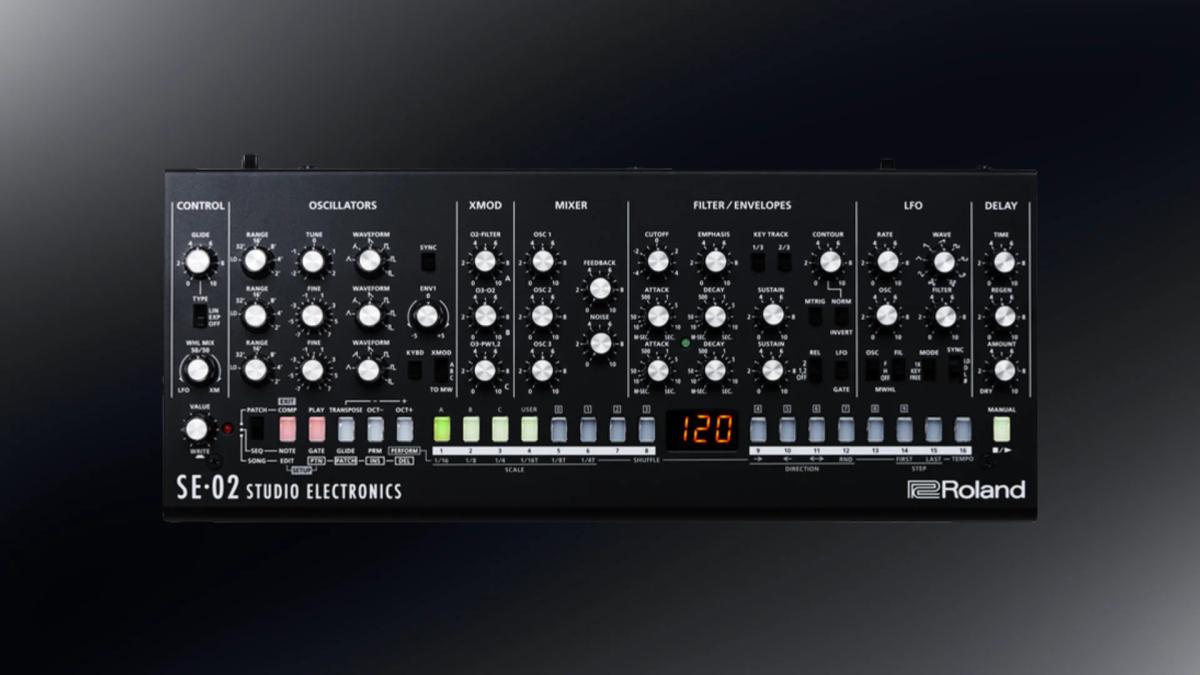
The Roland SE-02 is a monophonic analog synthesizer module that Roland developed with the American company Studio Electronics as the first product of its Boutique Designer Series. It was announced on June 20, 2017 at a US street price of $499.99, and Synthtopia was reporting it as available by September of that year. Inside the familiar Boutique case sit three temperature-stabilized voltage-controlled oscillators with automatic tuning, a 24 dB low-pass ladder filter, cross-modulation and a feedback loop, two envelopes, a nine-waveform LFO, a 16-step sequencer with song mode, and a tempo-synced digital delay. What set it apart at a glance was the signal path: where the earlier Boutiques modeled vintage Roland circuits in software, the SE-02 used discrete analog circuitry and an original design rather than a reissue of a Roland classic.
Table of Contents
Roland SE-02 sound and character
The SE-02 is built around a layout that most reviewers compared with the Moog Minimoog Model D: three oscillators feeding a mixer, a 24 dB ladder low-pass filter, and a pair of contour generators. FACT noted the resemblance in the panel, the oscillator arrangement and the filter type as soon as the instrument was announced. The comparison is useful as a map of the controls, but reviewers were careful not to treat the SE-02 as a clone. Dana Gumbiner, writing for Tape Op, heard a miniature Minimoog in the layout but not a Model D copy in the sound, and described an instrument with its own grit.
The raw oscillators carry much of that character. Dave Gale of MusicTech found them rich and tight, with a bright fizz at the top when the filter is left open, and he singled out the strength of the low mids. Each oscillator offers six switched waveforms across footages from 32′ to 2′, including a reverse sawtooth on the third oscillator that MusicTech called the “Sharktooth” wave. Dan Goldman of MusicRadar described a range that runs from warm and smooth to harsh and aggressive, and heard a blend of Roland, Moog-style and Studio Electronics flavors rather than a single borrowed voice. Sound On Sound’s Gordon Reid later learned that Studio Electronics had drawn on Oberheim and ARP technology for the oscillator design.
The filter is self-oscillating and paired with a dual gain-stage amplifier. MusicRadar’s reviewer found that modest resonance thickens the tone, while high settings turn aggressive and thin out the low end enough to behave almost like a high-pass. Gale heard more high-end squeal and less low-end grunt than he associated with a Moog, and Reid measured self-oscillation down to about 50 Hz, which is also the lowest cutoff the filter reaches. Reid pointed out that this limits how closely the SE-02 can match some of the deepest Minimoog bass sounds, because the original’s resonance behaves differently at the bottom of the range.
The modulation section is where the SE-02 moves furthest from its visual model. Three cross-modulation types let the oscillators modulate one another and the filter at audio rate, a feedback control routes the VCA output back into the mixer, and a noise generator sits alongside the oscillators. MusicTech described the feedback path as a route to howling, distorted tones, and Tape Op found it useful for squelch and drive. Reid concluded that the SE-02 can deliver the sound of a fat, aggressive American monosynth, with bass, leads and sound effects as its clearest strengths.
The final stage is a tempo-synced digital delay that can be bypassed to leave the analog path untouched. MusicRadar found it capable of long, wandering repeats and, at short settings, of something close to a small room. Tape Op heard it imitate the feedback behavior of analog delay. It is a single effect rather than a full multi-effects section, so most of the SE-02’s color comes from the oscillators, filter and feedback circuit.
Features and architecture
- Manufacturer: Roland Corporation, co-developed with Studio Electronics (USA)
- Year introduced: 2017 (announced June 20, 2017; reported as available by September 2017)
- Production years: 2017 to an undocumented end date; Roland now lists it among its legacy Boutique instruments, and major North American retailers list it as no longer available
- Synthesis type: Analog subtractive, with digital control of tuning, envelopes, LFO and portamento and a digital delay
- Category: Desktop monophonic synthesizer module in the Roland Boutique format
- Polyphony: Monophonic (one voice); Chain Mode links two or more units over MIDI for more voices
- Multitimbrality: None
- Original price: $499.99 US street; £509 UK; €595
- Current market price: Roughly $240 to $360 used in October 2026, with occasional new-old-stock listings priced far higher
- Oscillators: Three temperature-stabilized VCOs with automatic tuning; triangle, sawtooth, triangle plus sawtooth (oscillators 1 and 2), reverse sawtooth (oscillator 3) and three square widths; 32′ to 2′ footages; oscillator sync; oscillator 3 can run at low frequency as a modulator or be decoupled from the keyboard; noise generator
- Filter: 24 dB/octave low-pass ladder filter, self-oscillating, with cutoff, emphasis, contour amount, key tracking (1/3 and 2/3 switches), multi-trigger switch and normal/invert envelope switch; external audio input routed through the filter
- LFO: One tempo-syncable LFO with nine waveforms, destinations for oscillators and filter, mod wheel switch, and free-run, one-shot and key-trigger modes
- Envelopes: Two (filter and amplifier), each attack, decay and sustain, with a switchable release; times of roughly 10 ms to 10 seconds
- Modulation system: Three cross-modulation (XMOD) types, mixer feedback loop, envelope inversion, LFO, oscillator 3 as modulator, and aftertouch response over MIDI
- Sequencer / arpeggiator: 16-step sequencer with parameter recording, gate time, glide, shuffle, scale, four directions and adjustable first and last steps; 128 patterns and 16 songs of up to 16 parts; real-time recording added in firmware 1.10; no arpeggiator
- Effects: Tempo-synced digital delay (time, regeneration, amount) with bypass
- Memory: 384 presets (three banks of 128) plus 128 user patches, 128 patterns and 16 songs
- Keyboard: None; optional K-25m 25-key keyboard unit or DK-01 Boutique Dock
- Inputs / outputs: 3.5 mm stereo output and headphone jacks; 3.5 mm external audio input, pitch CV input, VCF CV input, gate input, trigger input and trigger output; small built-in speaker
- MIDI / USB: 5-pin MIDI In and Out; micro USB (type B) for audio and MIDI; panel controls transmit and receive MIDI CC
- Display: Small LED displays and backlit buttons
- Dimensions / weight: 300 x 128 x 46 mm (11-13/16 x 5-1/16 x 1-13/16 in); 950 g (2 lb 2 oz) without adaptor
- Power: Included PSB-1U AC adaptor, 2 A current draw; no battery operation or USB bus power
Strengths
- The signal path is genuinely analog. Unlike the modeled Boutiques that preceded it, the SE-02 runs its oscillators, filter and amplifier through discrete analog circuitry, which was the main reason it drew attention in 2017.
- The sound has real weight. Reviewers at Sound On Sound, MusicRadar, MusicTech and Tape Op all praised its bass and lead tones, and several described a character that is its own rather than a straight Minimoog imitation.
- Modulation goes beyond the classic template. Cross-modulation, the feedback loop, oscillator sync and a nine-waveform LFO give the SE-02 aggressive and metallic territory that a plain three-oscillator layout would not reach.
- The sequencer is deep for its size. Parameter recording, shuffle, scale, direction settings and song chaining across 128 patterns made it the feature MusicRadar’s reviewer counted among the unit’s main assets.
- Connectivity is unusually complete for a Boutique. CV, gate and trigger jacks sit alongside 5-pin MIDI and USB audio, so the SE-02 can work with modular systems, older analog gear and a computer without extra interfaces.
- Every control is available over MIDI. MusicTech noted that the panel sends and receives MIDI CC, which makes automation in a DAW and the use of an external controller straightforward.
- It was competitively priced. At about $500 for a three-VCO analog monosynth with a sequencer and memory, it offered a good deal of hardware for the money, a point Sound On Sound and MusicRadar both made.
Limitations
- The panel is crowded. With 37 knobs, 15 switches and 22 buttons in a Boutique case, MusicRadar found it easy to nudge neighboring controls, and every major review mentioned the cramped spacing.
- It cannot run on batteries. The SE-02 needs its dedicated adaptor, so it lacks the cable-free portability that most other Boutiques offer through AA batteries or USB power.
- Documentation was thin. Sound On Sound and Tape Op both criticized the manual, and Tape Op recommended an unofficial guide written by Sunshine Jones instead.
- Early units had teething problems. Gordon Reid’s review sample produced occasional popping sounds and drifted about 25 cents flat across the oscillator range, with no trimmers available for a user to correct it.
- Some modulation options were missing at launch. Reviewers noted the absence of gentle pulse-width modulation, which arrived only with the 1.10 firmware, and Tape Op found the PWM LFO still could not sync to tempo.
- The sequencer takes effort to learn. Sound On Sound described it as not very intuitive, Tape Op called programming it awkward, and key-transpose of patterns was limited to the K-25m rather than external MIDI at the time of MusicRadar’s review.
- Preset memory is fixed. MusicTech pointed out that the 384 presets cannot be overwritten, leaving 128 user locations for original sounds.
Historical context
Roland launched the Boutique range in 2015 with three small modules, the JP-08, JU-06 and JX-03, plus an optional K-25m keyboard dock. The JP-08 was a miniature take on the Roland Jupiter-8, and its siblings revisited other Roland polysynths. These first models recreated their sources through Roland’s Analog Circuit Behavior modeling, and later releases in the same spirit covered drum machines, bass synths and monosynths. When FACT reported the SE-02 announcement, it drew the contrast directly: the earlier Boutiques and Roland’s AIRA instruments used analog modeling, while the new unit used real analog circuits and an original three-oscillator design.