

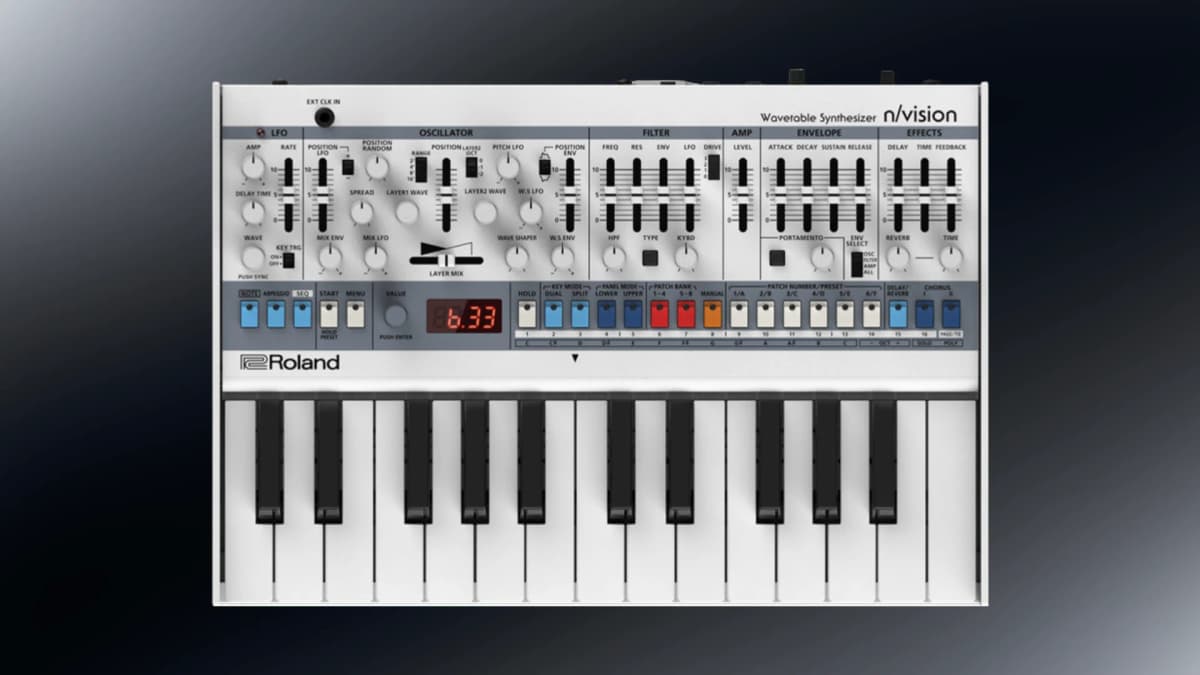
The Roland n/vision is a compact wavetable synthesizer in the Roland Boutique series, announced on October 20, 2026, alongside the JUPITER-08. It is the first Boutique model built around wavetable synthesis, and unlike most of the range it does not recreate a historical Roland instrument. Each of its two parts stacks two wavetable layers drawn from 63 tables, adds a wave shaper for nonlinear harmonic processing, and runs through an analog-modeled multimode filter with drive. Roland quotes up to 56 voices, a two-part 64-step polyphonic sequencer, 240 patch memories, and a 17-type effects engine with a dedicated delay and reverb. Launch coverage ties its engine to n/zyme, the wavetable Model Expansion Roland released for the Fantom in 2022. The n/vision also breaks two Boutique habits: it comes in white, and it is sold only with a matching white K-25m keyboard dock, at $549.99 in the US.
Table of Contents
Roland n/vision sound and character
The core of the n/vision’s sound is movement through a wavetable. Each voice plays two layers, each assigned one of 63 factory tables, and a single Position control scans through 127 steps of the selected tables. A vertical Layer Mix slider sets the balance between the two layers, and both position and mix have their own LFO and envelope amount knobs on the panel. Further controls randomize the start position per note and spread the voices across the stereo field. In practice this means a patch can shift timbre continuously while a note is held, which is the behavior Roland emphasizes when it describes pads, evolving textures and animated leads.
Two further stages give the instrument its edge. The wave shaper bends the waveform through a nonlinear transfer curve to add harmonics; Gearnews counts 15 shaping tables, and the shaper has its own envelope and LFO depth controls. After it sits a resonant filter with nine modes in Gearnews’s count: low-pass, high-pass and band-pass in 12 dB and 24 dB versions, plus three vintage-flavored low-pass types that Sonicstate describes as Roland, M-style and S-style. A resonance-free high-pass filter and a three-position drive switch complete the section. The drive and shaper together push the n/vision toward bright, crunchy tones more readily than the warm, rounded voices of Roland’s analog-modeled Boutiques.
The only full launch-day review found for this article, by Lasse Eilers at Gearnews, describes a palette dominated by glassy, nasal, hollow and piercing sounds. He hears the instrument as digital, direct and assertive, while noting that it can also turn warm and gentle, and he suggests it adds a genuinely different color to a setup built mostly around analog-style synths. Synth Anatomy, which had a unit for testing, called it fun and distinctive and promised a fuller review later. Peter Kirn at CDM framed it as something like a vintage synth from an alternate timeline, as if Roland had built its own answer to early German wavetable instruments.
The effects contribute a good share of the finished sound. The MFX engine includes three chorus types, among them the Juno chorus associated with the Juno-106, along with delays, overdrive, fuzz, a bit crusher, a lo-fi compressor, phasers and pitch shifters. A separate delay and a reverb with five types and a shimmer mode sit on dedicated panel controls. Some architectural choices narrow the range, however. Gearnews notes that the second layer can only be shifted in octaves, which rules out the classic detuned-layer thickening, and that wavetable position applies to both layers at once. Selecting a 24 dB filter mode also reduces available polyphony.
Because the n/vision was announced on the day this article was written, much remains untested. Sound On Sound and other long-form outlets had not published reviews at the time of writing, the USB audio driver was not available to the Gearnews reviewer, and whether users can import their own wavetables had not been confirmed. Gearnews reports a menu-based Drawing Mode for creating custom tables on the unit itself.
Features and architecture
- Manufacturer: Roland Corporation
- Year introduced: 2026 (announced October 20, 2026; Roland Japan lists a domestic release date of November 7, 2026)
- Production years: 2026 to present
- Synthesis type: Digital wavetable synthesis with two layers per part, wave shaper and analog-modeled filter
- Category: Compact Roland Boutique wavetable synthesizer, supplied with the K-25m 25-key keyboard dock
- Polyphony: Up to 56 voices, depending on sound generator load; 24 dB filter modes reduce the count
- Multitimbrality: Two parts (Upper and Lower), with dual and split modes
- Original price: $549.99 (US, including K-25m); £589 at UK dealers; €689 at Thomann
- Current market price: New only, at launch pricing (about $549.99 in the US, about £589 in the UK)
- Oscillators: Two wavetable layers per voice, 63 factory wavetables with 127 positions; position scan, random position, stereo spread, layer mix, Layer 2 octave switch, menu-based phase modulation and wavetable Drawing Mode
- Filter: Resonant multimode filter (low-pass, high-pass and band-pass at 12 or 24 dB, plus three vintage-style low-pass models), non-resonant high-pass filter, three-stage drive
- LFO: One syncable LFO with six waveforms, delay time and key trigger; a menu-based step LFO
- Envelopes: Three ADSR envelopes (oscillator, filter, amp) sharing one set of sliders through an envelope select switch; portamento
- Modulation system: Dedicated LFO and envelope amounts for wavetable position, layer mix, wave shaper and pitch; mod wheel and velocity; motion recording; no aftertouch from the K-25m
- Sequencer / arpeggiator: Two-part polyphonic step sequencer, up to 64 steps and eight notes per step, step and real-time recording, motion recording; arpeggiator with hold
- Effects: 17-type MFX (Chorus x3 including Juno chorus, Delay x4, Overdrive, Fuzz, Drive, Bit crusher, LOFI Comp, Phaser x2, Filter, Pitch Shifter x2), dedicated delay, reverb with five types and shimmer mode
- Memory: 240 patches and 96 patterns
- Keyboard: Included white K-25m dock with 25 velocity-sensitive mini keys; Boutique Dock DK-01 sold separately
- Inputs / outputs: 3.5 mm stereo output, 3.5 mm headphones, 3.5 mm stereo Mix In, 3.5 mm external clock input; built-in speaker; no trigger output
- MIDI / USB: 5-pin MIDI In and Out; USB-C for audio and MIDI (driver required)
- Display: Four-character, seven-segment LED
- Dimensions / weight: 308 x 209 x 54 mm (12-1/8 x 8-1/4 x 2-1/8 in); 1.7 kg (3 lb 12 oz) including K-25m and batteries
- Power: Four AA batteries (alkaline or Ni-MH, about six hours on Ni-MH) or USB bus power (500 mA)
Strengths
- It gives Roland a dedicated wavetable instrument. Earlier models such as the GAIA 2 included wavetable features, but the n/vision is the first Roland hardware synth built around the method.
- The key wavetable controls are on the panel. Position, layer mix, wave shaper and their modulation depths each have a dedicated knob or slider, so most sound shaping does not require the menu.
- Polyphony is generous for a Boutique. Roland quotes up to 56 voices across two parts, far beyond the four voices of the first Boutique models.
- The sequencer is unusually capable. Two polyphonic tracks of up to 64 steps, with motion recording, per-step gate and velocity, shuffle and randomization, make it a self-contained sketching tool.
- The effects are broad and well integrated. A 17-type MFX engine including the Juno chorus, plus a separate delay and a shimmer-capable reverb, covers most finishing needs without external processing.
- It is genuinely portable and studio-ready. Battery power, a built-in speaker, an included keyboard and a USB-C audio and MIDI interface let it work on a desk, a sofa or a DAW-centered rig.
Limitations
- Deep editing is menu-bound. The four-character LED cannot render letters clearly, and Gearnews found the menus hard to navigate without the manual or a software editor, which Roland has not announced.
- The layer structure is less flexible than it looks. Wavetable position is shared by both layers, and the second layer can only be offset in octaves.
- There is no aftertouch from the included keyboard. The K-25m sends velocity only, and its small keys drew criticism from Gearnews.
- Polyphony depends on the patch. Choosing a 24 dB filter mode reduces the voice count, so the 56-voice figure is a ceiling rather than a constant.
- The price is high against rivals. Gearnews points out that the Waldorf Protein costs less than half as much and that the Korg modwave can be cheaper in some regions.
- Integration details are still open. USB audio requires a driver, there is no trigger output, and user wavetable import had not been confirmed at launch.
Historical context
Roland launched the Boutique series in 2015 with the JP-08, JU-06 and JX-03, small modules that used Analog Circuit Behavior modeling to recreate the Jupiter-8, Juno-106 and JX-3P. Gordon Reid’s Sound On Sound review of those first three describes four-voice units that could be chained for more polyphony, ran on AA batteries or USB, carried a small speaker, and could be mounted in the optional K-25m keyboard, then sold separately for $99. Later entries such as the JD-08 and JX-08, covered by Robin Vincent at Gearnews in 2021, moved the format toward bi-timbral instruments with polyphonic sequencers and USB audio. The n/vision inherits that later template rather than the original single-part design.