

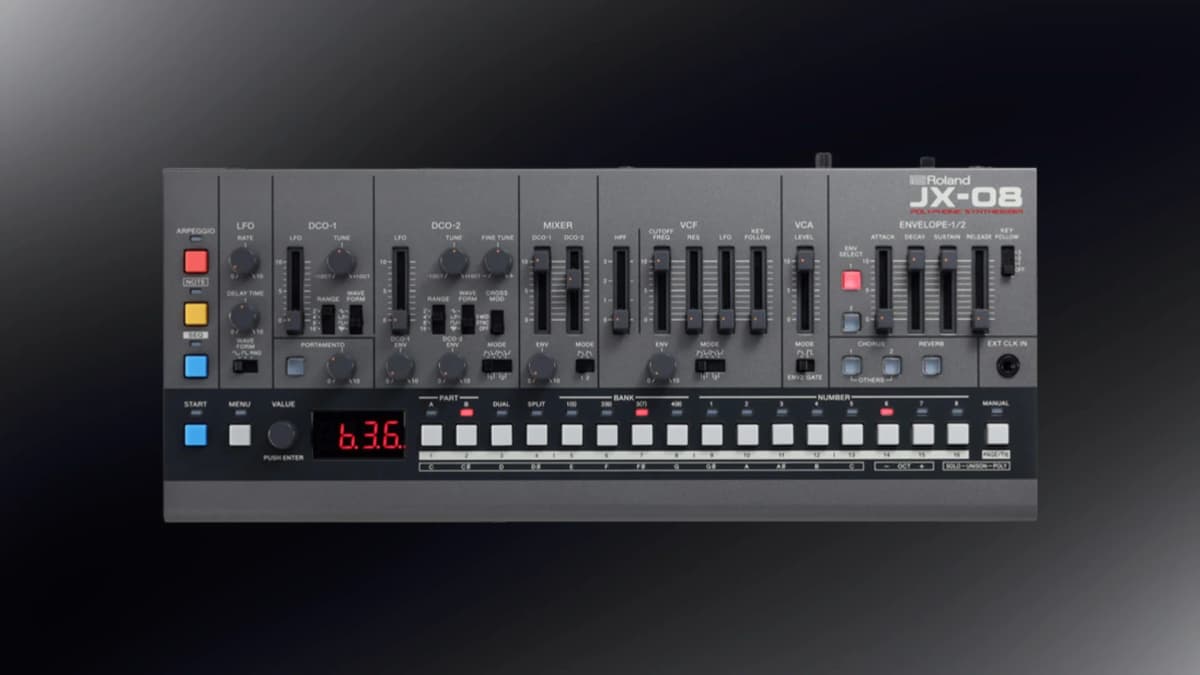
The Roland JX-08 is a compact desktop sound module in the Roland Boutique series that recreates the Roland JX-8P, the hybrid analog polysynth Roland released in 1985. Roland announced it on November 9, 2021, alongside the JD-08, and scheduled US availability for January 2022 at $399.99. Each voice follows the JX-8P layout of two oscillators with cross modulation, a high-pass and low-pass filter, two ADSR envelopes and one LFO, while the front panel borrows its sliders and knobs from the PG-800 programmer that was sold separately for the original. Polyphony rises from the JX-8P’s six voices to 20, and two independent parts can be split or layered, which reviewers noted brings the JX-08 closer to the dual-engine Super JX-10 than to the single JX-8P. A 64-step two-part sequencer, an arpeggiator, 17 effect types, battery power and a built-in speaker complete the package.
Table of Contents
Roland JX-08 sound and character
The JX-08 is built around the same simple voice that defined the JX-8P: two oscillators per voice, each with its own waveform, range and tuning controls, mixed into a filter section and shaped by envelopes and a single LFO. The waveforms are the basic analog shapes of the original, and the module keeps one of the JX-8P’s well-known omissions, the lack of pulse width modulation. Movement in the tone therefore comes mostly from oscillator detuning, the cross modulation section on the second oscillator, filter sweeps and the chorus rather than from evolving waveforms. Roland describes the result as authentic JX-8P sound and behavior, although its own pages do not name the modeling method. Sound On Sound’s Gordon Reid and Sonic State both identify it as Roland’s Analog Behavior Modeling (ABM) rather than the Analog Circuit Behavior (ACB) technology used in earlier Boutique modules.
That choice of engine shapes how the instrument is judged. Reid explains that ABM delivers more polyphony for a given processing load but captures fewer of the fine nuances that ACB targets, and he treats the JX-08 as an approximation built on Roland’s current platform rather than a dedicated circuit emulation. He is also critical of marketing that presents it as an exact recreation. Yet his listening tests found the oscillators sounding much like the originals across their waveforms, and he concluded that the JX-08 sounds great across the classic territory of strings, pads, brass, leads and basses. Bruce Aisher, reviewing it for MusicRadar, went further on one point: with the chorus switched off, he found the module very close to his own JX-10.
The filter is where the JX-08 departs most clearly from its source. A hidden parameter selects among three low-pass filter characters modeled on classic analog designs, which gives the module a wider range of timbres than the original. MusicRadar singled out a more Moog-like low-pass option among these extended settings. The high-pass filter, which on the JX-8P stepped through four fixed positions, is now a continuous slider. An extended-parameter mode stretches the LFO rate, cutoff range, resonance and envelope times, and Reid found that the enhanced resonance allows the filter to self-oscillate at high settings, although he found some of the extended ranges made little audible difference.
Cross modulation is a partial match. The original JX-8P offered three settings on its second oscillator, sync, cross modulation, and the two combined, while the JX-08 provides only sync and cross modulation as separate choices. Reid noted that the missing combined mode makes some of the original’s PWM-like timbres harder to program. Even so, Bruce MacPherson’s review for Mix highlighted cross modulation, the pitch envelope and layering as the module’s strongest sound-design tools, and he reported big filter sweeps, bell tones, basses and clock-synced arpeggios from patches built from scratch.
The effects finish the sound. Each part has its own multi-effect chosen from 17 types, including three chorus variations, among them a chorus modeled on the Roland Juno-106, followed by a shared reverb with room, hall and plate options. Aisher found that the stereo chorus adds warmth, and Sonic State’s review singled out the chorus as a highlight. Layering two parts, each with its own engine and effect, is what turns the JX-08 from a small JX-8P into something that recalls the larger Super JX: Reid credited the dual mode with lush pads and complex sounds that a single part cannot produce.
Features and architecture
- Manufacturer: Roland Corporation
- Year introduced: 2021 (announced November 9, 2021; US availability scheduled for January 2022)
- Production years: 2021 to present (Thomann lists it as available since December 2021; still listed by Roland and stocked new in October 2026)
- Synthesis type: Digital modeling of a hybrid analog subtractive synthesizer, using Roland’s Analog Behavior Modeling (ABM) according to reviewers
- Category: Desktop polyphonic sound module (Roland Boutique series)
- Polyphony: Up to 20 voices; 10 voices when two parts are layered in dual mode
- Multitimbrality: Two parts, playable in dual (layer) or split mode or on separate MIDI channels
- Original price: $399.99 (US); £349 including VAT (UK)
- Current market price: about $480 new in the US and about £313 new in the UK (October 2026); used units roughly $300–$340
- Oscillators: Two per voice (DCO-1 and DCO-2), each with waveform, range and tune controls; fine tune and cross modulation (sync or cross mod) on DCO-2; no pulse width modulation
- Filter: Continuous high-pass filter plus resonant low-pass filter with three selectable characters; key follow, envelope and LFO amounts
- LFO: One per part, with rate, delay time and waveform controls; routable to both oscillators and the filter
- Envelopes: Two ADSR envelopes, edited through one shared set of sliders with an envelope select switch
- Modulation system: Fixed routings for LFO and envelope amounts to the oscillators, mixer and filter; velocity response with three curves; aftertouch response over MIDI; portamento with several curves; no modulation matrix
- Sequencer / arpeggiator: Two-part, 64-step polyphonic sequencer with eight notes per part, motion recording and a random pattern generator; onboard arpeggiator; external clock input
- Effects: One multi-effect per part from 17 types (chorus, delay, phaser, pitch shifter, overdrive, fuzz, drive, bit crusher, lo-fi compressor, filter), followed by a shared reverb
- Memory: 256 patch slots (32 original JX-8P presets plus more than 100 new sounds) and 128 sequencer pattern slots; no performance memory
- Keyboard: None; the optional K-25m adds 25 velocity-sensitive mini keys, and the DK-01 dock is also available
- Inputs / outputs: Output, headphones, mix input and external clock input (all 3.5 mm mini jacks); built-in speaker
- MIDI / USB: Full-size MIDI In and Out; USB Type-C for audio and MIDI (requires Roland’s driver; not class compliant)
- Display: Four-character, seven-segment LED
- Dimensions / weight: 300 × 128 × 47 mm (11-13/16 × 5-1/16 × 1-7/8 in); 895 g (about 2 lb) including batteries
- Power: Four AA batteries (alkaline or NiMH, about six hours with 1,900 mAh NiMH cells) or USB bus power
Strengths
- Polyphony is generous for the format. Twenty voices is more than three times the original JX-8P and far beyond the four voices of the first Boutique modules, so pads and layered sounds rarely lose notes.
- Two parts open up Super JX territory. Split and dual modes, each part with its own engine and effect, let the module approach the stacked sounds of the JX-10 rather than only the single-layer JX-8P.
- The panel gives the JX-8P the controls it never had. Sliders and knobs derived from the PG-800 programmer replace the original’s single data slider and parameter menus, which makes the voice far quicker to program.
- The filter goes beyond the original. Three low-pass characters, a continuous high-pass slider and an extended range that allows self-oscillation widen the palette without changing the basic workflow.
- The sequencer is unusually capable for a Boutique. Two polyphonic tracks with motion recording, a random pattern generator, 128 pattern memories and an analog clock input make it usable as a self-contained sketching tool.
- It is genuinely portable. Battery power, a built-in speaker and a weight under 1 kg let it travel easily, a point Mix’s reviewer made after carrying it as hand luggage to a recording retreat.
- The effects are more than an afterthought. A Juno-106-style chorus, delays, drives and a shared reverb are available per part, and reviewers at MusicRadar and Mix described them favorably.
Limitations
- The controls are small and some are shared. MusicRadar found the knobs and sliders fiddly, and both envelopes are edited through one set of sliders, which slows detailed patch work.
- The emulation is not complete. The combined sync and cross modulation mode of the original is missing, there is no unison detune, and pulse width modulation remains absent, as it was on the JX-8P.
- The display and documentation are thin. A four-character LED readout makes deeper parameters hard to navigate, and Sound On Sound noted the absence of a full manual beyond online help, with some documented details incorrect.
- Memory management is basic. There is no performance memory for saving two-part setups as a unit, no software editor or librarian, and Sonic State noted that individual patches cannot be exported as files.
- Panel controls do not offer parameter pickup. Sonic State found that switching between parts can cause values to jump, because physical positions no longer match the stored settings.
- The USB implementation has caveats. The audio interface needs a driver supporting only macOS 10.14 and Windows 10 or later, and Sound On Sound heard a whine when USB and analog audio formed a loop.
- Connections are consumer-grade. All audio jacks are 3.5 mm mini sockets, so studio use usually requires adapter cables.
Historical context
The JX-8P arrived in 1985 as a six-voice synthesizer with two digitally controlled oscillators per voice, software-generated envelopes, high-pass and low-pass filtering, and a 61-note keyboard that responded to both velocity and aftertouch. Roland described it as a step forward in hybrid synthesis with “a compelling new analog-digital voice.” Its launch price was US$1,695 or £1,165. Programming relied on parameter selection and a single data slider, so Roland offered the PG-800 as an optional programmer with dedicated sliders for most parameters, connected through a proprietary six-pin cable. Used PG-800 units now often sell for more than the synthesizer itself, which helps explain why Roland chose to put PG-800-style controls on the Boutique version.