

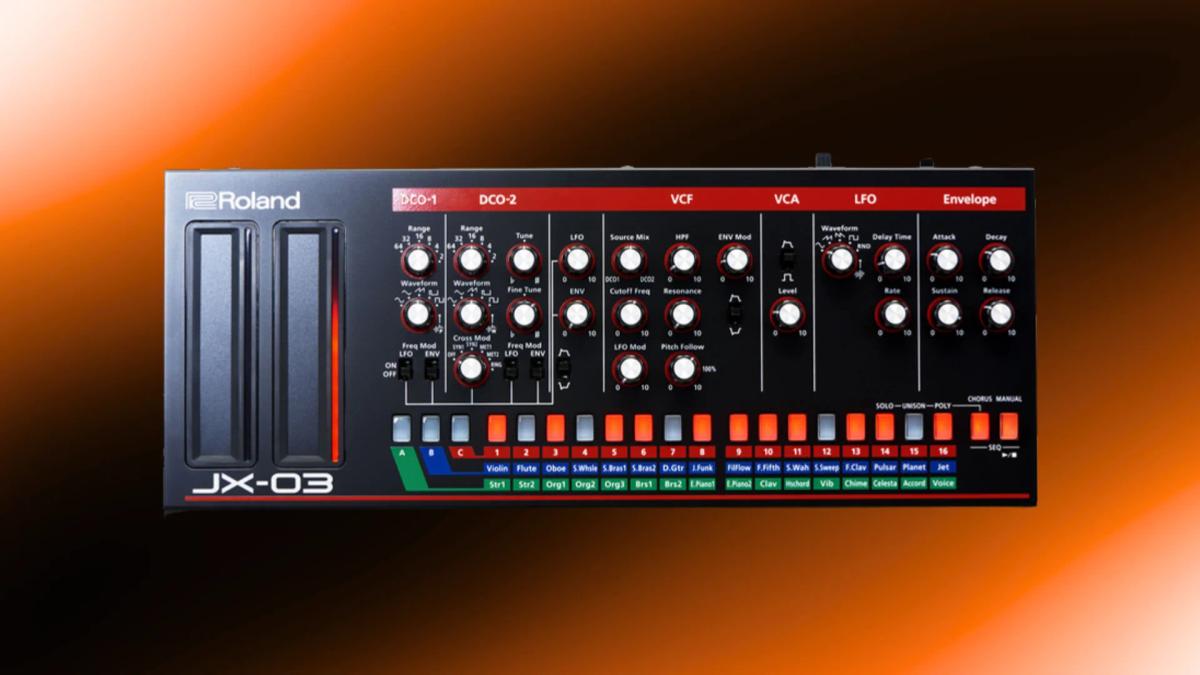
The Roland JX-03 is a compact four-voice sound module that recreates the 1983 Roland JX-3P together with the panel of its optional PG-200 programmer. Roland announced it on October 1, 2015, as one of the three launch models of the Boutique series, alongside the JP-08 and JU-06, and the first units went on sale in Japan on October 24, 2015. Its engine uses Analog Circuit Behavior (ACB), the modeling technology Roland first developed for the AIRA TR-8 and SYSTEM-1. Each voice has two DCOs, a high-pass and resonant low-pass filter, a VCA, an LFO, and an envelope, with chorus, delay, a 16-step sequencer, and a USB audio interface built in. What makes the JX-03 matter is the control layout: the original JX-3P was a preset-driven instrument whose deeper editing needed an extra box, while the JX-03 puts all 24 PG-200 knobs on its metal front panel.
Table of Contents
Roland JX-03 sound and character
The JX-03 aims at the JX-3P’s particular blend of clean, slightly glassy digitally controlled oscillators and a warm Roland filter. In his February 2016 Sound On Sound review of the first three Boutique modules, Gordon Reid compared the JX-03 directly with a JX-3P and found that many of the factory sounds were closely replicated. He heard the module as a little more open on some patches, and noted that its filter resonance was stronger, so settings copied from the original often needed to be backed off to match. MusicRadar’s Dan Goldman described the tone as warm and well defined, singling out the string and brass pads while also finding usable basses and cutting leads.
The filter is a large part of that character. MusicRadar traced it to the IR3109 design that Roland used across the SH-101, the Jupiter series, and the Juno-6 and Juno-60, and the Ask.Audio review by Darren Burgos likewise grouped it with the low-pass filters of the Juno-106 and Jupiter-8. Burgos found the single envelope fast enough for basses and stabs but smooth enough for strings, and called the result a near-perfect virtual analog emulation. A separate high-pass cutoff knob sits next to the low-pass section, which lets thin, airy pads be shaped without leaving the front panel.
Where the JX-03 departs from the JX-3P is in the oscillator palette. Reid listed the additions: sine and triangle waveforms, pink and white noise, extra 64′, 32′, and 2′ footages, and new cross-modulation modes labeled Sync1, Sync2, Metal1, Metal2, and ring modulation. He found the sine wave especially useful, but observed that Sync2 and Metal2 reverse the roles of carrier and modulator, which makes the modes harder to compare by ear. The LFO also gained ramp, sawtooth, and noise shapes. These extensions push the module toward metallic and clangorous timbres that the original could not reach, while the stock JX-3P waveforms remain available for faithful patches.
The chorus, a defining part of the original’s polish, needed attention. Reid found the default chorus noise far too loud on both the JX-03 and the JU-06, and discovered a poorly documented system setting that reduces or removes it; with the noise switched off, he preferred the module’s chorus to the JX-3P’s. A basic digital delay sits among the secondary functions. Reviewers broadly agreed that the delay is handy for auditioning a patch in context, but Reid saw little advantage over an external pedal because it does not follow MIDI clock.
Performance control is compact but complete. Two ribbon controllers handle pitch bend and modulation, and one can also trigger notes to preview a patch while editing. Peter Kirn’s CDM overview of the launch noted solo, unison, and polyphonic modes across the three modules, and the four voices can be doubled to eight by linking two JX-03 units over MIDI in Chain mode, with the first unit editing and controlling both. In practice the module suits pads, stabs, and basslines, while dense chord parts quickly run into the four-voice ceiling, a point that readers of CDM’s launch coverage raised at once.
Features and architecture
- Manufacturer: Roland Corporation
- Year introduced: 2015 (announced October 1, 2015; Japanese release October 24, 2015)
- Production years: 2015 to an undocumented end date; major retailers now list it as discontinued
- Synthesis type: Subtractive, digitally modeled analog using Roland’s Analog Circuit Behavior (ACB)
- Category: Desktop sound module (Roland Boutique series), dockable in the optional K-25m keyboard
- Polyphony: 4 voices; 8 voices with two units linked in Chain mode
- Multitimbrality: None (single part)
- Original price: About $299 street in the US and £229 in the UK at launch (MusicRadar quoted £239); open price in Japan
- Current market price: Used only; Reverb’s price guide sat near $208 in the US and £178 in the UK in October 2026, with many individual asks higher
- Oscillators: Two DCOs per voice with the JX-3P waveforms plus added sine, triangle, and pink and white noise; extended range including 64′, 32′, and 2′; DCO-2 tune, fine tune, and cross modulation (sync, metal, and ring modes); LFO and envelope pitch modulation switches
- Filter: High-pass filter plus resonant low-pass filter modeled on the IR3109-based original, with source mix, LFO modulation, pitch follow, and bipolar envelope modulation
- LFO: One LFO with rate and delay time; original waveforms plus ramp, sawtooth, and noise
- Envelopes: One ADSR envelope shared by the filter, the DCO pitch modulation switches, and the VCA (selected with the VCA mode switch)
- Modulation system: Fixed routings via panel switches and knobs; two ribbon controllers for pitch bend, modulation, and sound preview
- Sequencer / arpeggiator: 16-step monophonic sequencer with 16 patterns; no arpeggiator
- Effects: Chorus and digital delay
- Memory: 32 preset patches (banks A and B) and 16 user patches (bank C)
- Keyboard: None built in; optional K-25m 25-key velocity-sensitive mini keyboard
- Inputs / outputs: Input, output, and headphones on stereo 3.5 mm mini jacks; 0.5 W built-in speaker
- MIDI / USB: MIDI In and Out; USB Micro-B for MIDI, 24-bit/44.1 kHz stereo audio, and data backup; MIDI CC added in firmware 1.10
- Display: None listed in Roland’s specifications
- Dimensions / weight: 300 x 128 x 46 mm (11-13/16 x 5-1/16 x 1-13/16 in); 950 g (2 lb 2 oz)
- Power: Four AA batteries (alkaline or Ni-MH, about six hours with Ni-MH) or USB bus power; no DC input
Strengths
- The PG-200 panel is finally standard. On the original JX-3P the programmer was an optional extra that also blocked MIDI use, so putting all 24 knobs on the module turns a preset machine into an instrument that invites editing.
- The emulation is convincing. Sound On Sound found many JX-3P factory sounds closely matched, and Darren Burgos of Ask.Audio heard the module as nearly identical to the original.
- The oscillator section goes beyond the source. Sine and triangle waves, noise, wider footages, and extra cross-modulation modes give the JX-03 metallic and sync tones that a JX-3P cannot produce.
- It is genuinely portable. At 950 g with four AA batteries and a built-in speaker, the module can be programmed and played with no mains power or amplification.
- It integrates easily with a computer. A single USB cable carries power, MIDI, and 24-bit stereo audio, so the JX-03 can record into a DAW without a separate interface.
- Firmware support improved its MIDI. Version 1.10 in August 2016 added Control Change send and receive, addressing an early complaint that the knobs could not be recorded or automated.
Limitations
- Polyphony is lower than the original’s. The JX-03 plays four voices against the JX-3P’s six, so matching the original’s chord voicings requires a second module in Chain mode.
- User memory is small. With 16 user slots instead of the original’s 32, Reid saw a practical problem for stage use, and MusicRadar listed it as the main drawback.
- The sequencer is a step back. The JX-3P had a six-voice, 128-step sequencer, while the JX-03 offers a monophonic 16-step pattern sequencer, and reviewers disagreed on whether it follows external MIDI clock.
- Timing-based modulation does not sync. Ask.Audio noted that the LFO cannot lock to a DAW or internal tempo, and Sound On Sound found the same for the delay.
- The chorus is noisy by default. The hiss can be reduced through a system setting, but Reid found that fix poorly documented.
- The hardware is cramped and fragile in places. The knobs sit close together, the case behind the metal panel is plastic, and Reid questioned the stage durability of the 3.5 mm and micro-USB sockets.
Historical context
The JX-3P appeared in 1983 and was produced until 1985, selling for $1,395 in the US and £1,075 in the UK. It was a six-voice polysynth with two DCOs per voice, a resonant low-pass filter, a stereo chorus, and a 128-step polyphonic sequencer, and it was among Roland’s first instruments with MIDI, alongside the Jupiter-6. Its front panel was built around preset buttons. Detailed sound editing relied on the PG-200, an optional programmer with dedicated knobs and switches that connected through a proprietary port and could not be used at the same time as MIDI. The full hands-on experience that the architecture allowed therefore depended on buying a second unit.