

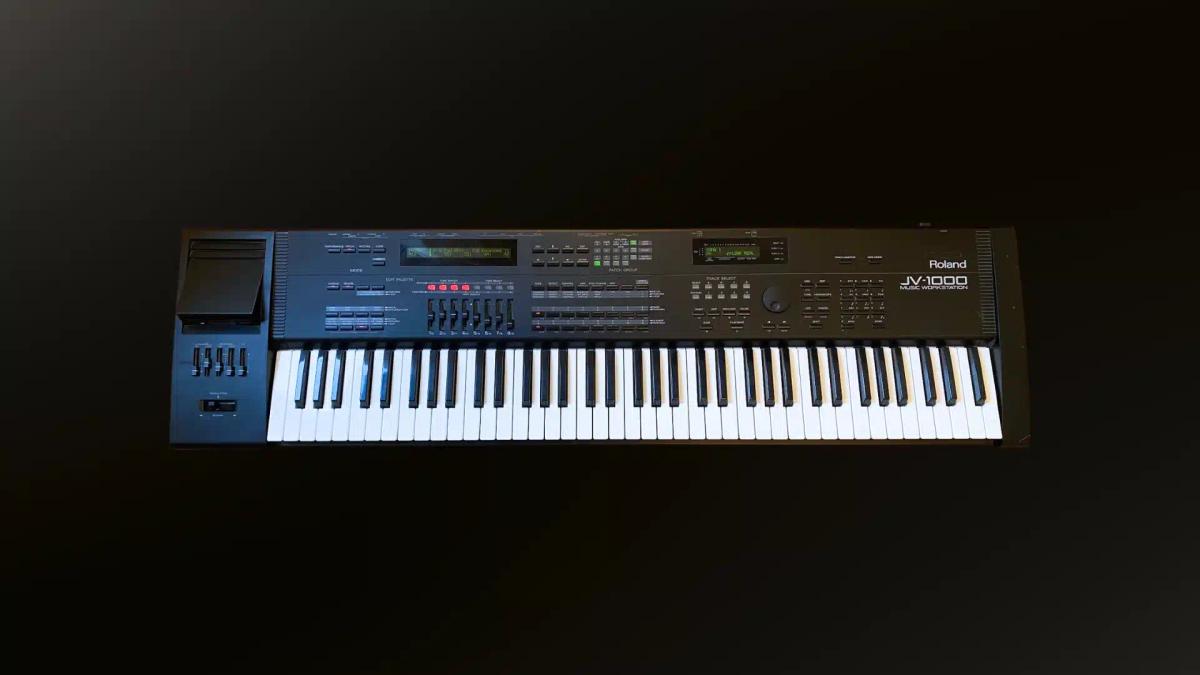
The Roland JV-1000 is a 76-key multitimbral keyboard workstation that Roland introduced in 1993 and built until about 1995. It combined the sound engine of the JV-80, the Roland JV-1000 that opened Roland’s JV era, with a sequencer derived from the stand-alone MC-50 MkII, and gave each half its own panel, display and MIDI output. The Roland JV-1000 side offers 28 voices of PCM-based FXM synthesis from a 4MB waveform ROM, while the sequencer records eight multichannel tracks plus rhythm and tempo tracks to a 3.5-inch floppy drive. Roland’s own anniversary history calls it the company’s first mainstream workstation, and that is the reason it matters: it was Roland’s real answer to the Korg M1 generation, arriving late but built around a proven sequencer.
Table of Contents
Roland JV-1000 sound and character
The Roland JV-1000 sounds like a JV-80 with a few useful additions, which is to say polished, wide and slightly hi-fi in the early 1990s Roland manner. Its 152 waveforms include the JV-80 set plus 22 new ones, among them a new sampled grand piano and extra drum and percussion samples, including a jazz kit. Sound On Sound’s Derek Johnson described the sound as big, sophisticated and rich, with a punchy bottom end, and singled out pianos, pads and strings. Music Technology’s Simon Trask reached a similar conclusion and summed it up as a great pianos and pads instrument, praising its ensemble strings, bright pads, tuned percussion and acoustic guitars.
The engine is subtractive at heart. A patch layers or splits up to four Tones, each with its own waveform, a time-variant filter that can run as low-pass or high-pass with resonance, an amplifier, multi-stage envelopes for pitch, filter and level, and two LFOs. FXM, Roland’s frequency cross modulation, lets one waveform modulate another to roughen or brighten the source, and it is the main route to anything harsher than the factory sounds. Pan key follow and velocity-switched layers add movement across a stereo image.
The weak spots are the ones reviewers heard in 1993. Trask found the basses powerful but lacking warmth, and electric guitars, brass and synth leads less convincing; Johnson thought the instrument a little too polite and said genuine dirt took work with FXM and extreme filter settings. The effects are limited to chorus and reverb, so the sound depends on the samples and layering more than on processing. Heard today, the Roland JV-1000 sits firmly in the clean, sample-based digital camp, closer to the session keyboards of the period than to the analog revival that was beginning around the same time.
Features and architecture
- Manufacturer: Roland Corporation, Japan
- Year introduced: 1993; Sound On Sound and Music Technology reviewed it in mid and late 1993
- Production years: 1993 to 1995 according to Roland’s support documentation
- Synthesis type: PCM sample playback with subtractive filtering and FXM (frequency cross modulation)
- Category: multitimbral keyboard workstation (synth, effects and sequencer in one instrument)
- Polyphony: 28 voices, falling to as few as 7 notes with four-Tone patches; 56 voices with the optional VE-GS1 V-EXP board
- Multitimbrality: 7 parts plus a rhythm part; up to 24 parts with the V-EXP board fitted
- Original price: $2,795 list in the United States according to soundprogramming.net; £1,859 in Sound On Sound’s review and £2,140 in Music Technology’s
- Current market price: typically around $400 to $700 used, based on Reverb’s listings, a current eBay listing near $580 and a serviced unit offered at $695
- Oscillators: up to four Tones per patch drawn from 152 waveforms in 4MB of ROM (Sound On Sound describes it as compressed, equivalent to 8MB of 16-bit samples)
- Filter: time-variant filter (TVF) per Tone, low-pass or high-pass, with resonance and key follow
- LFOs: two per Tone
- Envelopes: separate multi-stage envelopes for pitch, filter and amplifier on each Tone
- Modulation system: FXM, velocity and key follow on most parameters, aftertouch, two assignable pedals and an assignable slider that can transmit MIDI controllers
- Controllers: eight Edit Palette sliders for Tone levels and real-time editing, a pitch bend/modulation lever, plus hold and two assignable pedal inputs
- Sequencer / arpeggiator: MC-50 MkII-derived sequencer with 8 multichannel phrase tracks, a pattern-based rhythm track and a tempo track; 96 ppqn; 8 internal songs and about 40,000 notes; no arpeggiator
- Effects: reverb/delay (8 types) and chorus (3 types), in series or parallel
- Memory: 64 user patches, 16 user performances and 1 user rhythm set; Roland’s specification lists 384 preset patches, 96 preset performances and 6 rhythm sets, a total that includes the inherited JV-80 banks
- Storage: 3.5-inch double-density floppy drive for the sequencer, reading and writing Standard MIDI Files; M-256E RAM card for synth data
- Expansion: one SR-JV80 wave expansion board, one SO-PCM1 series PCM card slot, a data card slot and a bay for the VE-GS1 GS-format board; wave memory up to 14MB
- Keyboard: 76 semi-weighted keys with velocity (attack and release) and channel aftertouch
- Inputs / outputs: main stereo pair and a second stereo pair for the V-EXP board, headphones, hold and two assignable pedal inputs, sequencer start/stop and punch in/out jacks, metronome out, Tape Sync II in and out
- MIDI / USB: MIDI In, Out, Thru and a separate Sequencer Out; 8-zone controller mode; no USB
- Display: two backlit LCDs, 2 x 40 characters for the Roland JV-1000 and 2 x 20 characters for the sequencer
- Dimensions / weight: 1232 x 348 x 97 mm; 13.5 kg (29 lb 12 oz)
- Power: internal power supply; about 29 W consumption
Strengths
- The sequencer is a real hardware sequencer, not an afterthought. It descends from the MC-50 MkII, has its own transport, display and MIDI output, and reviewers considered it one of the strongest built-in sequencers of its day.
- The split between synth and sequencer sections is unusually clear. Each half has its own LCD and controls, so editing a sound while a song plays, or controlling other gear from the keyboard, is easier than on single-screen workstations.
- The 76-key keyboard with velocity and aftertouch gives more range than the 61-key JV-80, and both magazine reviewers and later owners rated it highly for playing.
- Pianos, strings, pads and tuned percussion remain usable. The JV-80 core was well voiced, and the Roland JV-1000 adds a better acoustic piano and more drums.
- Expansion is generous for 1993. A wave expansion board, PCM cards and the GS-format V-EXP board could turn it into a 56-voice, 24-part system for General MIDI and GS song files.
- Its separate Sequencer Out, Tape Sync II jacks and Standard MIDI File support made it practical as the center of a small MIDI studio or a live backing rig.
Limitations
- Twenty-eight voices disappear quickly. Four-Tone patches can reduce the count to seven notes, so dense multitimbral songs need careful voice management or the V-EXP board.
- There is no sampling or user sample RAM, which Sound On Sound already saw as a missed opportunity in 1993.
- The floppy drive belongs to the sequencer. Saving synth patches to disk requires a SysEx dump first, and synth data otherwise lives in internal memory or on an M-256E card.
- Effects are limited to reverb and chorus, without the multi-effects that rival workstations offered, and only one stereo pair is available without the optional board.
- User memory is small: 64 patches, 16 performances and one user rhythm set, with presets that cannot be overwritten. Trask called the 16 performance memories a real shame.
- The 720KB double-density drive is now a maintenance item; old drives and belts fail, and double-density disks are increasingly hard to find.
- At 13.5 kg and more than 1.2 meters wide, it is a large instrument for what the sound engine offers compared with later JV and XP models.
Historical context
Roland came to the workstation format later than its rivals. Korg’s M1 had defined the category in 1988, and by 1993 Korg’s 01/W Pro and Pro X and Yamaha’s SY99 were established; Trask framed the Roland JV-1000 as Roland’s late move into that market. Roland already had the parts. The JV-80, launched in 1992, had introduced the JV synth architecture, and the MC-50 MkII was a respected stand-alone sequencer. The Roland JV-1000 joined them in one chassis and added 22 waveforms, while the related JV-90, also from 1993, offered the same 76-key synth without the sequencer.
Sound On Sound reviewed it in July 1993 and Music Technology in October 1993. Johnson concluded that Roland had succeeded again and praised the elegance of the implementation, the keyboard and the sequencer, while regretting the lack of sample RAM and adventurous sounds. Trask was less enthusiastic about its originality, describing it as a seasoned performer rather than a fresh new face, but found it accessible and reasonably good value. The optional VE-GS1 board and SR-JV80 expansion boards extended its life as Roland’s library grew.