

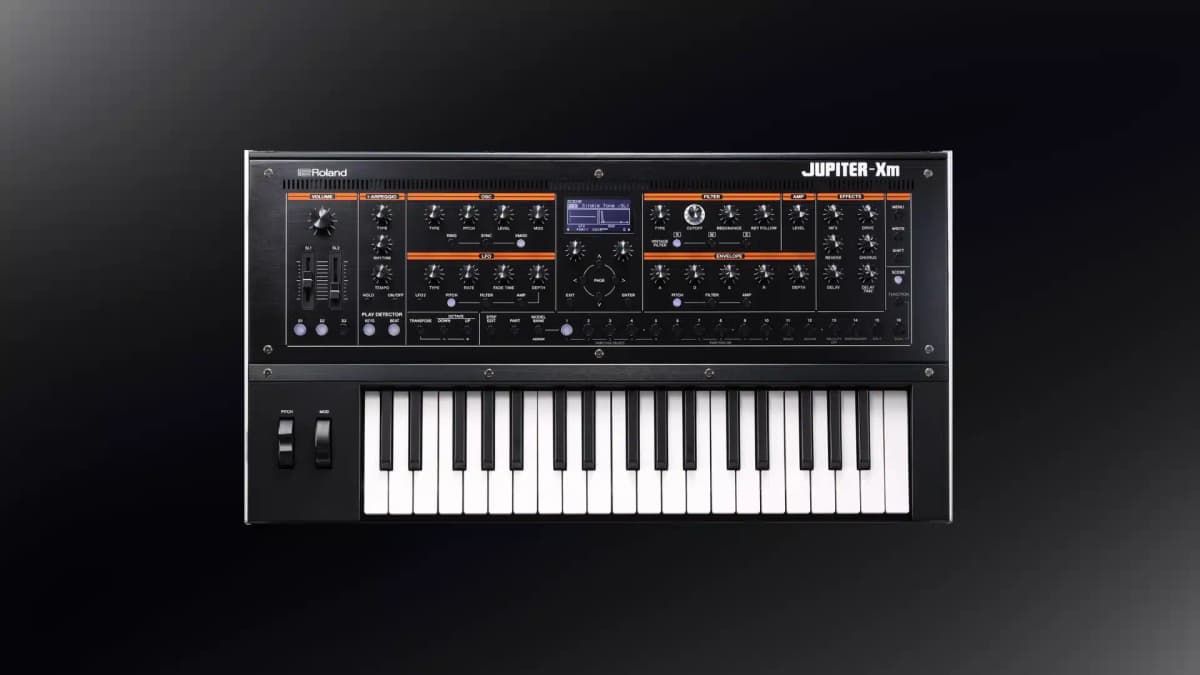
The Roland Jupiter-Xm is a compact digital synthesizer that Roland announced on September 5, 2019, alongside the larger Jupiter-X, and shipped that same month, several months ahead of its big sibling. It runs the same ZEN-Core engine, with Analog Behavior Modeling recreations of the Jupiter-8, Juno-106, JX-8P and SH-101, PCM sounds drawn from the XV-5080 and RD pianos, Roland drum machines, a vocoder and the I-Arpeggio pattern generator, across five parts. What sets it apart is the package: 37 slim keys, a metal panel, built-in speakers, Bluetooth audio and MIDI, and the option of running on eight AA batteries. It is essentially Roland’s back catalog in a box that fits under one arm.
Table of Contents
Roland Jupiter-Xm sound and character
Because the Roland Jupiter-Xm shares its engine with the Jupiter-X, it sounds the same. MusicTech put it plainly in its joint review: the Xm will sound identical to the full-size model. Sound On Sound’s Gordon Reid, reviewing the pair, described the Xm as the same synthesizer in different clothes. The character is therefore that of Roland’s ZEN-Core platform at its most analog-minded: the Jupiter model gives broad, bright brass and pads with a strong low end, the Juno model delivers the chorused, slightly hollow polysynth tone the Juno-106 is known for, and the JX model leans toward glassy, thinner digital-era textures.
The models are digital recreations rather than circuit-level ones. Attack Magazine noted that Roland’s Analog Behavior Modeling is less detailed than the Analog Circuit Behavior used in its Boutique and System-8 instruments, but lighter on processing, which is what allows up to 256 voices of ZEN-Core polyphony and generous layering; the analog models themselves are limited to 32 voices. Reviewers were broadly positive. Gordon Reid found that the engines did not always sound exactly like their inspirations but always sounded excellent, and Bonedo praised the quality of the classic sounds. The weak spot most often cited is the SH-101 model: MusicTech pointed out that it lacks sync and cross modulation, and GreatSynthesizers found no preset that really resembled the original.
Beyond the analog models, the Xm is a broad sound module. The XV-5080 bank supplies thousands of PCM tones, from acoustic instruments to vintage digital pads, alongside RD-series pianos and TR-808, TR-909 and CR-78 drum sounds. A vocoder fed from the rear microphone input covers robot voices and choirs. The filter section adds three vintage filter characters labeled R, M and S, which Roland and Polynominal associate with Roland, Moog and Sequential designs. Some of the PCM content now sounds dated, a point GreatSynthesizers made about the shared library.
Where it sits is clear: a modern, clean digital instrument with an analog-flavored front end, warmer and fuller through monitors than its spec sheet might suggest. Its built-in speakers are a convenience for practice and sketching, not a showcase. MusicTech said the speakers do not flatter the sound, Bonedo called the 2 x 4 W system weak, and Attack Magazine was a little kinder, finding them better than expected.
Features and architecture
- Manufacturer: Roland Corporation
- Year introduced: 2019; announced September 5, 2019, with availability that month, ahead of the 61-key Jupiter-X
- Production years: 2019 to present; still sold new by major US and European retailers in October 2026
- Synthesis type: digital; ZEN-Core engine combining Analog Behavior Modeling (ABM) synth models with PCM sample playback
- Category: compact, portable multitimbral synthesizer with built-in speakers
- Polyphony: up to 256 voices with ZEN-Core tones; the analog models are limited to 32 voices
- Multitimbrality: five parts per Scene (four synth parts and one drum part), usable as layers, splits or independent parts
- Original price: $1,499.99 in the United States; UK prices at launch were quoted between £1,199 (Sound On Sound) and £1,319 (MusicRadar, Attack, MusicTech)
- Current market price: US list now $1,919.99 at Sweetwater and other major dealers; Reverb’s recommended used price sits around $1,258
- Oscillators: model-dependent; Jupiter-8, Juno-106, JX-8P and SH-101 models, ZEN-Core PCM tones with up to four partials, and since version 3.0 a four-oscillator Jupiter-X model with seven waveform types
- Filter: modeled filters with cutoff, resonance and key follow, including three vintage types labeled R, M and S
- LFOs: per-tone LFOs, with layout and depth depending on the selected model
- Envelopes: per-tone filter, amp and pitch envelopes, structured to follow each modeled original
- Modulation system: model-specific panel controls plus ZEN-Core modulation, two assignable sliders and three assignable switches
- Sequencer / arpeggiator: I-Arpeggio multi-part arpeggiator that detects playing and generates patterns across five parts; version 3.0 added per-part step sequencer mode and note probability
- Effects: multi-effects with 90 types, part EQ, overdrive, reverb, chorus and delay, a microphone noise suppressor and compressor, master EQ and compressor
- Vocoder: built in, driven from the rear microphone input
- Memory: more than 4,000 preset tones and 90-plus drum kits; 256 user tones and 256 Scenes at launch, doubled to 512 each by version 3.0
- Keyboard: 37 slim velocity-sensitive keys; no aftertouch from the keybed, although aftertouch is received over MIDI; pitch and modulation wheels
- Inputs / outputs: 1/4-inch and XLR main outputs, front mini and rear 1/4-inch headphone jacks, combo XLR/1/4-inch mic input, stereo mini aux input, hold and control pedal jacks
- MIDI / USB: MIDI In and Out; USB computer port carrying MIDI and multichannel audio; USB memory port; Bluetooth 4.2 for audio streaming and MIDI
- Speakers: 2 x 4 W amplifier driving two full-range speakers and two tweeters
- Display: 128 x 64 dot graphic LCD
- Dimensions / weight: 576 x 308 x 93 mm; 4.4 kg without adaptor or batteries
- Power: 12 V DC adaptor (included) or eight AA Ni-MH batteries
Strengths
- It is genuinely portable. At 4.4 kg, with speakers and battery power, it can be played on a sofa, in a hotel room or on a train without any other equipment.
- It sounds the same as the full Jupiter-X. Reviewers agreed that the engine is shared, so the smaller instrument does not trade sound quality for size.
- The range of sounds is wide. Analog models, XV-5080 PCM tones, RD pianos and classic Roland drum kits make it a self-contained sketching and backing-track instrument.
- The five-part Scene structure is practical for live use. Layers, splits and a drum part can be stored together and recalled in one move.
- It works well as a computer instrument. USB audio and MIDI with separate part streams let it record into a DAW without an audio interface, a point Attack Magazine singled out.
- Roland kept developing it. Free updates added Roland Cloud Connect support, a new Jupiter-X model, step sequencing, probability and doubled user memory, which kept the Roland Jupiter-Xm current years after release.
Limitations
- The keyboard is the obvious compromise. Three octaves of slim keys without aftertouch make chordal playing and expressive leads awkward, as MusicTech, MusicRadar and Bonedo all noted.
- Editing depends on menus. The small LCD and long parameter lists slow down deep work, and early reviewers wished for a dedicated editor until Roland supplied one.
- Panel controls do not always do something. Because the controls follow each modeled original, some knobs are inactive on certain models, which reviewers found confusing.
- The SH-101 model is the weakest of the analog emulations, lacking features such as sync and cross modulation.
- The built-in speakers are only adequate. They suit practice, but they do not convey the Roland Jupiter-Xm’s bass or stereo image.
- It is expensive for a mini-key instrument, a complaint that has grown louder since US list prices rose to around $1,920.
- Sound On Sound criticized the shared Jupiter-X platform for terse documentation and a panel that transmits SysEx rather than standard MIDI CCs.
Historical context
The Roland Jupiter-Xm came out of Roland’s move to a single sound platform. ZEN-Core, launched in 2019, was designed to run across new hardware such as the Fantom workstations and MC-707 and MC-101 grooveboxes as well as software, so that tones could move between instruments. Roland used its 909 Day event on September 5, 2019 to announce the new Fantom range together with the Jupiter-X line. The flagship Jupiter-X, with 61 keys and aftertouch, was presented as the heir to the Jupiter-8, while the Xm was the compact sibling.
The Xm reached stores first, in September 2019 at $1,499.99, while the Jupiter-X followed in the United States in April 2020 at $2,499.99. Roland pitched the Xm as a complete production and performance environment, with I-Arpeggio, an arpeggiator co-developed with Meiji University according to Attack Magazine, as its headline idea. Early firmware drew criticism for interface quirks, and MusicRadar’s November 2019 review noted that it was sometimes unclear what a knob was controlling under OS 1.01.