

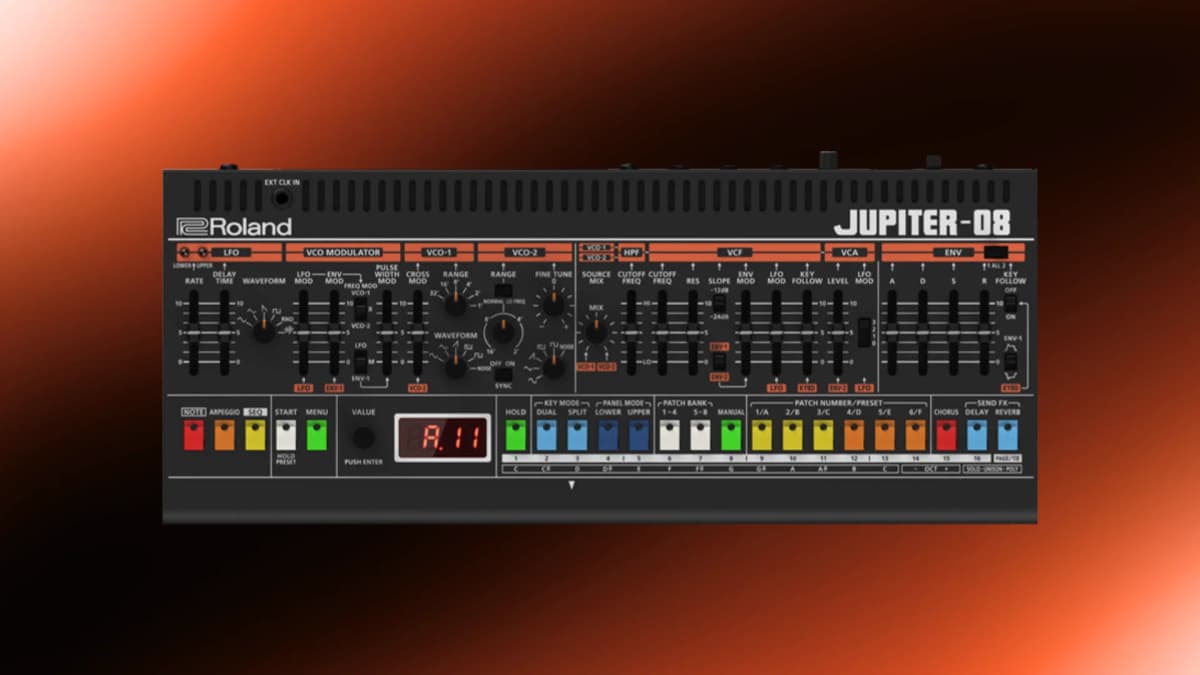
The Roland Jupiter-08 is a compact digital polysynth in the Roland Boutique series, announced on October 20, 2026, to mark 45 years since the Roland Jupiter-8 first appeared in 1981. Roland styles the name in capitals as JUPITER-08, and it is a different instrument from the four-voice JP-08 Boutique module of 2015. Instead of the ACB circuit modeling used in that earlier unit, the new model runs on Roland’s ABM (Analog Behavior Modeling) engine, which Roland says leaves enough processing headroom for far more voices. By default it follows the original’s eight-voice layout with two parts, Upper and Lower, for split and layered sounds, and it can be expanded internally to 32 voices. It adds a two-part 64-step polyphonic sequencer, an arpeggiator, a 17-type multi-effects section with dedicated delay and reverb, USB-C audio, and battery power. It is also the first Boutique sold only as a bundle with the K-25m keyboard dock.
Table of Contents
Roland Jupiter-08 sound and character
Because the Jupiter-08 was announced and reviewed on the same day, judgments about its sound rest on a small number of early hands-on tests and on Roland’s own demonstrations, not on months of studio use. Those first reports agree on the basic point: the instrument aims squarely at the classic Jupiter-8 vocabulary of wide string machines, slow pads, brassy polyphonic stabs and round, sync-driven basses, and it lands close to that target. Lasse Eilers, testing a pre-release unit for Gearnews, found it most convincing in exactly those categories, while noting that it did not quite give him the physical thrill of an original instrument with sixteen oscillators sounding at once.
Matthias Sauer at the German site Bonedo went further, suggesting that in a blind comparison many listeners would struggle to tell the Jupiter-08 from a vintage Jupiter-8. He still found the original fatter and more cutting, with a silkier top end, and he noticed a slight built-in oscillator drift that seemed intended to add an analog feel. That drift ties into one of the new model’s more distinctive ideas, a Condition control that sets how worn the virtual instrument behaves. Sonicstate’s launch report describes it as reaching all the way to aging artifacts such as dead notes, so the player can choose anything from a factory-fresh unit to a tired one.
The palette is broader than the original’s. Sonicstate and Gearnews both report that the two oscillators now share a full set of waveforms, including sine and noise, and that the ranges extend to 32-foot and 1-foot settings. The LFO gains extra shapes, including a chaos option, and Sonicstate mentions additional filter models and wider filter and LFO ranges. The familiar cross-modulation and sync controls remain on the panel, so the clangorous, metallic edge that the Jupiter-8 could produce is still part of the character.
Effects play a bigger role than on any earlier Boutique Jupiter. Alongside a dedicated delay and a five-type reverb with a shimmer mode, a multi-effects slot offers 17 types, among them three chorus variants, distortion, a bit crusher, phasers and pitch shifters. Sauer found the effects more useful than he expected, though he sometimes had to adjust chorus and reverb by hand. The factory library of 240 patches includes the original Jupiter-8 presets according to Sonicstate, while Sauer felt that some of the newer sounds were dated and undersold the engine. One expressive gap matters for playing feel: both reviewers report that the sound engine does not respond to velocity, which limits dynamic control from the bundled keyboard.
Features and architecture
- Manufacturer: Roland Corporation
- Year introduced: 2026 (announced October 20, 2026)
- Production years: 2026–present (launched October 2026 and listed as available at launch)
- Synthesis type: Virtual analog subtractive synthesis using Roland’s ABM (Analog Behavior Modeling) digital engine
- Category: Compact polyphonic synthesizer in the Roland Boutique series, supplied with a detachable 25-key keyboard dock
- Polyphony: Eight voices in the default original-style mode; expandable internally to a maximum of 32 voices
- Multitimbrality: Two parts (Upper and Lower), used in Dual (layer) and Split modes; mono, poly and unison voice modes
- Original price: US$549.99 including the K-25m; £589 at UK retail (Sonicstate lists a £592 RRP); €689 at Thomann (Sonicstate lists a €699 RRP)
- Current market price: Unchanged from launch, since the instrument went on sale in October 2026; no used market exists yet
- Oscillators: Two VCOs per voice with a shared full waveform set (including sine and noise), ranges extended to 32-foot and 1-foot, cross-mod on VCO-1, sync and fine tune on VCO-2, a source mix control, and a modulator section for LFO, envelope and pulse-width modulation
- Filter: Resonant low-pass VCF with switchable 12 dB and 24 dB slopes, envelope and LFO modulation and key follow, plus a non-resonant high-pass filter; Sonicstate reports additional filter models
- LFO: One LFO with rate, delay time and waveform controls, including added triangle and chaos shapes; Gearnews reports no clock sync
- Envelopes: Two ADSR envelopes (filter and amplifier) edited through one shared set of sliders with an envelope select switch, key follow and envelope-1 polarity
- Modulation system: Fixed panel routing in the style of the original, with VCO, VCF and VCA modulation controls and a Condition parameter for simulated component aging; aftertouch is received, velocity is not used by the engine
- Sequencer / arpeggiator: Two-part, 64-step polyphonic sequencer with up to eight notes per step per part and motion recording; arpeggiator; Hold function
- Effects: Multi-effects with 17 types (three chorus, four delay, overdrive, fuzz, drive, bit crusher, lo-fi compressor, two phaser, filter, two pitch shifter), plus a dedicated delay and a dedicated reverb with five types including shimmer
- Memory: 240 patches and 96 sequencer patterns; Bonedo notes there are no performance memories
- Keyboard: Bundled K-25m 25-key mini keyboard dock (velocity-sensing) with silver side panels specific to this model; optional DK-01 Boutique Dock sold separately
- Inputs / outputs: Stereo 3.5 mm headphone and main outputs, stereo 3.5 mm mix input, mono 3.5 mm external clock input, built-in speaker; no trigger output
- MIDI / USB: 5-pin MIDI In and Out; USB-C for MIDI and audio, with separate USB audio streams for the main mix, each part and the external input according to Sonicstate; a Roland driver is required (Windows 11, macOS Sonoma 14 or later); panel controls send MIDI CC
- Display: Four-character, seven-segment LED
- Dimensions / weight: 308 × 209 × 54 mm (12-1/8 × 8-1/4 × 2-1/8 in); 1.6 kg (3 lb 9 oz) including the K-25m and batteries
- Power: Four AA batteries (alkaline or Ni-MH) or USB bus power over USB-C; 500 mA draw; about six hours of use on 1,900 mAh Ni-MH cells
Strengths
- Polyphony is no longer a bottleneck. The jump from the JP-08’s four voices to as many as 32 means full chords, long releases and layered parts no longer require chaining a second unit.
- The two-part design is genuinely usable. Upper and Lower parts with Dual and Split modes recreate the original’s layering workflow with enough voices to make it practical, something early reviewers singled out.
- The core Jupiter character is convincing. Both early hands-on reviewers judged the strings, pads, brass and basses close to the original, with Bonedo suggesting a blind test would be difficult.
- The sequencer is a major upgrade. A two-part, 64-step polyphonic sequencer with eight notes per step and motion recording replaces the JP-08’s 16-step, single-track design.
- The Condition control adds a new kind of realism. Being able to dial in drift and even failing voices gives the player control over how vintage the instrument behaves instead of fixing one degree of imperfection.
- It is a complete, portable instrument out of the box. The bundled K-25m, built-in speaker, battery operation and USB-C audio interface mean it can be played, recorded and carried without extra purchases.
Limitations
- The engine ignores velocity. Gearnews and Bonedo both report no velocity response, even over MIDI, although the bundled keyboard sends velocity and the sequencer stores it.
- Menu editing is awkward. Deeper parameters sit behind a four-character LED display with abbreviated names, and Gearnews found the PDF manual often necessary.
- Some expected details are missing. Gearnews notes that unison has no detune control and the LFO cannot sync to clock, and Bonedo points out the lack of performance memories.
- The USB connection needs a driver. Roland supplies drivers for Windows 11 and recent macOS versions, but class-compliant operation without installation is not offered, according to Gearnews.
- The price is high by Boutique standards. At US$549.99 it costs well above earlier Boutique modules, and the keyboard bundle cannot be skipped by buyers who already own a controller.
- The physical format is small. Short sliders, tiny knobs and mini keys that Gearnews described as rattly make it less comfortable to play than full-size instruments.
- Integration with hardware setups is limited. CDM’s Peter Kirn noted the absence of a trigger output, so analog drum machines and modular systems need another clock or trigger source.
Historical context
The original Jupiter-8 arrived in 1981 as Roland’s flagship analog polysynth, with eight voices, two VCOs per voice, a 12/24 dB resonant low-pass filter, a separate high-pass filter, and a split keyboard that could assign different patches to two zones. It sold for about $5,295 in the United States and remained in production until 1985, with around 3,300 units made. Bonedo notes that used originals now sell for five-figure sums, and Roland has returned to the design several times since.