

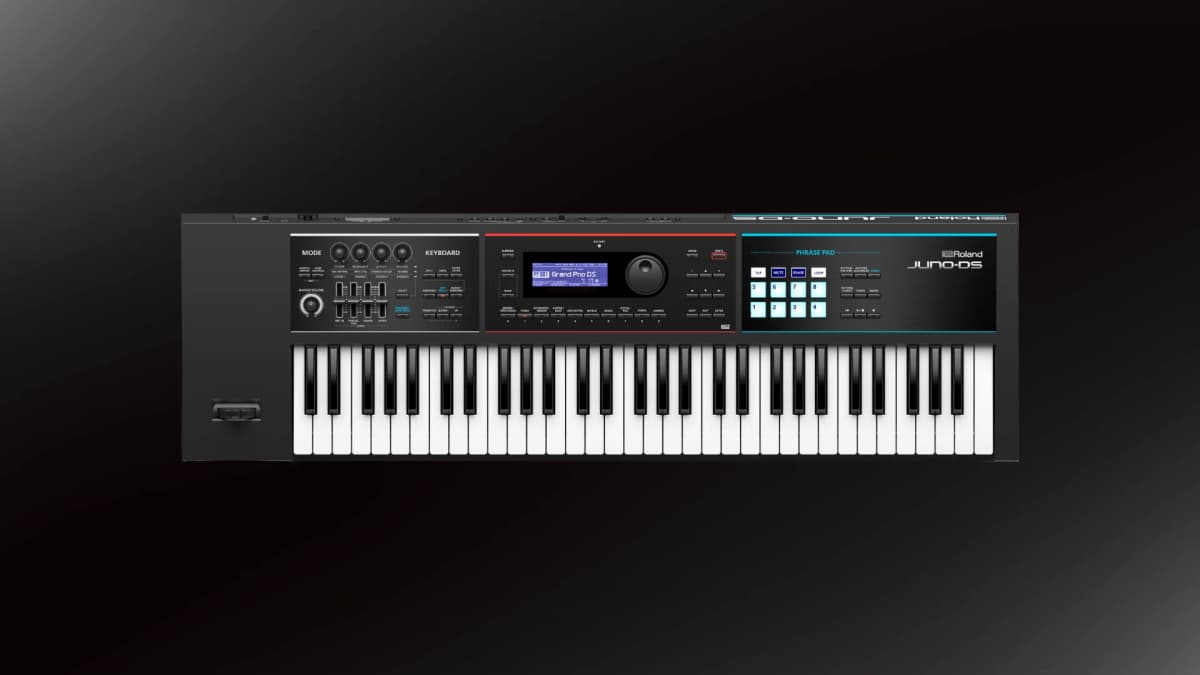
The Roland Juno-DS is a family of lightweight digital performance keyboards that Roland introduced in September 2015 with the 61-key Juno-DS61 and the weighted 88-key Juno-DS88, adding the 76-key Juno-DS76 in September 2018. All three share a 128-voice, 16-part PCM sound engine that carries over the complete Juno-Di sound set with updated pianos and organs, plus a wave expansion slot, WAV sample import, eight phrase pads, an eight-track pattern sequencer, a microphone input with vocoder and Auto Pitch, and optional battery power. It matters less as a synthesizer for sound designers than as a working musician’s keyboard: for nine years it was Roland’s affordable, portable answer for cover bands, church musicians, students and players who needed many usable sounds in one light instrument.
Table of Contents
Roland Juno-DS sound and character
The Roland Juno-DS sounds like what it is: a broad, practical ROMpler voiced for the stage. Its library of more than 1,200 presets spans acoustic and electric pianos, organs, strings, brass, guitars, world instruments, drum kits and synth patches, sorted into categories that can be reached from the front panel. Roland’s emphasis at launch was on the updated acoustic and electric pianos and the additional organs, the sounds a band keyboardist calls up most often.
Reviews have been more measured than the marketing. Bonedo’s Christian Frentzen found the piano selection large but only average in quality, with sample loops audible in the decay, and noted that quality varies across the other categories, so browsing is worthwhile. The Wave Expansion slot is the main way to raise the ceiling: it is rewritable internal waveform memory that holds one of Roland’s free EXP libraries at a time, with the EXP-06 Studio Collection preloaded, and Frentzen singled out the Electric Piano Collection as a clear improvement. Users can also import their own WAV files and play them from the keys.
The synth patches are clean and functional rather than characterful. The engine is entirely digital, and as both FACT and Bonedo pointed out, the Roland Juno-DS has little in common with the analog Juno-6, Juno-60 or Juno-106 beyond the name. Knobs and sliders allow quick real-time edits, but the instrument is built for selecting, layering and splitting sounds rather than deep programming.
Where it stands out is the vocal section. The microphone input offers eight dedicated reverb types, Auto Pitch for the stepped, pitch-corrected effect popular in pop and hip hop, and a vocoder that Bonedo described as excellent. Combined with the effects (three multi-effects processors with 80 types, plus chorus and reverb), it gives the Roland Juno-DS a modern, clean and slightly generic sound that is dependable on stage more than distinctive on record.
Features and architecture
- Manufacturer: Roland Corporation, Japan
- Year introduced: 2015 for the Juno-DS61 and Juno-DS88 (announced September 15 and 16, 2015, shipping from October); 2018 for the Juno-DS76 (announced September 13, 2018)
- Production years: 2015 to 2024; the Juno-D6, D7 and D8 replaced the line in September 2024, though dealer stock remained on sale afterwards
- Synthesis type: digital sample-based (PCM) subtractive synthesis with user sample import
- Category: portable performance keyboard and synthesizer, often described as an entry-level workstation
- Models covered: Juno-DS61 (61 synth-action keys), Juno-DS76 (76 synth-action keys), Juno-DS88 (88 weighted Ivory Feel-G keys); limited Juno-DS61W white and Juno-DS61B black editions
- Polyphony: 128 voices
- Multitimbrality: 16 parts
- Original price: about $700 street for the DS61 and about $1,000 for the DS88 at launch (Synthtopia); £549 and £799 in the UK; €819 and €1,199 list in Germany
- Current market price: Equipboard tracked new DS61 prices from $799.99 near the end of its run; used DS61 units around $470 on Reverb, with used DS88s listed around €700
- Oscillators: PCM waveform ROM carrying the full Juno-Di sound set plus new piano and organ waves; one rewritable Wave Expansion slot loaded with Roland EXP libraries; WAV import
- Filter: digital, per tone; front-panel knobs and sliders for real-time sound editing
- Memory: more than 1,200 preset patches, 30-plus drum kits and 64 performances; 256 user patches, 8 user drum kits, 128 user performances and 100 favorites
- Sequencer / arpeggiator: 8-track pattern sequencer with loops of 1, 2, 4 or 8 bars and non-stop loop recording; 128 preset arpeggios; 30 groups of rhythm patterns
- Pads: 8 multicolor phrase pads for rhythm patterns, sequencer patterns and sample or audio playback from USB
- Effects: 3 multi-effects (80 types), 3 chorus types, 5 reverb types, plus 8 reverb types on the mic input
- Vocal functions: mic input with vocoder and Auto Pitch
- Keyboard: velocity-sensitive; synth action on the DS61 and DS76 (the DS76 with slightly longer keys), Ivory Feel-G progressive hammer action on the DS88
- Inputs / outputs: L/mono and R outputs, headphones, 1/4-inch mic input, external input, hold and control pedal jacks
- MIDI / USB: MIDI In and Out; USB computer port with audio/MIDI interface and DAW Control mode; USB memory port
- Display: 256 x 80 dot graphic LCD
- Dimensions / weight: DS61 1,008 x 300 x 97 mm and 5.3 kg; DS76 6.9 kg; DS88 about 16.2 kg according to Bonedo
- Power: 9V DC adapter or eight AA NiMH rechargeable batteries (about five hours with 1,900 mAh cells, according to Roland’s specifications)
Strengths
- The DS61 and DS76 are unusually light for full-size keyboards. At 5.3 kg and 6.9 kg, they can be carried in one hand to a rehearsal or gig, which was the core of Roland’s pitch for the line.
- Battery operation is rare at this size and price. Eight AA rechargeable cells give around five hours of playing, useful for street performance, school use and venues with awkward power.
- The sound library covers almost any cover-band request. More than 1,200 presets, with pianos, organs, strings and synths reachable by category, mean little time spent programming between songs.
- The vocal tools are genuinely useful. A mic input with dedicated reverb, Auto Pitch and a well-regarded vocoder lets a keyboardist add vocal effects without extra hardware.
- It is expandable for free. The Wave Expansion slot and Roland’s EXP libraries, plus WAV import, let owners upgrade core sounds such as electric pianos or load their own samples.
- USB audio and MIDI with a DAW Control mode make it a practical studio controller and audio interface when it comes off the stage.
Limitations
- The core sounds were already dated at launch. The engine carried over the Juno-Di library of 2009, and Bonedo found the pianos only average, with audible sample loops.
- Only one expansion library can be loaded at a time, so switching between, for example, an electric piano collection and an orchestral set means reloading the slot.
- Construction is light because it is mostly plastic; Bonedo described the housing as feeling cheap and scratching easily.
- The DS88’s Ivory Feel-G action felt somewhat heavy and sluggish to Bonedo’s reviewer, with simulated escapement that was barely perceptible.
- The built-in rhythm patterns are fixed and, in Bonedo’s view, dated and uninspired, and they cannot be edited.
- Programming depth is modest and the menu structure is not always clear; reviewers mentioned a learning curve and a sparse manual.
- The synth-action keyboards on the DS61 and DS76 are unweighted, which limits them for piano-focused players, while the weighted DS88 gives up much of the portability that defines the series.
Historical context
The Roland Juno-DS belongs to the digital Juno line that Roland launched in 2005 with the Juno-D, reviving the name of its 1980s analog polysynths for a range of affordable PCM keyboards. The Juno-D was followed by models including the Juno-G and the Juno-Di of 2009, which MusicRadar described as a budget, portable workhorse with 128-voice polyphony, more than 1,200 presets, battery power, a mic input and a vocoder. The Roland Juno-DS refined that formula rather than replacing it: FACT and Synthtopia both reported that the new models included every Juno-Di sound, plus updated pianos and organs.
Roland announced the Juno-DS61 and Juno-DS88 in mid-September 2015 as gig-ready performance keyboards, with availability from October. The DS88 brought fully weighted keys to the series; FACT described it as the first Roland Juno synth with fully weighted keys. New features compared with the Juno-Di included the Wave Expansion slot, WAV import, phrase pads, the eight-track pattern sequencer and USB audio. In September 2018 Roland added the Juno-DS76, with slightly longer synth-action keys and a weight of 6.9 kg, aimed at players who split sounds between two hands. A white Juno-DS61W was sold in Japan, and in December 2019 Gearnews reported a limited all-black Juno-DS61B edition alongside an FA-06 Black Edition.