

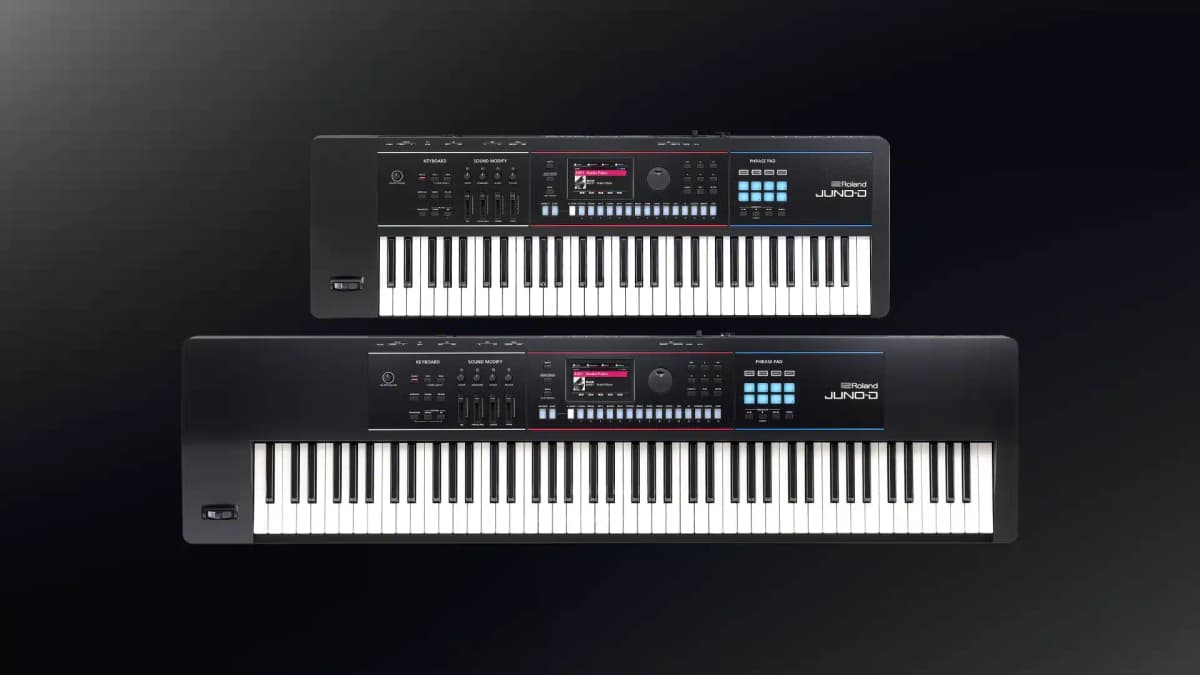
The Roland Juno-D6, Juno-D7 and Juno-D8 are a family of performance synthesizers that Roland announced on September 24, 2024, as successors to the long-running Juno-DS. All three share one instrument: the ZEN-Core sound engine with more than 3,800 tones, eight parts, an eight-track pattern sequencer with phrase pads, WAV sample import, a microphone input with vocoder and vocal effects, and a class-compliant USB-C audio and MIDI interface. They differ only in their keyboards: 61 and 76 synth-action keys on the D6 and D7, and an 88-key PHA-4 hammer action on the D8. What makes them matter is less a new sound than a new price point for Roland’s current engine, aimed squarely at working players who need a light keyboard that covers every song on the set list.
Table of Contents
Roland Juno-D sound and character
The Roland Juno-D line sounds like a modern Roland workstation in miniature, because that is essentially what it is. ZEN-Core, which Roland introduced in January 2020 across the Fantom, Jupiter-X and RD-88, combines sample-based waveforms with virtual analog oscillators, modeled filters and Roland’s DSP effects. On the Roland Juno-D that engine is presented as a library rather than a synthesizer to be programmed from scratch: pianos, electric pianos, organs, strings, brass, pads, synth leads and basses, orchestral and world instruments, plus more than 95 drum kits, sorted under 16 category buttons on the front panel.
The character is clean, polished and mix-ready rather than raw. Acoustic and electric pianos, pads and string sections are the core of what owners praise in retailer reviews, and the synth patches lean on Roland’s own history, with Juno-style brass and supersaw leads among the familiar flavors. Effects carry much of the sound: each of the eight parts has its own multi-effect drawn from 93 types, there is a further insertion effect, separate chorus and reverb, part EQ and compressors for drum parts. The result is that presets arrive already finished, which is exactly the point for a player switching sounds between songs.
The limits are equally clear. Editing on the panel centers on four Sound Modify knobs and four sliders for cutoff, resonance, envelope and level-style adjustments, while deeper tone editing is buried in menus. Some owners report digital artifacts on certain patches, and one user upgrading from the Juno-DS noted that a few favorite tones from the older model had not carried over.
It sits firmly on the modern, digital, practical end of the spectrum. Players who want analog drift or deep synthesis will look elsewhere in Roland’s range, including the Juno-X covered separately on this site; players who need a convincing piano, a usable organ and a big pad within one light chassis are who the Roland Juno-D was designed for.
Features and architecture
- Manufacturer: Roland Corporation
- Year introduced: 2024; announced September 24, 2024, and shipping from the same month
- Production years: 2024 to present; current Roland products as of October 2026
- Synthesis type: ZEN-Core (sample-based PCM combined with virtual analog modeling) with user WAV sample import
- Category: performance synthesizer and compact stage keyboard
- Polyphony: Roland’s own specification pages do not list a figure; retailer listings at Thomann and Reverb give 128 voices
- Multitimbrality: 8 parts, with Dual, Split and Super Layer modes and 16 sound-category buttons
- Original price: $899.99 (D6), $1,149.99 (D7) and $1,299.99 (D8) in the United States at launch; €949, €1,049 and €1,299 in Europe
- Current market price: Sweetwater lists the D6 at $999.99 and the D8 at $1,469.99, while Kraft Music lists the D7 at $1,299.99
- Sounds: more than 3,800 tones and more than 95 drum kits; expandable with EXZ Series expansions and Roland Cloud Sound Packs and Wave Expansions
- Oscillators: ZEN-Core waveforms (PCM samples and virtual analog types) per tone
- Filter: ZEN-Core modeled filters, with cutoff and resonance available from the front panel
- LFOs and envelopes: per-tone ZEN-Core LFOs and envelopes, edited in menus; panel knobs give quick access to the main envelope and filter settings
- Sequencer / arpeggiator: eight-track pattern sequencer per scene with up to 64 steps, realtime, step and TR-REC recording, eight phrase pads for patterns, samples, audio files and track mutes; arpeggiator, chord memory and rhythm patterns
- Effects: multi-effects on 8 parts (93 types), 1 insertion effect (93 types), 10 chorus types, 8 reverb types, part EQ, 6 drum-part compressors and system EQ
- Vocal processing: microphone input with noise suppressor, compressor, EQ, 8 mic reverb types, auto pitch and a 13-band mono vocoder
- Memory: scenes in 2 preset banks of 128, 128 user scenes and 128 favorites, with Scene Remain for smooth switching; USB flash drive for storage
- Keyboard: D6, 61 synth-action keys with velocity; D7, 76 synth-action keys with velocity, the same keybed family as the Fantom-0; D8, 88-key PHA-4 Standard with escapement and Ivory Feel; no aftertouch on any model
- Controllers: pitch bend and modulation lever, 4 Sound Modify knobs, 4 sliders, 8 pads
- Inputs / outputs: balanced 1/4-inch TRS main outputs, headphone jack, combo XLR and 1/4-inch mic input, stereo mini-jack external input, Hold and Control pedal jacks
- MIDI / USB: 5-pin MIDI In and Out; USB-C class-compliant audio and MIDI interface (24-bit/96kHz according to Thomann’s listing); USB-A port for flash drives
- Display: color LCD, 480 x 272 dots, backlit
- Dimensions / weight: D6, 1,005 x 324 x 94 mm and 5.8 kg; D7, 1,217 x 324 x 94 mm and 6.8 kg; D8, 1,393 x 355 x 138 mm and 14.5 kg
- Power: PSB-5U AC adaptor or USB-C bus power, including a USB-C mobile battery; no internal battery
Strengths
- It puts Roland’s current engine in an affordable, light body. The same ZEN-Core family that drives the Fantom and Jupiter-X powers the Roland Juno-D, which gives a working player modern pianos, pads and synths for well under the price of a flagship.
- Portability is real. The D6 weighs 5.8 kg and the D7 6.8 kg, and all three can run from a USB-C power bank, which suits rehearsals, small venues, church gigs and street performance.
- The panel is built for finding sounds fast. Sixteen category buttons, favorites and scenes with Scene Remain make it quick to move between songs without menu diving.
- It does more than play presets. The eight-track sequencer, phrase pads, rhythm patterns, audio file playback and sample import let one keyboard handle backing tracks and simple song sketches.
- The vocal section is unusually complete for the class. A combo mic input with compression, EQ, reverb, auto pitch and a vocoder means a singer-keyboardist can run a basic vocal chain without extra hardware.
- Three key counts, one instrument. Because the feature set is identical, players choose purely by keyboard: compact 61, the extended 76, or the PHA-4 88 for piano-heavy work.
Limitations
- There is no aftertouch on any model, a point raised by commentators at launch and a real limitation for expressive synth and string playing.
- Deep sound design is not its strength. Four knobs and four sliders cover the essentials, but detailed tone editing sits in menus, and owners who program their own sounds describe it as limited compared with a Fantom or Juno-X.
- The sequencer is capped at 64 steps per pattern, which suits loops and backing figures but not long through-composed parts, as one Thomann reviewer pointed out.
- Expansion depends partly on Roland Cloud. Sound Packs and Wave Expansions require a subscription or lifetime key, and the series accepts EXZ expansions but not the larger models’ expansion formats.
- Owners of the D8 have reported a few hardware quibbles, including a flexing plastic chassis, rattling buttons, a mic gain control with a very narrow usable range, and pads that feel less dependable than the Juno-DS’s.
- Some Juno-DS users miss specific tones from the older instrument, and the shift from the DS’s scene layout has divided players who knew it well.
- US prices have risen since launch, narrowing the gap to Roland’s larger instruments.
Historical context
The Roland Juno-D name is a revival. Roland first used it in 2005 for a slim, 61-key PCM synthesizer with 64-voice polyphony, a D-Beam controller and a large arpeggiator, priced at £399 in the UK. Sound On Sound’s Paul Nagle judged it a solid, good-value all-rounder with roots in Roland’s PCM range, while noting that the Juno name, borrowed from the analog Juno-6, Juno-60 and Juno-106, set the wrong expectations. The digital Juno line continued with the Juno-G (2006), Juno-Di (2009), Juno-Gi (2010) and the Juno-DS, which arrived in late 2015 as the DS61 and DS88, priced at £549 and £799, with battery operation. A 76-key DS76 followed in September 2018.
By the 2020s the Juno-DS was running an older PCM generation while the rest of Roland’s range moved to ZEN-Core: the Fantom workstations, the Jupiter-X, the RD-88, the MC grooveboxes and, in 2022, the Juno-X. The Juno-D6, D7 and D8 closed that gap. Announced on September 24, 2024, they took their keybeds from the Fantom-0 series and their engine from the shared ZEN-Core platform, and Synth Anatomy described the series as the replacement for the 2015 Juno-DS line.