

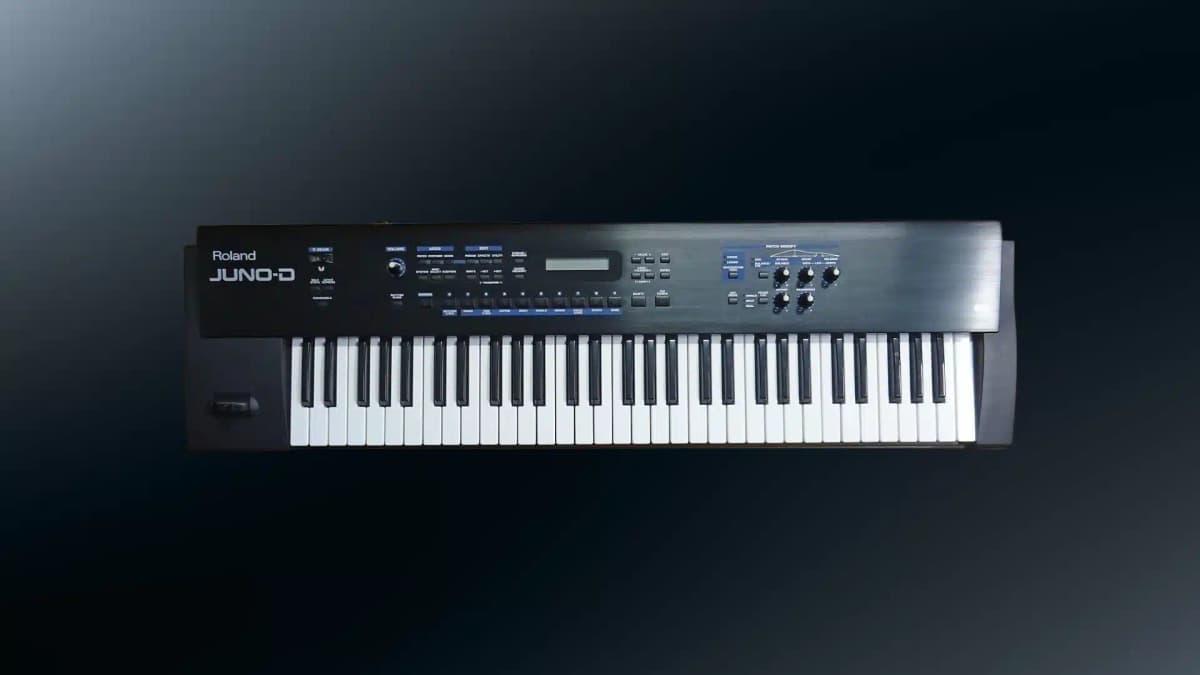
The Roland Juno-D is a 61-key PCM synthesizer that Roland announced at Summer NAMM in July 2004 at £399, shipping from the autumn of that year and reaching most reviews and listings in 2005. It is a preset-oriented sample-playback instrument with 64-voice polyphony, 16-part multitimbrality, 32MB of waveform memory, 768 patches including a General MIDI 2 set, an arpeggiator, chord memory, 47 multi-effect types and Roland’s infrared D-Beam controller, all in a 5 kg aluminum-panel case. It has nothing in common with the analog Junos of the 1980s except the name. That name is why it matters: the Roland Juno-D restarted the Juno brand as Roland’s affordable gigging synth line, a role it still holds two decades later.
Table of Contents
Roland Juno-D sound and character
The Roland Juno-D sounds like what it is: a compact, well-chosen slice of Roland’s PCM library from the early 2000s. Sound On Sound’s Paul Nagle placed it within Roland’s RS range of PCM keyboards and compared it to the RS-9, rather than to any Juno, and its 640 tones in 32MB of memory cover pianos, electric pianos, organs, strings, brass, guitars, basses, drums and a selection of synth sounds. The result is clean, bright and immediately usable, with the polished, slightly glossy finish of Roland’s sample-based instruments of the period.
The strongest material is in the keyboard staples. Nagle liked the electric pianos and a respectable Mellotron flute, while finding the Mellotron strings lifeless and the 303-style basses merely serviceable. Owners on zZounds most often praise the electric pianos, organs and strings, but several found the grand piano thin through small speakers. A Sweetwater reviewer singled out the 808 and 909 drum sounds, especially the 909 kick, which hints at the instrument’s dance-friendly side.
Synthesis depth is deliberately shallow. Each patch uses one or two tones, layered or split, and real-time editing runs through five knobs for envelope, filter cutoff and resonance, and modulation depth and rate. That is enough to open a filter, soften an attack or add movement, but not to build sounds from the ground up. Much of the character comes from the effects, whose delays Nagle singled out, and from the arpeggiator, which turns static presets into rhythmic parts.
In context, the Roland Juno-D sits on the modern, clinical side of the line. It does not attempt the chorus-washed analog warmth of the Juno-60 or Juno-106, and comparisons on those terms do it no favors. Judged as a light, affordable PCM keyboard for covers, worship, schools and home studios, it is consistent and dependable.
Features and architecture
- Manufacturer: Roland Corporation
- Year introduced: 2004; announced at Summer NAMM in July 2004 with UK availability expected in September or October, though many references, including Vintage Synth Explorer and Wikipedia, date it to 2005
- Production years: about 2004 to 2007 according to Reverb and Equipboard product data; a Juno-D Limited Edition followed, dated 2007 by Audiofanzine
- Synthesis type: PCM sample playback with basic subtractive editing
- Category: entry-level 61-key performance synthesizer
- Polyphony: 64 voices
- Multitimbrality: 16 parts, with a Voice Reserve function to protect key parts from note stealing
- Original price: £399 including VAT in the UK; a US list price was not confirmed in the sources consulted
- Current market price: Sweetwater’s Gear Exchange guide shows a used range of $260 to $385, and Reverb’s price guide suggests about $471
- Oscillators: one or two tones per patch, layered or split, drawn from 640 tones in 32MB of waveform memory (64MB and 686 tones on the Limited Edition)
- Filter: resonant filter per tone, with cutoff and resonance on front-panel knobs
- LFOs: per-tone LFO, with depth and rate available from a front-panel knob
- Envelopes: attack, decay and release adjustable from the panel
- Modulation system: pitch/modulation lever, D-Beam, two pedal inputs and the five real-time knobs
- Sequencer / arpeggiator: no sequencer; arpeggiator with 82 styles (473 with variations) and phrase templates organized by sound category, plus eight user templates; Rhythm Guide with 32 preset drum patterns and tap tempo
- Chord memory: Multi Chord with 16 preset and 8 user sets, each assigning a chord of up to eight notes to a key
- Effects: 47 multi-effect types, 8 reverb types and 8 chorus types
- Memory: 768 patches (384 Roland Juno-D originals, 256 General MIDI 2, 128 user), 22 rhythm sets (two user), 40 performances (eight user)
- Keyboard: 61 full-size velocity-sensitive keys, no aftertouch
- Controllers: D-Beam with Solo Synth, Active Expression and Assignable modes; pitch/modulation lever; five knobs; hold and control pedal jacks
- Inputs / outputs: stereo main outputs (L/Mono and R), headphones
- MIDI / USB: MIDI In and Out, no MIDI Thru; Roland’s specification lists no USB port, although Wikipedia mentions USB
- Display: 20-character, two-line backlit LCD; editor and librarian software for Mac and PC supplied on CD-ROM
- Dimensions / weight: 1,021 x 292 x 103 mm; 5.0 kg
- Power: external 9V DC adapter
Strengths
- It is light and easy to carry. At 5 kg with a metal panel and full-size keys, it suited players who needed a reliable second keyboard or a single board for small gigs.
- Finding sounds is fast. Ten category buttons covering 38 categories put pianos, organs, strings or basses one press away, which Roland’s own promotion and several user reviews highlighted.
- The arpeggiator and chord memory go well beyond what the price suggests. Sound On Sound called the arpeggiator powerful, and its templates are matched to sound categories so that patterns suit the patch.
- The effects are of genuinely high quality for an entry instrument, with tempo-based delays that Sound On Sound picked out by name.
- Voice Reserve and 16-part multitimbrality make it a capable General MIDI 2 sound source for sequencing and backing tracks.
- Value was its main appeal at launch, and remains so today: used units sell for a few hundred dollars.
Limitations
- There is no aftertouch, which Sound On Sound found disappointing on a performance-oriented keyboard.
- Programming is shallow. Five knobs cover the basics, but deeper editing is limited, and changes to a patch also affect every performance that uses it.
- User storage is small, with only eight user performances and two user rhythm sets.
- The D-Beam is hard to control in some modes: in Active Expression and Assignable modes the sound drops to zero when the hand leaves the beam unless the setting is reversed.
- There is no sequencer, sampler or audio input, so it cannot record or build songs on its own.
- It uses an external power supply, and some owners on zZounds reported key and contact failures, with one noting that Roland covered a known fault on early units.
- The Juno name sets expectations the instrument was never designed to meet, a point both Sound On Sound and Vintage Synth Explorer made.
Historical context
By the early 2000s the Juno name had been dormant since the analog Juno line of the 1980s, while Roland’s affordable keyboards were sold under functional labels such as the RS series of PCM synths. The Roland Juno-D, announced at Summer NAMM in July 2004, applied the old name to a new idea: a straightforward, light PCM synth for working musicians, with the look of a modern synth rather than an arranger keyboard. Wikipedia notes a visual nod to the Juno-106 and ties the instrument both to Roland’s RS keyboards and to technology from the Fantom-X range of the same period.
Sound On Sound reviewed it in March 2005 at £399, calling it a solid all-rounder with synthesis about as uncomplicated as anything the reviewer had encountered, and suggesting that the Juno name got it off on the wrong foot. Its market was beginners, young bands and budget gigging players. In 2006 Roland extended the name upward with the Juno-G, which added a deeper engine, a sequencer and audio recording, and Wikipedia notes that the two models were sold side by side rather than one replacing the other.