

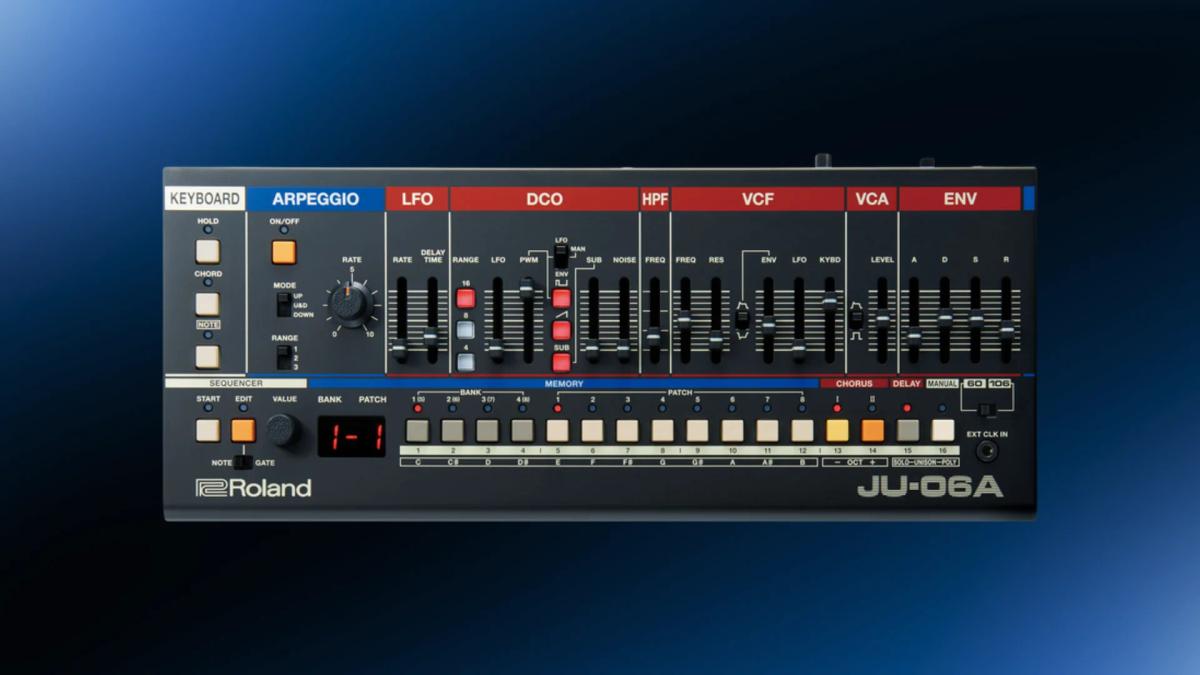
The Roland JU-06A is a compact digital synthesizer module in Roland’s Boutique series that recreates two of the company’s best-known 1980s polysynths, the Juno-60 and the Juno-106, in a single four-voice unit. Roland announced it on September 5, 2019, as the successor to the 2015 JU-06, with U.S. availability that month at $399.99. Its engine uses Roland’s Analog Circuit Behavior (ACB) modeling, and a front-panel switch moves the voice between Juno-60 and Juno-106 behavior, each mode with its own bank of 64 patches. The classic Juno signal path is all present: one DCO per voice with sub-oscillator and noise, a continuous high-pass filter, a resonant low-pass filter, a single envelope, an LFO, and the two-button chorus. Around that core Roland added a Juno-60-style arpeggiator, chord memory, a 16-step sequencer, a delay, and an external clock input, all in a battery-powered box with a built-in speaker.
Table of Contents
Roland JU-06A sound and character
The JU-06A sounds like a Juno because it is built around the same small set of ingredients that defined the originals. Each voice has one digitally controlled oscillator offering square and sawtooth waves, a sub-oscillator one octave down, and a noise source, all mixed before a high-pass and a low-pass filter. That simplicity is the point. The Juno sound comes less from oscillator complexity than from the interaction between pulse-width modulation, a smooth resonant filter, and the chorus that widens everything after it. In his MusicRadar review, Si Truss described the result as richer and fuller than most virtual analog instruments, while noting that differences from the originals can be argued over, particularly in the higher frequencies.
The 60/106 switch is the feature that separates the JU-06A from its predecessor. According to MusicRadar, the switch changes filter and envelope behavior, giving punchier tones in Juno-60 mode and a fuller, more open character in Juno-106 mode. Roland describes the two modes as carrying the distinct filter behavior of each instrument. Jono Buchanan, reviewing the module for MusicTech, found that the switch could be flipped mid-sequence or during a held arpeggio, which makes the comparison immediate rather than theoretical. Readers who want the background on how the two vintage instruments differ can find it in our Juno-60 vs Juno-106 comparison.
Pulse-width modulation carries much of the instrument’s character. The PWM slider works in three modes, set by a switch: manual pulse width, LFO-driven modulation, or modulation that follows the envelope. That last option comes from the Juno-60 and was absent from the original JU-06. Buchanan pointed out that envelope-driven PWM keeps moving through a note’s release. Rich Tozzoli, writing for Mix in 2020, heard LFO-driven PWM as something close to a slightly detuned two-oscillator polysynth, useful for strings and pads, and used envelope PWM to make plucked basses that grew richer as they decayed. He also built every part of one track on the unit, drums included, by blending oscillator and noise through the high- and low-pass filters.
The chorus finishes the sound. Two buttons recall the original Juno’s chorus switches, and MusicTech counted three chorus modes in all. Roland also modeled the hiss that came with the original effect. The owner’s manual offers three chorus noise settings: off, half level, and the original Juno noise, which is the default. Tozzoli leaned on the chorus to thicken and smooth patches. A delay, which MusicTech described as a new addition, sits next to it with adjustable level, time, and feedback. The JU-06A therefore covers the expected Juno territory of warm pads, round basses, bright brass, and simple leads, rather than aggressive or complex timbres. Its limits are those of the originals: one oscillator per voice and a single ADSR envelope, so the filter and amplifier cannot be given independently shaped contours.
Features and architecture
- Manufacturer: Roland Corporation
- Year introduced: 2019 (announced September 5, 2019; U.S. availability the same month)
- Production years: 2019 to present (still sold new as of October 2026)
- Synthesis type: Digital circuit modeling (Roland ACB, Analog Circuit Behavior) of subtractive Juno-60 and Juno-106 voices
- Category: Compact desktop sound module (Roland Boutique series)
- Polyphony: 4 voices; more with two or more units linked in Chain mode over MIDI
- Multitimbrality: None (single part)
- Original price: $399.99 (U.S.); about £349 to £351 in the UK, depending on source
- Current market price: About $480 new in the U.S. and £339 in the UK (October 2026); used units roughly $430 to $450
- Oscillators: One DCO per voice with range buttons (16′, 8′, 4′), square and sawtooth waveform buttons, sub-oscillator and noise level sliders, and a PWM slider with a three-way mode switch (manual, LFO, envelope)
- Filter: Continuously variable high-pass filter; resonant low-pass filter with cutoff, resonance, envelope amount (with polarity switch), LFO amount, and key follow; filter behavior changes with the 60/106 sound mode switch
- LFO: One LFO with rate and delay time sliders; seven waveforms selectable in the settings (triangle, square, two sawtooth variants, sine, two random types); optional key trigger
- Envelopes: One ADSR envelope; the VCA has a switch that sets its control source, plus a level slider
- Modulation system: Fixed panel routings in the Juno manner: LFO to pitch, pulse width, and filter; envelope to filter and pulse width; keyboard tracking on the filter; selectable velocity response when played from a K-25m
- Sequencer / arpeggiator: 16-step monophonic step sequencer with 16 patterns, step-order variations, shuffle, and note/gate editing; arpeggiator with up, up and down, and down modes, a one- to three-octave range, and a rate knob from quarter notes to 64th-note triplets; Hold and Chord functions
- Effects: Chorus (Chorus 1 and Chorus 2 buttons, with adjustable chorus noise) and delay (level, time, and feedback)
- Memory: 64 patches for Juno-60 mode and 64 for Juno-106 mode (8 banks of 8 each); 16 sequencer patterns; 16 chord memories
- Keyboard: None built in; compatible with the optional K-25m 25-key keyboard unit and the DK-01 Boutique Dock
- Inputs / outputs: Stereo main output, stereo headphone output, and stereo mix input (all 1/8-inch mini jacks); external clock input (mono mini jack); built-in speaker
- MIDI / USB: Full-size MIDI In and Out; micro-USB port for audio and MIDI; panel moves can be sent as MIDI control changes over USB, MIDI, or both
- Display: 3-character, 7-segment LED
- Dimensions / weight: 300 x 128 x 49 mm (11-13/16 x 5-1/16 x 1-15/16 in); 995 g (2 lb 4 oz) with batteries
- Power: Four AA batteries (alkaline or Ni-MH) or USB bus power (500 mA); about six hours of continuous use on Ni-MH batteries, per Roland
Strengths
- Two Juno characters share one panel. The 60/106 switch changes filter and envelope behavior instantly and keeps separate patch banks for each mode, so the module covers ground that used to require two vintage instruments.
- The sound is convincingly Juno. Reviewers at MusicRadar and MusicTech both praised its richness, and MusicRadar called it “authentically ‘Juno'” while allowing that close listening reveals differences.
- The Juno-60’s performance features return. The arpeggiator, Hold, and chord memory fill a gap that Sound On Sound identified in the original JU-06, which had no arpeggiator at all.
- It integrates easily with other gear. Full-size MIDI jacks, USB audio and MIDI, panel control-change output, and an external clock input let it sync with drum machines, Eurorack systems, or a computer.
- It is genuinely portable. Battery power, a built-in speaker, and a weight just under one kilogram make it usable away from a studio, as Tozzoli’s Mix review, written around travel use, illustrates.
- Hidden settings add depth. Seven LFO waveforms, adjustable chorus noise, delay feedback, sequencer shuffle, and alternative step orders extend the instrument beyond the original Juno panels without cluttering the front.
Limitations
- Four voices is the main constraint. Both originals had six, and MusicTech’s reviewer named the voice count as the module’s biggest drawback; Chain mode adds voices only by buying a second unit.
- The sequencer is monophonic. It plays one note per step, so polyphonic parts require chord memory or an external sequencer, a restriction MusicRadar listed among its cons.
- The connections are mini jacks. Main output, headphone output, and mix input all use 1/8-inch sockets, which are less robust than full-size jacks for stage use.
- The controls are small. Short sliders and closely spaced buttons are inherent to the Boutique format, and MusicRadar described it as somewhat fiddly.
- Pitch and modulation controls disappeared from the panel. The JU-06’s ribbon controllers were removed, so a K-25m alone offers no pitch bend or modulation, as MusicTech noted, and an external MIDI controller is needed for those gestures.
- There is no multitimbral or layering capability. The module plays one patch at a time, which suits its Juno model but limits it as a sound source in a larger rig.
Historical context
The JU-06A refers back to a short and influential run of Roland polysynths. The Juno-6 came first, followed in September 1982 by the Juno-60, a near-identical instrument that stored patches and added Roland’s DCB connector, a pre-MIDI interface. The Juno-60 listed at $1,795 in the U.S., had six voices of one DCO plus sub-oscillator each, and carried the arpeggiator and the bucket-brigade chorus that became the series’ signature. In February 1984 the Juno-106 replaced it, adding MIDI, 128 patch memories, and the bender lever that became standard on Roland instruments, while dropping the arpeggiator in favor of portamento. Wikipedia’s account notes that the Juno-106 remained Roland’s best-selling synthesizer until the D-50 arrived later in the decade.