

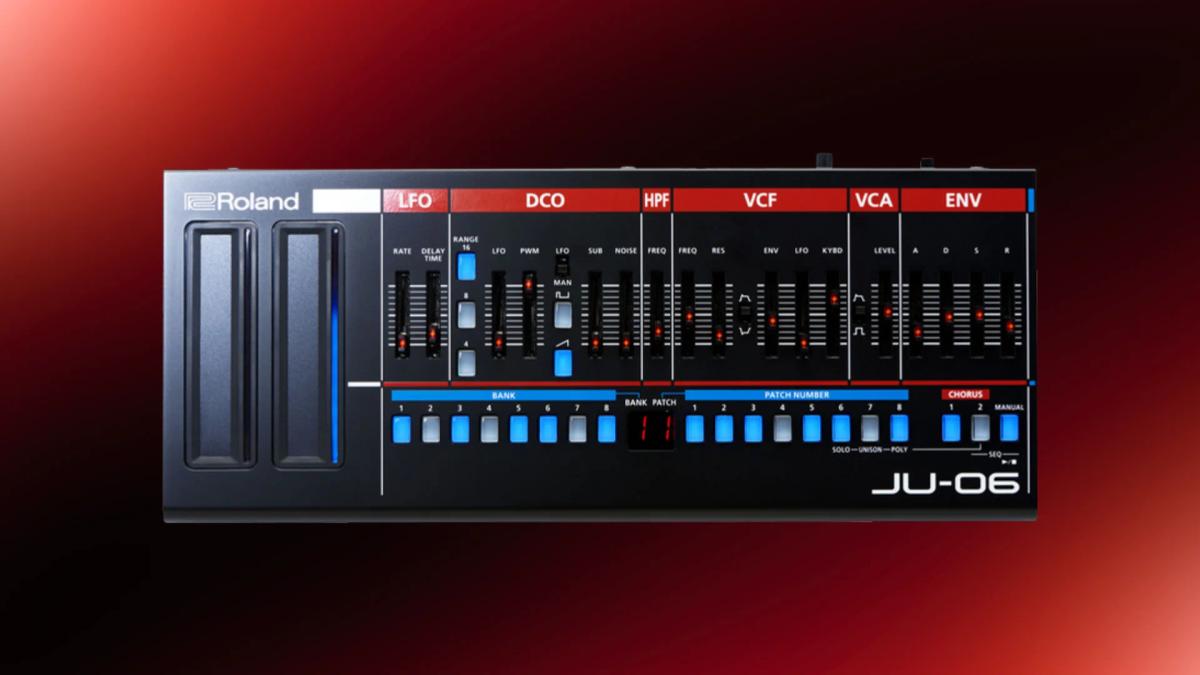
The Roland JU-06 is a compact digital sound module that recreates the Roland Juno-106 using Roland’s Analog Circuit Behavior (ACB) modeling. Roland announced it on October 1, 2015, as one of the three launch modules of the Roland Boutique series, and it reached Japanese stores on October 24 of that year at a US price of $299. Each voice follows the Juno-106 signal path: one DCO with sawtooth, pulse, sub-oscillator and noise, a high-pass filter, a resonant low-pass filter, a VCA and the original’s two-mode chorus. The module offers four voices, 23 front-panel controls, a 16-step sequencer, 64 patch memories, a delay, a built-in speaker and power from four AA batteries or USB. It matters because it put the Juno-106’s sound and layout into a battery-powered box no wider than 30 cm.
Table of Contents
Roland JU-06 sound and character
The JU-06 does not use sampled waveforms or a generic virtual analog engine. ACB models the behavior of the original circuits, and the result is a voice that runs through the same stages as the 1984 instrument: a digitally controlled oscillator with sawtooth and pulse waves that can be mixed, a square sub-oscillator one octave down, a noise source, then a high-pass filter, a 24 dB per octave low-pass filter with resonance, and a VCA driven either by the envelope or by a simple gate. Because the original Juno-106 already relied on stable DCOs rather than drifting VCOs, its character came less from oscillator wobble than from the filter and the chorus, and those are the two areas reviewers focused on.
Most early reviews judged the emulation close. Sonicstate’s Sonic LAB review concluded that the module sounds and behaves like a Juno-106, singling out the filter and chorus as especially well modeled. Resident Advisor’s reviewer heard a slightly crisper, clearer and more precise version of the same lush, retro character. Writing for Synthtopia, reader and former Juno owner Robert Dorschel was even more emphatic, although several commenters under his piece disagreed and described the top end as harsher and more digital than the original.
The most detailed reservation came from Dan Goldman at MusicRadar. He found that the top end and upper mids sounded less open than on an analog Juno-106, a difference he described as typical of ACB against real circuitry, yet he also judged the JU-06 a more convincing likeness of its source than the JP-08 was of the Roland Jupiter-8. He praised the low-pass filter for its texture and low end, and noted that the LFO can be pushed to audio rate, which takes the module into harsh, distorted tones the original could not easily produce.
The chorus is central to the sound. The JU-06 keeps the Chorus I and Chorus II buttons, and Synthtopia’s review notes that both can be engaged together. Roland’s Japanese announcement described the chorus as redeveloped with newer technology, and the modeling extends to its hiss: Andy Jones at MusicTech listed the noise added when the chorus is on among his few complaints, while some Synthtopia commenters felt the noise was louder or differently colored than on their original units.
Polyphony shapes the character as much as the engine does. With four voices instead of the original’s six, Goldman found the sound slightly more compact in poly and unison modes, and wide pad voicings run out of notes quickly. Jones described the results as strong basses, searing leads and pads that live up to the Juno’s reputation, but he also called them familiar and workmanlike rather than surprising. That is a fair summary of the JU-06’s sonic identity: a faithful, well-behaved reproduction of a known sound rather than a new instrument.
Features and architecture
- Manufacturer: Roland Corporation
- Year introduced: 2015 (announced October 1, 2015; Japanese release October 24, 2015)
- Production years: from 2015 as a limited edition; Roland has not published an end date; succeeded by the JU-06A in September 2019
- Synthesis type: digital modeling of analog subtractive synthesis, using Roland’s Analog Circuit Behavior (ACB)
- Category: compact desktop sound module (Roland Boutique series)
- Polyphony: 4 voices; 8 voices with two units linked in chain mode
- Multitimbrality: none; one patch plays at a time
- Original price: $299 (US) and £229 (UK); optional K-25m keyboard unit $99 / £75
- Current market price: sold mainly used; Reverb’s price guide places a typical example at about $340 (October 2026)
- Oscillators: one DCO per voice with sawtooth and pulse (selectable together), PWM set manually or by LFO, square sub-oscillator, noise; range 16′, 8′, 4′
- Filter: continuously variable high-pass filter (replacing the original’s four-position switch); 24 dB per octave resonant low-pass filter with envelope amount and polarity, LFO amount and key follow
- LFO: one, with rate and delay time; routable to DCO pitch and filter; faster maximum rate than the original, reaching audio rate
- Envelopes: one ADSR, shared by filter and VCA; VCA switchable between envelope and gate
- Modulation system: fixed panel routings in the Juno-106 manner; two ribbon controllers for pitch bend and modulation, which also trigger sounds without a keyboard
- Sequencer / arpeggiator: monophonic 16-step sequencer with 16 patterns, tie, gate time, swing and several play-order modes; no arpeggiator
- Effects: Chorus I and II (usable together); delay with settings stored per patch and no dedicated panel controls
- Memory: 64 user patches (8 banks of 8)
- Keyboard: none; optional K-25m unit with 25 velocity-sensitive mini keys
- Inputs / outputs: stereo mini-jack output, stereo mini-jack headphone output, stereo mini-jack input; built-in 0.5 W speaker
- MIDI / USB: 5-pin DIN MIDI In and Out; micro-USB for MIDI, 24-bit/44.1 kHz audio interface and data backup
- Display: two-character, seven-segment LED
- Dimensions / weight: 300 x 128 x 45 mm; 940 g
- Power: four AA batteries (alkaline or Ni-MH, about 6 hours on Ni-MH) or USB bus power (500 mA)
Strengths
- The emulation is close to the source. Sonicstate, Resident Advisor and MusicRadar all heard the Juno-106’s basic sound and behavior, with the filter and chorus drawing the most praise.
- The panel is quick to program. The 23 sliders and switches follow the original’s one-function-per-control layout, and MusicTech’s Andy Jones counted ease of programming among its main advantages.
- Two additions extend the original sensibly. The continuously variable high-pass filter replaces a four-step switch, and the faster LFO opens up audio-rate effects.
- It is genuinely portable. Battery power, a built-in speaker and a weight under one kilogram let it work away from a studio, with the ribbons available for auditioning patches.
- USB integration is unusually complete for its price. A single micro-USB cable carries power, MIDI and 24-bit stereo audio, so the module can act as its own audio interface.
- It avoids the original’s maintenance burden. MusicRadar’s verdict stressed that buyers get the key Juno-106 traits without the reliability problems of a decades-old instrument.
Limitations
- Four voices are not enough for many Juno parts. It was the most common criticism at launch, and chaining a second unit over DIN MIDI is the only way to reach eight.
- MIDI control of the panel is limited. MusicRadar found that only the mod ribbon, expression and hold respond to standard CCs, while slider data travels as SysEx, which Sonicstate found was output only over DIN in chain mode.
- Performance routing is fixed. Sonicstate noted that the ribbons cannot be sent to the filter as the original bender could, and Resident Advisor found two ribbons harder to work together than a lever.
- The sequencer is a sketchpad rather than a production tool. It is monophonic, does not send its notes over MIDI, and Synthtopia noted that unsaved edits are lost at power-down.
- Some functions are buried. Portamento and the delay sit behind button combinations, and Resident Advisor found patch saving less direct than it could be.
- Memory and connections are reduced. It holds 64 patches against the original’s 128, all audio connections are mini-jacks, and MusicTech reported the speaker rattling the case when the module sat upright in the K-25m.
Historical context
The Juno-106 was a six-voice polysynth that Roland’s own Japanese materials place on sale in 1984 and 1985. It became one of the most familiar Roland sounds of the decade and stayed popular on the used market, which is why a reproduction made commercial sense three decades later. By 2015, Roland had already used ACB in its AIRA products, including the TR-8 drum machine and the SYSTEM-1 synthesizer, and the October 1, 2015, press release presented the Boutique line as the next application of that technology: three limited-edition modules, each based on a classic Roland synth, each with a step sequencer, built-in speakers, USB and MIDI, and chain mode.
The JU-06 launched beside the JP-08, a four-voice Jupiter-8 model, and the JX-03, based on the Roland JX-3P and its PG-200 programmer. Sound On Sound’s launch news gave prices of $299 / £229 for the JU-06 and JX-03, $399 / £299 for the JP-08 and $99 / £75 for the K-25m keyboard unit, and placed the series in the same market as the Korg Volca and Yamaha reface lines. In Japan, Roland sold the modules at open price from October 24, 2015.