

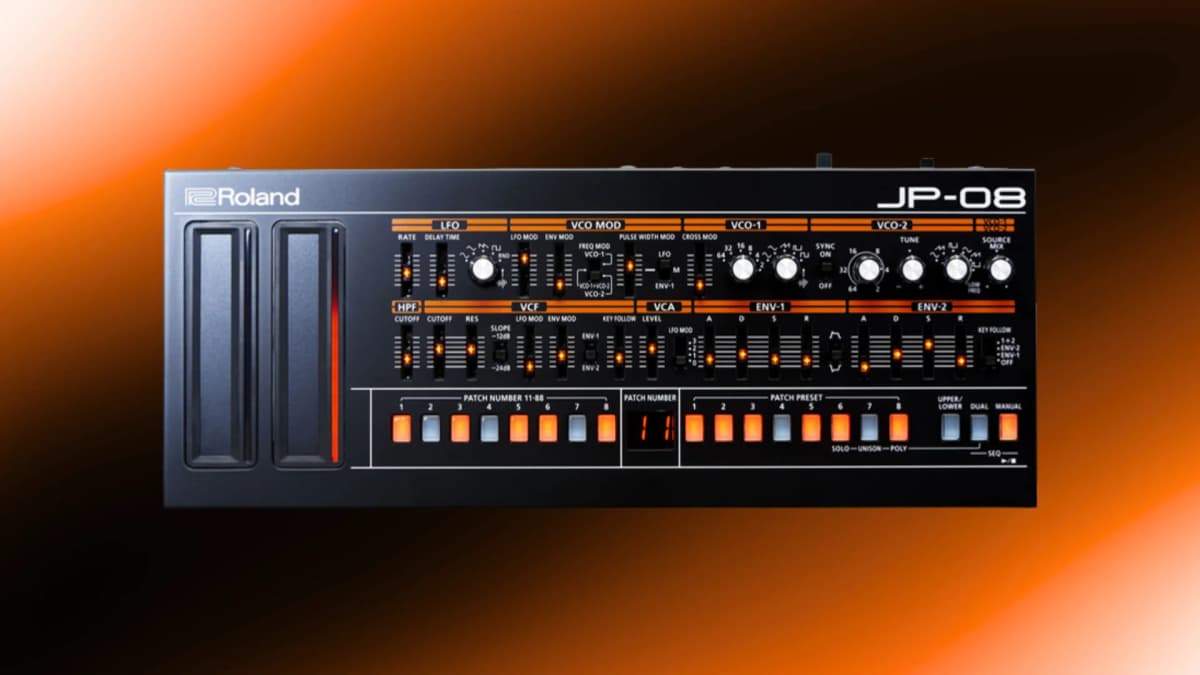
The Roland JP-08 is a compact digital sound module that recreates the Jupiter-8 in a metal-fronted case roughly the size of a hardback book. Roland announced it on October 1, 2015 as the flagship of the first Roland Boutique trio, alongside the JU-06 and JX-03, with US shipping expected that November. Its engine uses Roland’s Analog Circuit Behavior (ACB) modeling, the same approach the company had applied to its AIRA instruments, to reproduce the behavior of the original’s two VCOs, high-pass filter, resonant low-pass filter, VCA and two envelopes. Each unit plays four voices, and two units can be chained into a single eight-voice instrument. It also runs on four AA batteries, has a built-in speaker, a 16-step sequencer and a USB audio interface. What makes it matter is simple: it put a convincing Jupiter-8 voice within reach for $399.
Table of Contents
Roland JP-08 sound and character
The JP-08 follows the signal path of the Roland Jupiter-8 closely. Two oscillators feed a source mixer, with cross modulation and hard sync available between them, then pass through a non-resonant high-pass filter and a resonant low-pass filter switchable between 12 dB and 24 dB slopes. Two ADSR envelopes, one with selectable polarity, shape the filter and amplifier, and a single LFO with a delay time control handles vibrato and filter movement. Roland widened the palette slightly: VCO-1 gains a sine wave, both oscillators reach lower footages than the original, and the LFO adds triangle and noise shapes.
Reviewers broadly agreed that the core tone is close to the source. In his February 2016 Sound On Sound review, Gordon Reid compared the module against his own Jupiter-8 and found the waveforms, filter sweeps and sync sounds very well recreated. He found cross modulation the hardest area to match, but suspected that the tracking drift of his aging original was part of the difference, which implied the JP-08 might sit closer to a freshly calibrated Jupiter-8. He also noted small differences in attack and decay timing that showed up during filter sweeps but could be corrected by ear. Sonicstate’s November 2015 Sonic LAB video reached a similar conclusion, matching waveforms on an oscilloscope and praising the filter modes, while still giving the original the edge in low-end weight.
Dan Goldman’s March 2016 review for MusicRadar described a sound that was smooth but gritty in the Jupiter manner, and singled out cross-modulated and synced leads, evolving tones, brass and pulse-width pads as particular strengths. He also heard a darker, slightly less lively result than the analog original, missing some of its air and stereo width, and connected this in part to the module’s 24-bit/44.1 kHz engine, set against the 96 kHz operation of Roland’s SYSTEM-1. That remark is a useful summary of the JP-08’s position: close enough to be recognizably Jupiter, not quite the same as hearing eight analog voices at once.
The factory sounds shape first impressions more than they should. Andy Jones, writing for MusicTech, found the opening banks of solo presets thin, with dry basses and raspy leads, but warmed to the string and pad patches and to Dual mode, which layers two sounds and gives the unit much more size. Because Dual mode splits four voices into two per layer, it is also where the polyphony limit is most audible. Played as a mono or four-voice instrument, the JP-08 is strongest on leads, basses, sync tones and short chordal parts. Two chained units restore the eight voices that make classic Jupiter pads and layered stacks breathe.
Features and architecture
- Manufacturer: Roland Corporation
- Year introduced: 2015 (announced October 1, 2015; US shipping expected in November 2015)
- Production years: 2015 to an undocumented end date; reported as discontinued several years before 2026
- Synthesis type: Digital modeling of analog subtractive synthesis (Roland ACB, Analog Circuit Behavior)
- Category: Compact polyphonic sound module (Roland Boutique series)
- Polyphony: 4 voices; 8 voices with two units in Chain mode, and each additional unit adds 4 more; Dual mode gives two voices per layer
- Multitimbrality: Not multitimbral in the usual sense; Dual mode layers an upper and a lower patch; no keyboard split
- Original price: $399 US street; £299 UK (K-25m keyboard sold separately, $99 US / £75 UK)
- Current market price: Used only; approximately $160–$320 in the US in 2026, more when bundled with the K-25m
- Oscillators: Two per voice (VCO-1 and VCO-2) with expanded range; VCO-1 adds a sine wave; VCO-2 offers sync and fine tune; cross modulation; source mix control
- Filter: High-pass filter (cutoff) plus resonant low-pass VCF with 12/24 dB slope switch, key follow, envelope and LFO modulation
- LFO: One, with rate, delay time and waveform selection; triangle and noise added to the original shapes
- Envelopes: Two ADSR envelopes; ENV-1 with polarity switch, ENV-2 with key follow
- Modulation system: Fixed Jupiter-style routings: VCO modulation by LFO and envelope (pitch and pulse width), cross mod, filter modulation by envelope and LFO, VCA LFO switch
- Sequencer / arpeggiator: 16-step sequencer with 16 patterns; no arpeggiator
- Effects: Delay
- Memory: 64 user patches plus 8 patch presets for upper, lower and dual combinations
- Keyboard: None; two ribbon controllers for pitch bend, modulation and sound preview; optional K-25m 25-key velocity-sensitive dock
- Inputs / outputs: Stereo mini-jack output, stereo mini-jack input, mini-jack headphone output; built-in 0.5 W speaker
- MIDI / USB: 5-pin MIDI In and Out; USB Micro-B for MIDI and 24-bit/44.1 kHz stereo audio, plus data backup
- Display: Two-character, 7-segment LED
- Dimensions / weight: 300 × 128 × 46 mm; 970 g with batteries
- Power: Four AA batteries (alkaline or Ni-MH, about 6 hours on Ni-MH) or USB bus power (500 mA); no DC input
Strengths
- The core sound is a credible Jupiter-8. Reviewers at Sound On Sound, MusicRadar and Sonicstate all found the oscillators, filters and sync tones close to the original, with differences mostly in low-end weight and openness.
- The panel follows the original’s logic. The LFO, VCO, mixer, filter, VCA and envelope sections sit in a familiar order, so Jupiter patch sheets and programming habits transfer with only minor adjustments.
- The launch price was a small fraction of a vintage unit. Reid estimated the UK price at under a tenth of what an original Jupiter-8 cost on the used market at the time.
- It is genuinely portable. Battery power, a built-in speaker and a weight under 1 kg let it work on a desk, a sofa or a train without other equipment.
- USB audio simplifies recording. The module streams stereo audio and MIDI over one USB connection, so it can be tracked into a computer without an audio interface.
- Polyphony can be expanded. Chain mode links two or more JP-08 units into one instrument, which brings the voice count back to the original’s eight.
- Firmware improved integration after launch. Version 1.10 in August 2016 added Control Change transmission and reception for parameters, which addressed one of the earliest review complaints.
Limitations
- Four voices is the central compromise. Reid identified polyphony as the module’s main problem, since a layered patch plays only two notes, which rules out most of the lush pads the Jupiter-8 is known for.
- Several performance features are missing. There is no arpeggiator, no keyboard split, no chorus and no Hold buttons, all of which were part of how the original was played.
- The short faders demand care. Goldman measured roughly 1.5 cm of travel and Sonicstate about 20 mm, which makes precise adjustments slower, even if Reid found the feel better than expected.
- The ribbons are limited. MusicRadar found the recessed ribbons hard to play precisely and noted that they cannot be reassigned or have their modulation depth set, and Sonicstate made a similar point about their fixed routing.
- The sequencer is basic. Reid described it as a monophonic 16-step design without MIDI sync, which limits its use beyond sketching.
- Connections are built for convenience rather than the stage. Audio uses 3.5 mm jacks, there is no dedicated DC power input, and the external audio input does not pass through the filter or VCA.
- Patch management is spartan. Patches have no names and are selected by number on a two-character display, and some functions are reached only through button combinations.
Historical context
The Jupiter-8 that the JP-08 imitates arrived in early 1981 as Roland’s eight-voice analog flagship, with two VCOs per voice, split and layer modes and an arpeggiator. It listed at $5,295 in the US and £3,995 in the UK, and roughly 3,300 units were produced during a run that ended in the mid-1980s. By 2015 clean examples had become expensive collectors’ instruments, and Roland had already reused the name for the digital JUPITER-80 and JUPITER-50 in 2011.
Roland Boutique grew out of the company’s AIRA line, which introduced ACB modeling in instruments such as the TR-8 and SYSTEM-1. In September 2015, photos of three small modules leaked via Reddit, and Attack Magazine reported the $399 price, the four voices and a planned November US release before Roland had said anything. The official announcement on October 1, 2015 presented the JP-08, the JU-06 based on the Roland Juno-106, the JX-03 based on the Roland JX-3P, and the optional K-25m keyboard dock. Roland described the series as limited edition, a label that Reid questioned in his review because the company never explained what was limited.