

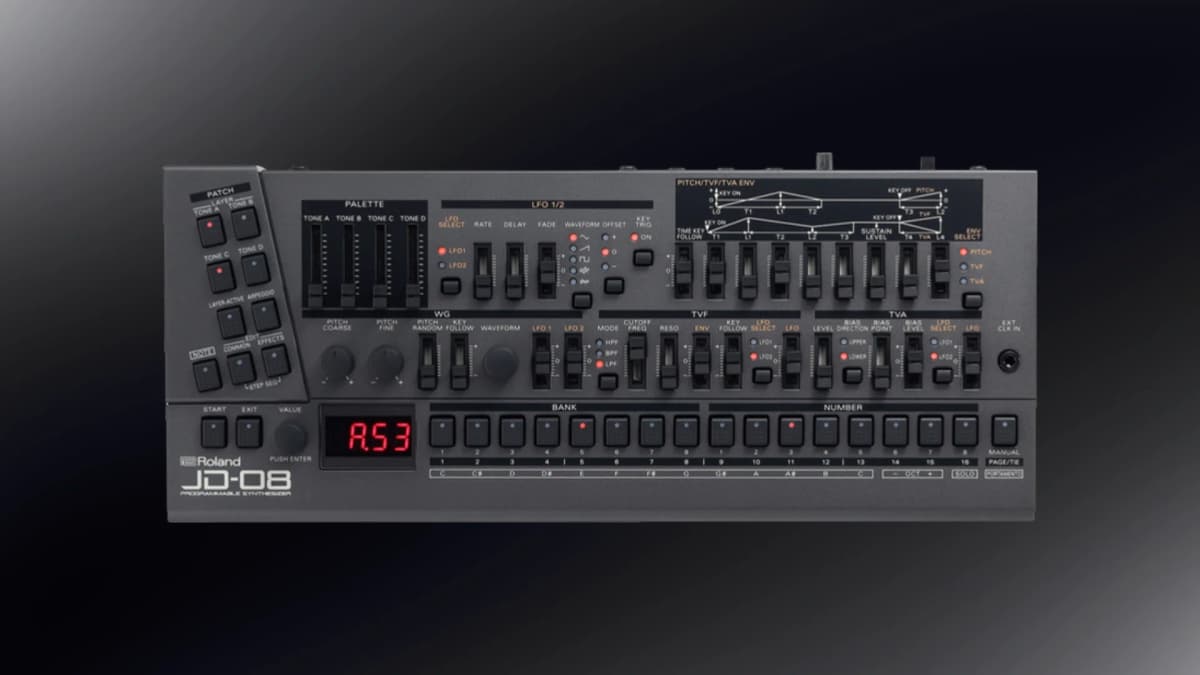
The Roland JD-08 is a compact digital sound module in the Roland Boutique series that recreates the JD-800, Roland’s slider-covered 1991 flagship. Roland announced it on November 9, 2021, alongside the JX-08, and it reached US dealers in January 2022 at $399.99. It rebuilds the JD-800’s architecture with what Roland calls advanced sound modeling: the original 108 waveforms, four tones per patch, a multimode filter, time/level envelopes, the two-stage multi-effects section and the 64 factory patches. The front panel is a shrunken copy of the original’s, with a dedicated slider, knob or button for nearly every parameter. Roland added a two-part polyphonic step sequencer, an arpeggiator, a USB-C audio and MIDI interface, and polyphony of up to 128 voices, depending on how many tones each patch uses. It runs on four AA batteries or USB power and docks into the optional K-25m keyboard.
Table of Contents
Roland JD-08 sound and character
The JD-08 is built around the sound that made the Roland JD-800 distinctive: bright PCM waveforms, glassy digital pads, airy strings and layered keys, shaped by a subtractive signal path and finished by built-in effects. Each patch can stack up to four tones, and each tone draws one of the 108 original waveforms, runs it through its own filter and amplifier, and has its own envelopes and LFOs. Andy Jones, reviewing it for MusicRadar, heard a close match to the original, with the familiar shimmer and movement. He singled out pads, strings and keys of the kind associated with the Roland D-50 era, and found the four-tone layering useful for thick, supersaw-style string sounds as well as more openly digital textures. He also noted that his original JD-800 sounded slightly fuller, in part because it ran more effects at once.
Jono Buchanan at MusicTech described the sound as bright, rich and detailed and felt the module captured the spirit of the JD-800 well, giving it 9 out of 10. Peter Kirn at CDM, writing at the announcement, made a broader point about the architecture: because the JD-800 combines sampled waveforms with a fairly conventional subtractive path, he argued it is more flexible than the D-50, calling it “really versatile in a way the D-50 isn’t.” The factory content leans on that range. Alongside the 64 original JD-800 patches, Roland added 21 new ones, and the user memory holds 256 patches in all.
The most detailed technical assessment came from Gordon Reid in Sound On Sound, who compared the JD-08 directly with a JD-800. He liked the sound and found much of the original’s character, but he concluded that it is not a drop-in replacement. In his tests, several waveforms played an octave away from their JD-800 counterparts, and the filter’s resonance, tone and overall response differed enough that he would not call it a strict emulation. He also found the JD-08 less prone to aliasing in the upper register than the original, which changes the high-end character. For someone who wants the general JD-800 color, those differences matter little; for someone trying to match a specific record or an old patch exactly, they matter more.
The effects are a large part of the sound. Roland split them into two groups, as on the original: Effect A covers distortion, phaser, spectrum (a fixed-band EQ) and enhancer, and Effect B covers delay, chorus and reverb. CDM listed distortion types ranging from mellow and overdrive to fat and fuzz. Sonicstate’s Sonic LAB review observed that the classic effects matter less today than they did in 1991, though they remain central to the factory sound. Reid pointed out one constraint that shapes how the instrument sounds in practice: Part A can use all seven effects, while Part B has no access to Effect B, which he described as “unnecessarily limiting” when building two-part layers or splits.
Features and architecture
- Manufacturer: Roland Corporation
- Year introduced: 2021 (announced November 9, 2021; US availability January 2022)
- Production years: 2021–present; still listed in Roland’s current Boutique product lineup in October 2026
- Synthesis type: digital, PCM-waveform subtractive synthesis; Roland describes the engine as the JD-800’s original waveforms combined with advanced sound modeling
- Category: Roland Boutique desktop sound module; compact recreation of the JD-800
- Polyphony: up to 128 voices depending on patch load; Sonicstate reports 128 voices with one tone per patch, 64 with two and 32 with four, and Sound On Sound measured 16 notes per part with four-tone patches in both parts (the JD-800 offered 24 voices, or six with four tones)
- Multitimbrality: two parts (A and B), each holding one four-tone patch; per-tone key ranges allow splits and layers of up to eight tones; no equivalent of the JD-800’s Multi mode
- Original price: $399.99 in the US (Roland press release); £349 in the UK according to Sound On Sound and MusicTech
- Current market price: $479.99 new at Sweetwater in October 2026 (backordered at the time of writing); Equipboard’s October 2026 listing shows lower prices at some dealers, including about $329 at Thomann, £332 at Gear4Music and roughly $321 new on Reverb
- Oscillators: one waveform generator per tone, four tones per patch; 108 original JD-800 waveforms; coarse and fine pitch, pitch random, key follow and two LFO depth controls per tone
- Filter: TVF per tone with low-pass, band-pass and high-pass modes; cutoff, resonance, envelope depth, key follow and LFO depth
- LFO: two LFOs per tone with rate, delay, fade, waveform, offset and key trigger; waveforms include sawtooth, triangle, square, random and noise
- Envelopes: three multi-stage time/level envelopes per tone (pitch, TVF and TVA) with T1–T4, L1–L4, sustain level and time key follow; Sound On Sound notes an added level control for the release stage
- Modulation system: fixed routings from the LFOs and envelopes to pitch, filter and amplitude; key follow and bias controls; four palette sliders that adjust a chosen parameter across tones A–D at once; responds to aftertouch, according to Sonicstate
- Sequencer / arpeggiator: two-part, 64-step polyphonic step sequencer with up to eight notes per step, motion recording, a random pattern generator, six replay modes and 128 pattern memories; arpeggiator with up, down, up/down, random and as-played modes
- Effects: two-stage multi-effects modeled on the JD-800; Effect A with distortion, phaser, spectrum and enhancer, Effect B with delay, chorus and reverb (Part B cannot use Effect B)
- Memory: 256 patches and 128 sequencer patterns; 64 original JD-800 presets plus 21 new presets
- Keyboard: none; optional K-25m keyboard unit with 25 velocity-sensitive mini keys
- Inputs / outputs: stereo output, stereo headphone output and stereo mix input on 3.5 mm jacks; external clock input on a 3.5 mm mono jack; built-in mini speaker
- MIDI / USB: full-size MIDI In and Out; USB Type-C for audio and MIDI; a Roland driver is required, and Sound On Sound found the unit is not USB class-compliant
- Display: four-character, seven-segment LED
- Dimensions / weight: 300 x 128 x 49 mm; 840 g including batteries
- Power: four AA batteries (alkaline or Ni-MH) or USB bus power (500 mA); about six hours on 1,900 mAh Ni-MH cells according to Roland; no power adapter included
Strengths
- It has far more polyphony than the original. With single-tone patches the JD-08 reaches 128 voices and still offers 32 with full four-tone layers, against six on a JD-800 using all four tones.
- The core sound is convincing. MusicRadar and MusicTech both found it close to the JD-800, especially on pads, strings and layered keys, even though Sound On Sound documented measurable differences.
- The panel keeps the hands-on idea intact. Almost every tone parameter has its own slider or knob, so the JD-800’s approach of editing by moving physical controls survives the reduction in size.
- The sequencer and arpeggiator are real additions. The original had neither, and reviewers described the two-part polyphonic sequencer, with motion recording and random generation, as a creative tool in its own right.
- It is portable and self-contained. Battery power, a built-in speaker and a USB audio interface make it usable on a desk, on location or in a small live rig, as Mix’s reviewer found on a recording trip.
- It costs a fraction of an original. Reid noted that it is cheaper than a used JD-800, which can be unreliable with age, while offering much higher polyphony.
- The controls double as a MIDI controller. The panel sends MIDI CC data, and CDM reported that it works as a pre-mapped controller for Roland Cloud’s JD-800 software.
Limitations
- The display is too small for serious editing. A four-character LED replaces the JD-800’s screen, and every major review named it as the main obstacle to programming beyond the front-panel parameters.
- There is no official editor or librarian. Sound On Sound and Sonicstate both noted the lack of software editing, which also means original JD-800 patches cannot simply be transferred; MusicRadar pointed to a low-cost third-party editor as a workaround.
- The faders are very small. CDM and Sonicstate put them at 20 mm, with 30 mm for the palette sliders, and MusicRadar warned that the compact layout can feel fiddly for larger hands.
- Multitimbral use is restricted. There are only two parts, no Multi mode, and Part B cannot use the delay, chorus and reverb block.
- It is not a strict recreation. Sound On Sound found waveforms pitched an octave off and a filter that responds differently, and Reid disputed Roland’s description of it as an authentic recreation.
- The USB and firmware behavior had rough edges at launch. Reid reported a whine on the analog output in some USB setups, a driver requirement, a hidden monosynth lead on MIDI channels 4 and 5, and stray notes during fast playing; the later system updates Roland lists describe only minor bug fixes and an administrative version change.
Historical context
Roland’s own account of the JD-800 frames it as a reaction to its time. By the early 1990s, digital synthesizers were largely preset machines with few physical controls, and the JD-800 arrived in 1991 with a panel full of sliders and an assertively electronic sound. It was expensive: Wikipedia gives launch prices of $2,895 in the US and £1,699 in the UK. It offered 24 voices with single-tone patches, a five-part Multi mode and 108 waveforms that could be expanded with PCM cards. Roland Japan lists its sales period as 1991 to 1995, and in 1993 Roland followed it with the JD-990, a rackmount version with a larger display. Gordon Reid describes the JD-800 as the true successor to the D-50 but also as a short-lived instrument.
The Boutique series that eventually produced the JD-08 began on October 1, 2015, when Roland announced the JP-08, JU-06 and JX-03 together with the K-25m keyboard unit. Those first models were four-voice, limited-edition modules based on the JUPITER-8, JUNO-106 and JX-3P, using Roland’s Analog Circuit Behavior modeling, battery or USB power and built-in speakers. Over the following years the line expanded through drum machines, monosynths and other reissues, but most entries kept the small voice counts and tightly packed panels of the original trio.