Home›Synths›Roland Fantom 6/7/8: The ZEN-Core workstation that kept…
Synths

Roland Fantom 6/7/8: The ZEN-Core workstation that kept evolving long after launch

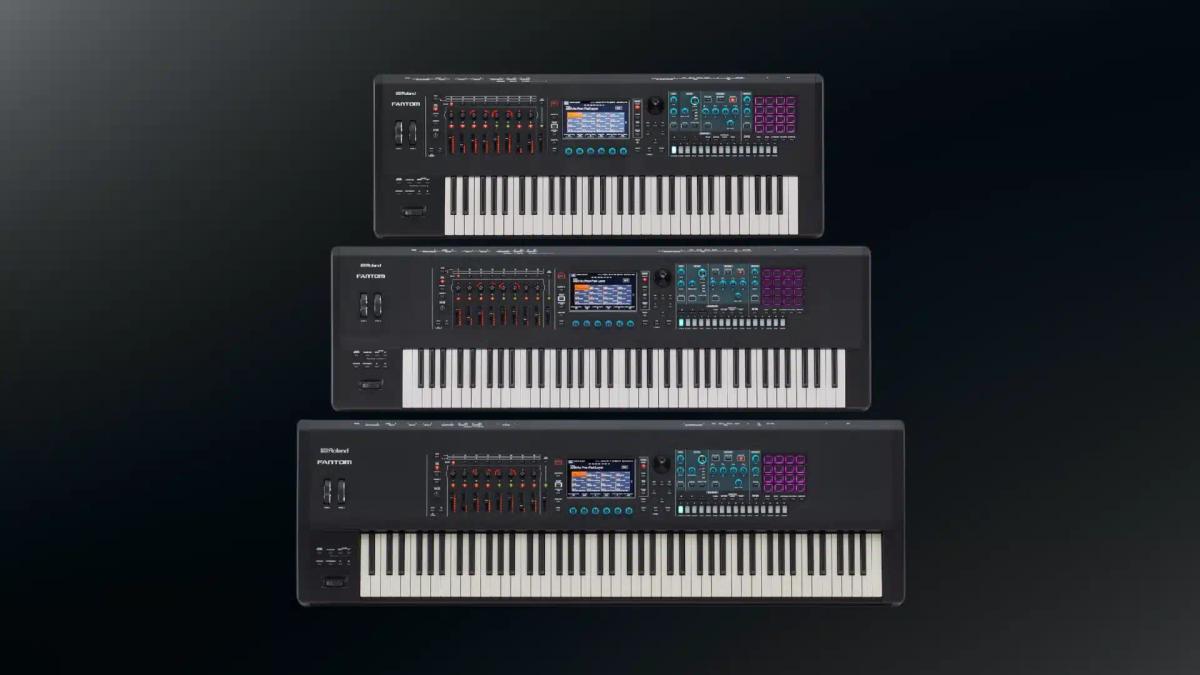
The Roland Fantom 6, Fantom 7 and Fantom 8 are a family of flagship keyboard workstations announced in September 2019, sharing one architecture across 61, 76 and 88-key versions.

Bernardo de Azevedo
Bernardo de Azevedo
Roland Fantom 6/7/8 synthesizer

The Roland Fantom 6, Fantom 7 and Fantom 8 are a family of flagship keyboard workstations announced in September 2019, sharing one architecture across 61, 76 and 88-key versions. Built around Roland’s ZEN-Core synthesis system, a physical-modeling V-Piano engine, a genuine stereo analog filter, a 16-part pattern sequencer, a pad sampler and a 7-inch color touchscreen, they revived the Roland Fantom name a decade after the Fantom-G.

What makes them meaningful is less any single feature than their trajectory: a workstation that shipped with notable gaps and was steadily filled out by free updates, model expansions and, eventually, a paid EX upgrade, until Roland replaced it with the Fantom EX range in 2024.

Sound and character

The Roland Fantom’s sound is polished, wide and generously voiced rather than raw. Sound On Sound’s Dave Stewart described its pads and synths as sumptuous and analogue-like, explicitly drawing on Jupiter-8 and D-50 heritage, while Stephen Fortner, the former Keyboard editor who ran a long-form review on the MPN forum, called the overall sound huge, lush and smooth. Its home ground is big layered pads, bright polysynth stacks and full-range keyboard sounds that arrive already finished for a mix.

Much of that character comes from ZEN-Core. Each tone can combine up to four partials, and each partial works either as a PCM sample player or as a virtual analog oscillator with its own filter, LFOs and EQ. That suits hybrid sounds that blend a sampled attack with a synthetic body, and the virtual analog side supports the sync and cross-modulation timbres Sound On Sound singled out.

The stereo analog filter adds a different flavor: Sound On Sound found that routing a sound through it made the result warmer, fatter and louder, while Fortner warned that its resonance can turn into harsh screeches if pushed carelessly, and its drive stage lets an otherwise clean digital tone pick up grit and weight.

Keyboard sounds are the other pillar. Sound On Sound found the V-Piano engine strong enough to make the Roland Fantom a serious stage piano, and Bonedo rated piano and synth sounds as its best areas, with natural instruments usable but weaker. The vintage emulations added later through Model Expansions drew more reservation: Fortner found them authentic but gave a slight edge in vintage character to software rivals from Arturia and Cherry Audio, and CDM later called them primitive next to the ACB versions of 2023.

Features and architecture

  • Manufacturer: Roland
  • Year introduced: 2019, announced as part of Roland’s 909 Day activities in early September and shown at Knobcon 2019
  • Production years: 2019 until the Fantom EX range replaced it in 2024
  • Synthesis type: ZEN-Core (PCM and virtual analog partials), V-Piano physical modeling, SuperNATURAL Acoustic, Virtual ToneWheel organ (added in 2021), Model Expansion engines (added in 2021), plus a stereo analog filter
  • Category: flagship keyboard synthesizer workstation
  • Polyphony: Roland’s specifications do not publish a single maximum figure for the Roland Fantom engine, and Sound On Sound judged it unlimited in practical terms; the pad sampler is limited to 8 voices
  • Original price: $3,299.99 (Fantom 6), $3,599.99 (Fantom 7) and $3,999.99 (Fantom 8) in the U.S.; £3,069, £3,249 and £3,519 in the UK at launch
  • Oscillators: up to four partials per tone, each a PCM sample player (Bonedo counts 964 samples) or a virtual analog oscillator with eleven basic waveforms, including supersaw
  • Filter: ZEN-Core digital filter with ten characteristics and selectable slopes per partial; stereo analog filter with LPF1, LPF2, LPF3, HPF, BPF and bypass settings plus drive and amp controls
  • LFOs: two tempo-syncable LFOs with eleven waveforms, with step-LFO shapes of up to 16 steps
  • Modulation system: oscillator sync and cross-modulation, per-partial 3-band EQ, Motional Pad, eight knobs, eight sliders, two wheels, a pitch/mod lever, 11 sound-modify knobs and four pedal inputs
  • Sequencer / arpeggiator: 16-track pattern sequencer with eight patterns per track of up to 32 measures, real-time, step and TR-REC recording, piano roll, Scene Chain, plus arpeggiator, rhythm patterns and chord memory; pattern length was extended to 64 measures in version 3.00
  • Effects: 16 multi-effects with 90 types, two insertion effects, chorus, reverb, master compressor and EQ, a stereo vocoder, and from version 2.00 a TFX processor on the main bus
  • Sampler: pad sampler with 16 pads by four banks and up to 60 minutes of sampling; keyboard multisampling added in version 2.00
  • Memory: more than 3,500 tones and more than 90 drum kits, 128 x 4 banks of Scenes, about 2 GB of sample memory shared with expansions
  • Keyboard: Fantom 6 with 61 semi-weighted synth-action keys; Fantom 7 with 76 semi-weighted keys; Fantom 8 with 88-key PHA-50 hammer action with escapement; all with channel aftertouch, plus 16 RGB pads
  • Inputs / outputs: balanced main outs on 1/4-inch and XLR, two stereo sub outs, two dedicated analog filter outputs, two mic/line combo inputs, two CV and two Gate outputs, headphones
  • MIDI / USB: MIDI In, Out 1 and Out 2/Thru; USB computer port with 16 x 3 stereo audio and MIDI; USB memory port; three USB host ports for Roland controllers
  • Display: 7-inch color touchscreen, 800 x 480
  • Dimensions / weight: Fantom 6 1,084 x 403 x 106 mm, 15.3 kg; Fantom 7 1,296 x 403 x 106 mm, 17.7 kg; Fantom 8 1,432 x 439 x 153 mm, 27.7 kg
  • Power: internal supply, AC 117 to 240 V, 50 W consumption

Strengths

  • The sound set is broad and consistently strong. Reviewers highlighted pads, synths, V-Piano and drums, so one instrument can cover a wide keyboard book without a laptop.
  • ZEN-Core links the hardware to the ZENOLOGY plug-in and other ZEN-Core instruments, making programming on a computer and recall on stage practical.
  • The genuine analog filter, with its own outputs and drive stage, can roughen and thicken digital sources in a way pure DSP filtering does not.
  • Integration is deep: dual CV/Gate outputs for modular gear, a multichannel USB audio interface, and Logic Pro and MainStage control from launch.
  • Its updates added real substance. Keyboard multisampling, Model Expansions, the Virtual ToneWheel organ and longer patterns all arrived without new hardware.
  • Sound On Sound praised its mode-free, scene-based concept for fast changes and its bright panel for dark stages.

Limitations

  • At launch, user samples could only be played from the pads, not mapped across the keyboard, something Sound On Sound noted the Fantom-G had done a decade earlier. Version 2.00 fixed this in September 2020.
  • There was no clonewheel organ mode at launch. The Virtual ToneWheel engine arrived in version 2.50 in July 2021, restricted to zone 2.
  • The pads are not velocity-sensitive, and Fortner also criticized cramped sequencer screens, zone-only synth knobs and stepping on scene-level encoders.
  • Bonedo found early firmware not yet fully stable and the interface inconsistent, with effects shown mainly as parameter lists.
  • Weight and price are significant. The Fantom 8 weighs 27.7 kg, and Sound On Sound listed cost among its main drawbacks.
  • The ACB analog-modeling engine was never part of the original package. It arrived only with the paid EX upgrade in November 2023.

Historical context

The Roland Fantom name first appeared on the Fantom FA76, which Sound On Sound dates to 2001, followed by the Fantom S in 2003, the Fantom X in 2004 and the Fantom-G in 2008. The Fantom-G had pushed the line toward an 8.5-inch color screen and a sequencer with 128 MIDI and 24 audio tracks. After it, the Roland Fantom name went quiet for more than a decade, with the scaled-down FA08 of 2014 filling the gap.

When it returned in September 2019, DAWs had absorbed much of the workstation’s original purpose, so Roland pitched the new Roland Fantom as a hub that cooperated with the computer rather than replacing it. It was announced alongside the Jupiter-X and Jupiter-Xm, a pairing that made Roland’s strategy clear: one flagship for professional keyboardists and DAW integration, and a more synth-focused range built on the same ZEN-Core foundation. Sound On Sound described the hardware as built around assignable internal BMC chips, framing it from the start as a platform for later expansion.

That framing turned out to be accurate. The firmware history runs from version 1.10 in October 2019 to version 3.02 in October 2023, adding Roland Cloud support, SuperNATURAL piano expansions, keyboard multisampling, Model Expansions, the Virtual ToneWheel organ, Ableton Live integration and the n/zyme wavetable model. In 2022 Roland also introduced the lighter and cheaper Fantom-0 series, which kept ZEN-Core, scenes, the sequencer and the sampler but cut connectivity, confirming that the 2019 architecture had become a platform rather than a single product.

Legacy and significance

The Fantom 6/7/8 matters as an example of what a hardware workstation became in the age of software updates. Earlier Fantoms were largely defined by what they shipped with. This one was defined by what it grew into. Its 2019 version had obvious holes, and reviewers said so; by 2023 most had been filled, often for free, with engines that did not exist when it was designed.

It also mattered for Roland’s internal coherence. ZEN-Core made the Roland Fantom the flagship of a shared platform stretching from the Jupiter-X and Juno-X to the MC grooveboxes and the ZENOLOGY plug-in. Rather than a closed sound world, the flagship became a node in a system where patches could travel between studio and stage.

The way it ended is telling too. In November 2023 Roland sold existing owners an EX upgrade adding ACB models of the Jupiter-8 and SH-101, new pianos and new effects, and in April 2024 it launched the Fantom EX models with the same key counts and the same published dimensions and weights. The 2019 Roland Fantom effectively became the basis of its own successor, an unusual degree of continuity for a flagship.

Artists, users, and curiosities

The Roland Fantom was introduced to many players through demonstrators rather than famous album credits. At Knobcon 2019, Roland’s Ed Diaz gave the public overview and demo that Synthtopia filmed, and Fortner’s multi-part review, which ran from mid-2020 into early 2021, became one of the most detailed long-term evaluations of the Roland Fantom. Among performing musicians, Finnish synthesist Kebu (Sebastian Teir) used a Fantom 6 at the center of an all-Roland rig for a 2020 video performance of “Just Another Space Odyssey,” with the Roland Fantom both playing parts and triggering pre-recorded MIDI sequences.

One curiosity is how different the launch reviews read today. Sound On Sound’s complaint about unmappable samples and Fortner’s note that there was no dedicated drawbar organ mode both describe features the Roland Fantom later gained. Another is a small annoyance Sound On Sound flagged: an Auto Off function that shut the Roland Fantom down after 30 minutes without playing, an odd default for a stage flagship. And when the EX upgrade arrived at $199, CDM noted that the bundled expansions would cost more separately, a sign that the Roland Fantom’s identity was by then sold as much through software as through hardware.

Roland Fantom market value

  • Current market position: a discontinued flagship workstation whose platform lives on in the Fantom EX, valued mainly by working keyboardists rather than collectors
  • New price signal: launch prices of $3,299.99, $3,599.99 and $3,999.99; by mid-2020 Fortner reported street prices about $300 lower, at $2,999, $3,299 and $3,699; the replacement Fantom EX models were announced at $3,199.99, $3,699.99 and $4,199.99
  • Used market signal: no reliable used price-guide range was found, so judge prices against current Fantom EX pricing and each unit’s condition
  • Availability: no longer sold new, as Roland lists all three models as discontinued; the 27.7 kg Fantom 8 in particular is often better bought locally than shipped
  • Buyer notes: confirm the installed system version (3.02 was the final standard release), check whether the EX upgrade or Model Expansions are registered to the unit, and inspect keybed feel, aftertouch, pads, touchscreen response and all USB ports
  • Support ecosystem: Roland’s support pages still host the system updates and manuals, Roland Cloud still offers expansions, and ZEN-Core sounds remain compatible with ZENOLOGY and other ZEN-Core hardware
  • Market character: stable and practical rather than collectible; its value tracks usefulness and the price of the current Fantom EX
  • Long-term position: still forming, with the EX upgrade path making an original Roland Fantom a credible route into the current platform

Conclusion

The 2019 Roland Fantom 6/7/8 marks the moment Roland’s workstation stopped being a finished object and became an evolving platform. It launched with a strong sound set, a real analog filter and serious integration with computers and modular gear, but also with gaps reviewers were right to name. Four years of updates made it a more complete instrument and, finally, the foundation of the Fantom EX. That is why it matters: not as a vintage icon, but as a modern Roland flagship whose real identity was written after it left the factory.

Sources

  1. Roland Fantom (review), Sound On Sound
  2. Roland Unveils Next-Generation FANTOM Keyboard Series, Roland
  3. Roland debuts next-gen Fantom keyboards, Jupiter synths, MusicTech
  4. Roland Debuts New Fantom Synthesizer At Knobcon 2019, Synthtopia
  5. FANTOM 8 Specifications, Roland
  6. FANTOM-6/FANTOM-7/FANTOM-8 System Program (Ver.3.02), Roland
  7. In the Lab: Roland Fantom Synth Workstation, MPN Forum
  8. Roland Fantom 8 Test, Bonedo
  9. Roland Fantom EX gets ACB, CDM
  10. Roland announces FANTOM EX synthesizers (press release PDF), Roland
  11. Roland reveal Fantom EX range, Sound On Sound
  12. Roland Fantom G (review), Sound On Sound
  13. Roland Unveil The FANTOM 06 / 07 / 08, The Keyboard Chronicles
  14. Kebu Live Roland Synth Jam, Just Another Space Odyssey, Synthtopia
  15. ZENOLOGY Software Synthesizer, Roland

Bernardo de Azevedo
Written by
Bernardo de AzevedoFounder & Editor

His connection with music began at age 6, in the 1980s, when his father introduced him to Jean-Michel Jarre's Rendez-Vous on vinyl. He works professionally in the legal field, while synthesizers became his space for abstraction and creative exploration. Founder of The Synth Source.