

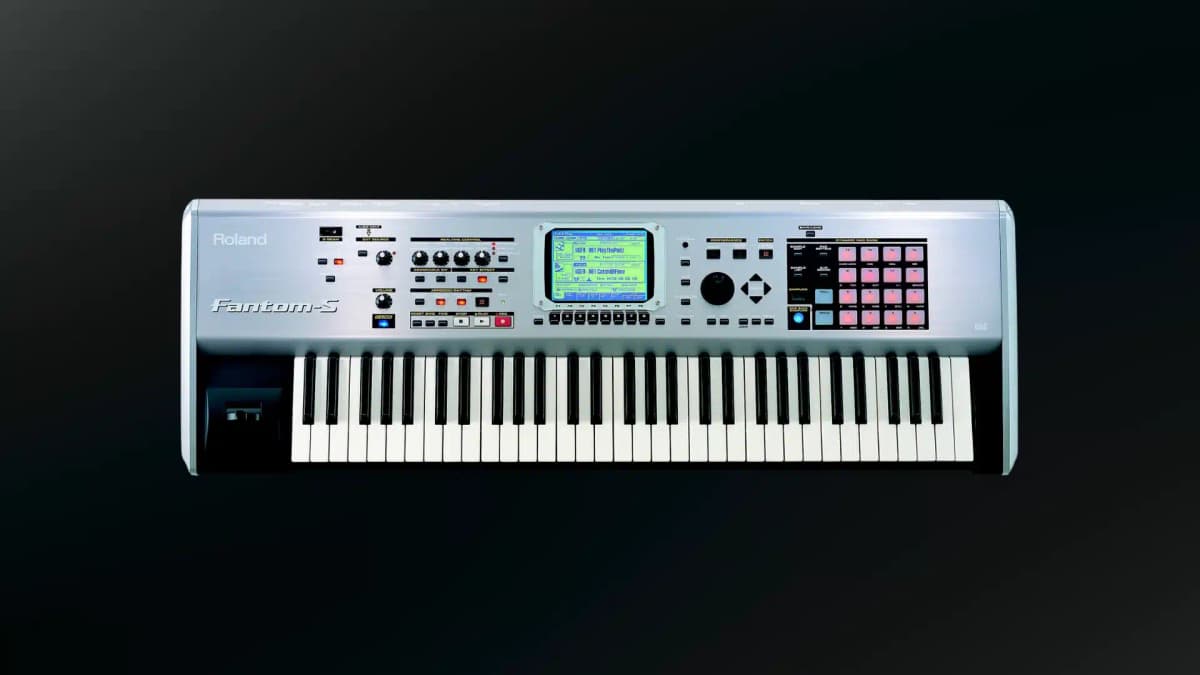
The Roland Fantom-S is a sampling workstation that Roland launched at the Winter NAMM show in January 2003, in two versions: the 61-key Roland Fantom-S and the 88-key Fantom-S88 with Progressive Hammer Action. It replaced the original 2001 Fantom and answered that instrument’s main criticism by adding a 16-bit, 44.1kHz sampler with 32MB of RAM expandable to 288MB, alongside a 64-voice XV-series engine with a new 64MB-equivalent wave ROM. Roland surrounded it with a 4 x 4 pad bank, Skip Back Sampling, a mastering compressor, USB file transfer and four SRX expansion slots. What makes it matter at a glance is that it turned the Fantom into a sampling workstation and set the template, pads included, for the Fantom-X and Fantom-G that followed.
Table of Contents
Roland Fantom-S sound and character
The Roland Fantom-S keeps the XV engine of the first Fantom, so its character is the same clean, detailed and mix-ready Roland PCM tone of the early 2000s. What changed was the material. The ROM grew to 1,228 waveforms, and Sound On Sound’s Nick Magnus reported improved piano and string waves and new dance-oriented drum and percussion samples. Roland’s own specifications stress newly sampled stereo waves, and its product page calls them the finest building blocks it had offered in a keyboard up to that point. Magnus summed the instrument up as one that looks great, sounds great and is surprisingly easy to use.
Owners on Audiofanzine generally praise the pianos, drums and presets but describe the strings as a little weak, a gap that SRX boards such as Symphonique Strings or Complete Orchestra were designed to fill. On the S88, Piano Mode limits selection to piano patches and adds lid, key-touch and sympathetic resonance controls, the last powered by an effect that the 61-key model lacks.
The sampler adds a second, rougher dimension. Samples can be recorded through the analog stereo input, resampled from the Roland Fantom-S’s own output, captured retrospectively with Skip Back, chopped, time-stretched to tempo and played from the keys or pads, with six input effects on the way in. Magnus found it best suited to spontaneous loops, vocal phrases and performance sampling, in the spirit of Roland’s SP-808, rather than to building deep multisampled instruments.
Its limits come from the engine. Polyphony stays at 64 voices and is shared between ROM sounds and samples, and the filter is the same clean digital TVF. The Roland Fantom-S belongs to the modern, polished side of the spectrum, closer to a production tool than to a characterful synth.
Features and architecture
- Manufacturer: Roland Corporation
- Year introduced: 2003; shown at Winter NAMM in January 2003, where Sonic State reported the instruments were already shipping
- Production years: 2003 to 2004, when the Fantom-X series replaced it
- Models: Roland Fantom-S (61 keys) and Fantom-S88 (88 keys); there was no 76-key version
- Synthesis type: PCM sample playback with subtractive processing (Roland XV architecture) plus user sampling
- Category: sampling music workstation
- Polyphony: 64 voices, shared between ROM sounds and samples
- Multitimbrality: 16 parts
- Original price: £1,799 (Roland Fantom-S) and £2,299 (Fantom-S88) including VAT, according to Sound On Sound in October 2003; US list prices are not consistently documented
- Current market price: Equipboard’s tracking of Reverb shows used Roland Fantom-S units averaging about $299 and Fantom-S88 units about $575 in 2026
- Oscillators: up to four mono or stereo tones per patch; 64MB (16-bit linear equivalent) wave ROM with 1,228 waveforms
- Filter: one TVF per tone with low-pass, band-pass, high-pass and peaking types, cutoff and resonance
- LFOs: two per tone, with new V-Sine and 16-step Step LFO waveforms
- Envelopes: pitch, filter and amplitude envelopes per tone
- Modulation system: Matrix Control, as on the XV engine
- Sampling: 16-bit linear at a fixed 44.1kHz; 32MB RAM, expandable by DIMM to 288MB (about 54 minutes mono or 27 minutes stereo); the full 288MB requires giving up two SRX slots, leaving 192MB with all four in use; Skip Back Sampling of up to 40 seconds; resampling; WAV and AIFF import and export
- Sample editing: truncate, normalize, emphasis, amp, time-stretch, chop and combine; tempo sync for loops; Create Multisample and Create Rhythm functions
- Sequencer / arpeggiator: 16 phrase tracks plus pattern, tempo and beat tracks, 480 ppqn; Roland’s specifications give about 400,000 notes while Sound On Sound described a 120,000-note song; RPS with 100 patterns; polyphonic arpeggiator with 128 preset and 128 user styles; 256 preset and 256 user rhythm patterns; chord memory
- Effects: three multi-effect processors (Roland lists 78 types, Sound On Sound counted 77), three chorus types, five 24-bit reverb types, six input effect types and a three-band mastering compressor
- Memory: 640 preset patches plus 256 GM2 patches, 64 preset performances; user memory of 256 patches, 32 rhythm sets and 64 performances, held in 16MB of flash RAM
- Expansion: four SRX slots; no SR-JV80 support; DIMM slot for sample RAM
- Storage: 16MB internal flash, SmartMedia cards up to 128MB, USB mass-storage connection for WAV and AIFF transfer
- Keyboard: Roland Fantom-S, 61-key synth action with velocity and channel aftertouch; Fantom-S88, 88-key Progressive Hammer Action with channel aftertouch and Piano Mode
- Controllers: 16 velocity- and aftertouch-sensitive pads, D-Beam with a hidden monophonic Solo Synth, four knobs, two assignable switches, pitch/modulation lever, V-LINK video control
- Inputs / outputs: four line outputs (two stereo or four mono), stereo line input with mic capability, coaxial and optical 24-bit S/PDIF outputs, headphones, hold and control pedal jacks; no digital input
- MIDI / USB: MIDI In, Out and Thru; USB for file transfer (editor software communicates via MIDI)
- Display: 320 x 240 pixel four-shade backlit LCD, not touch-sensitive
- Dimensions / weight: Fantom-S, 1,050 x 358 x 109 mm and 12.5 kg; Fantom-S88, 1,408 x 455 x 151 mm and 29.5 kg
- Power: internal power supply, 17 W
Strengths
- It fixed the first Fantom’s biggest omission. Sampling, resampling, an audio input and WAV/AIFF import brought the line level with the Korg Triton and Yamaha Motif, which had offered user sampling from the start.
- Skip Back Sampling is genuinely useful. Roland described it as a first for the instrument, continuously buffering what is played so that the last few seconds of an idea can be captured after the fact.
- The pad bank changed how the Fantom was played. Sixteen velocity- and aftertouch-sensitive pads trigger samples, ROM sounds or RPS phrases, which suited the loop-based production that was spreading in the early 2000s.
- Expansion is generous. Four SRX slots, compared with two on the original Fantom, and up to 288MB of sample RAM, which Roland claimed was more than any other workstation offered at launch.
- The sequencer is well regarded. Sound On Sound called it well specified and easy to use, and Audiofanzine owners praise its layout.
- The Fantom-S88 adds a respected hammer-action keyboard and Piano Mode, which made it a credible stage piano as well as a workstation.
Limitations
- Polyphony remained at 64 voices and is shared with the sampler, a ceiling the Fantom-X doubled to 128 a year later.
- There is no digital input, so all sampling passes through the analog converters, a point Sound On Sound and Vintage Synth Explorer both raised.
- It cannot import existing multisample libraries such as Akai or Roland S-series programs, it ignores loop points in imported WAV files, and it has no alternating loop mode.
- Using the maximum 288MB of sample RAM means giving up two of the four SRX slots, a trade-off that Sound On Sound felt the manual explained poorly.
- Samples are volatile unless saved to flash or SmartMedia, and SmartMedia cards are now an obsolete and scarce format.
- The 61-key keyboard drew criticism; Magnus found it rather clattery and a little too light.
- The Fantom-S88 weighs 29.5 kg, which makes it heavy to move, and the display, though large, is monochrome and not touch-sensitive.
Historical context
Roland’s first Fantom of 2001 had been praised for its sound and criticized for its lack of sampling, at a time when Korg’s Triton and Yamaha’s Motif included it. Roland already had sampling expertise in its S-series samplers, SP-808 and MC-909, and the XV-5080 module could load samples. The Fantom-S brought those threads into the workstation line, and also dropped SR-JV80 compatibility in favor of four SRX slots, moving the Fantom fully onto the newer expansion format.
Sonic State reported from Winter NAMM on January 30, 2003 that Roland was showing the Roland Fantom-S and the 88-key model alongside the V-Synth, and that both Fantoms were already shipping. Roland’s marketing called it the perfect marriage of sampling and synthesis and stressed audio and MIDI integration, real-time time-stretch and Skip Back Sampling. Sound On Sound’s October 2003 review priced the two models at £1,799 and £2,299 and concluded that Roland had addressed the original’s main weakness, while noting that the new sampler favored spontaneous use over library playback.