

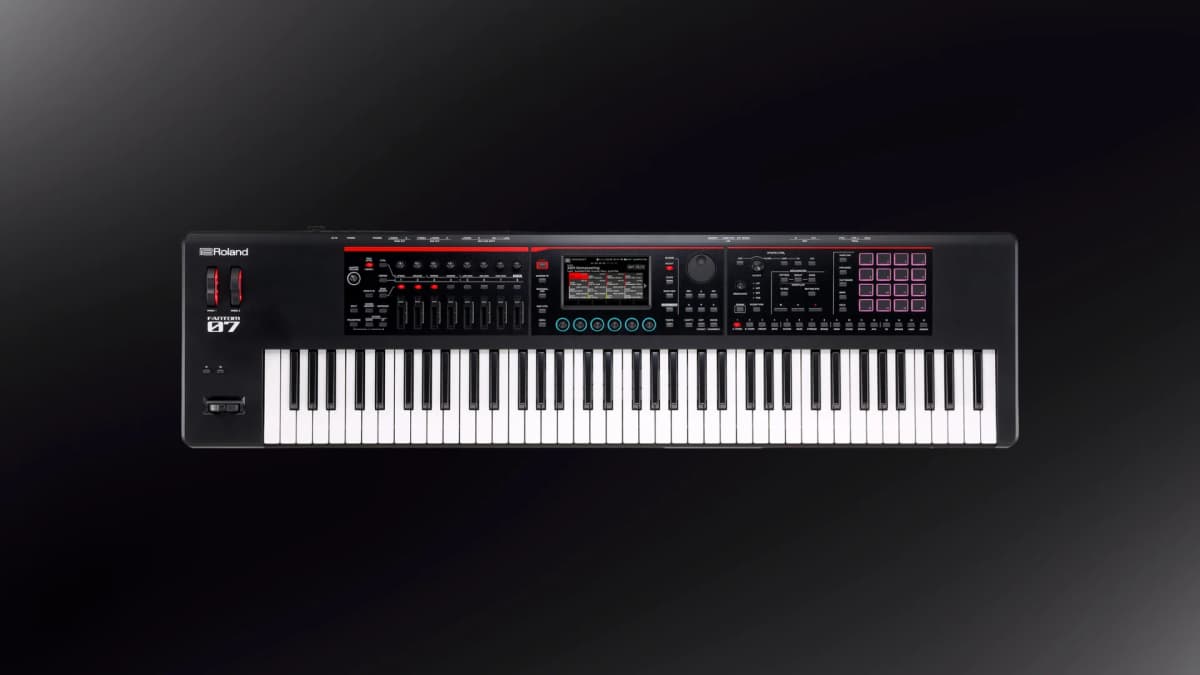
The Roland Fantom-0 is a series of three workstation keyboards, the 61-key Fantom-06, 76-key Fantom-07 and 88-key Fantom-08, that Roland announced in March 2022 and shipped from April that year. It takes the core of the 2019 Fantom flagship (the ZEN-Core engine with 256-voice polyphony, SuperNATURAL pianos, the Virtual ToneWheel organ, a 16-zone Scene structure, a clip-based pattern sequencer with TR-REC, sampling and a 4×32 USB audio interface) and puts it in a plastic chassis that weighs roughly half as much. The cuts are real: no aftertouch, no analog filter, no V-Piano, less processing and far less multisample memory. What it offers is most of the Fantom’s sound and workflow at a much lower price.
Table of Contents
Roland Fantom-0 sound and character
The Roland Fantom-0 sounds like a Fantom because it uses the same sound library. Sound On Sound’s Dave Stewart found the same 2,108 waveforms and the same counts of ZEN-Core tones, SuperNATURAL tones and drum kits as in the flagship, and Roland lists more than 3,500 tones and 90 drum kits. The character is that of a modern Roland workstation: polished, bright and mix-ready, strong on electric pianos, basses, pads and contemporary synth sounds, with a broad orchestral and world palette behind them. Stewart singled out the Rhodes sample as one of the best he had heard in a workstation, praised the fretless, slap and synth basses, and found the vocoder close in feel to his old Roland SVC-350.
Under the presets, ZEN-Core is a deep subtractive engine built on samples. Each tone has up to four partials, each with its own oscillator, filter, amplifier, envelopes and two LFOs, including 16-step LFOs, the same modulation structure as the full Fantom according to Synth Anatomy. The Virtual ToneWheel organ, available on zone 2, gives drawbars, percussion, vibrato and chorus, overdrive and rotary effects. Classic Roland synth recreations of the Jupiter-8, Juno-106, JX-8P and SH-101 are available as paid Model Expansions from Roland Cloud.
The differences from the flagship are mostly at the edges. The V-Piano modeled piano is gone, replaced by two SuperNATURAL pianos that Stewart rated well, one for loud pop and rock and one for quieter ballads. The analog filter, which on the flagship could process a few presets, is also absent. Processing comes from two of Roland’s BMC chips instead of four, so the Roland Fantom-0 has less headroom for heavy layering, and the n/zyme wavetable model expansion does not run on it, a point both Sound On Sound and MusicRadar’s review made.
Overall it sits firmly in the clean, contemporary workstation camp alongside Yamaha’s MODX and Korg’s Nautilus rather than among warm, characterful synths. Its strengths are versatility and production-ready presets, not a single signature voice, and its tonal range is close enough to the Fantom that most listeners would not hear the difference.
Features and architecture
- Manufacturer: Roland Corporation
- Year introduced: 2022; announced March 15, 2022 in Roland’s US press release (much coverage is dated March 16), with US availability in April 2022
- Production years: 2022 to present; Roland was still issuing system updates in July 2026
- Synthesis type: digital; ZEN-Core sample-based synthesis, SuperNATURAL Acoustic and piano engines, Virtual ToneWheel organ, and optional MODEL synth engines via EXM expansions
- Category: lightweight workstation keyboard in three sizes (Fantom-06, Fantom-07, Fantom-08)
- Polyphony: 256 voices, from two BMC chips (the flagship Fantom uses four)
- Multitimbrality: 16 zones per Scene (internal or external), with up to eight zones held through Scene changes by Scene Remain
- Original price: $1,499.99 (Fantom-06), $1,799.99 (Fantom-07) and $1,999.99 (Fantom-08) at launch in the US; by Sound On Sound’s January 2023 review, $1,599, $1,899 and $2,149, or £1,249, £1,499 and £1,599 in the UK
- Current market price: US dealers now list about $1,810 (Fantom-06), $2,160 (Fantom-07) and $2,430 (Fantom-08); Thomann shows the Fantom-06 around $1,199, and Reverb shows used Fantom-06 units around $1,077
- Oscillators: ZEN-Core tones with up to four partials, drawing on 2,108 waveforms; more than 3,500 preset tones and 90-plus drum kits
- Filter: digital multimode filters per partial; no analog filter, unlike the flagship
- LFOs: two per partial, including 16-step LFOs
- Envelopes: pitch, filter and amp envelopes per partial
- Modulation system: ZEN-Core matrix per tone; 8 knobs, 8 sliders, 6 function knobs, 2 sound-modify knobs, 2 assignable switches, pitch/mod lever and two illuminated wheels
- Sequencer / arpeggiator: 16-track pattern sequencer with up to eight patterns per track and up to 64 measures, realtime, step and TR-REC recording, piano roll with automation, scene chains, SMF import/export and SMF player; arpeggiator
- Sampling: keyboard multisampling with up to 2,048 samples and 128 multisamples in about 256 MB shared with expansions, up to 2 minutes 44 seconds per sample; pad sampler with 16 pads in four banks and up to 60 minutes of samples
- Effects: 16 multi-effects (90 types), 2 insert effects, total effect, input MFX, chorus, reverb, master compressor, part EQ, drum compressors and a vocoder with 13, 20 or 32 bands
- Memory: 128 Scenes in each of four banks; 2 GB internal storage plus USB memory
- Keyboard: Fantom-06 (61) and Fantom-07 (76) use a newly developed synth action; Fantom-08 (88) uses PHA-4 Standard weighted action with escapement and ivory feel; no aftertouch on any model
- Inputs / outputs: balanced 1/4-inch main outputs, sub outputs, headphones, 1/4-inch mic input, stereo line inputs, three pedal jacks (hold, control 1, control 2), external device port for Roland A-series controllers
- MIDI / USB: MIDI In and Out; USB computer port as an audio interface up to 24-bit/96 kHz (16 stereo recording and 2 stereo playback channels); USB memory port; integration with Logic Pro, MainStage and Ableton Live
- Display: 5.5-inch 1280 x 720 color touchscreen
- Dimensions / weight: Fantom-06 1,006 x 323 x 95 mm, 6.0 kg; Fantom-07 7.0 kg; Fantom-08 1,393 x 354 x 138 mm, 14.8 kg
- Power: external AC adaptor
Strengths
- It delivers nearly the full Fantom sound library for much less money. Reviewers found the same waveforms and tone counts as the flagship, at a launch price far below it.
- It is light enough to carry easily. The 61-key model weighs 6.0 kg against 15.3 kg for the Fantom 6, which matters for players who gig without help.
- The workflow suits both stage and studio. Scenes hold sounds, splits, patterns and layouts together, and the clip sequencer with TR-REC and piano roll makes it a capable sketchpad.
- Sampling was built in from the start. Keyboard multisampling and a 16-pad sampler let users add their own material without extra software.
- It integrates well with computers. The USB audio interface and native support for Logic Pro, MainStage and Ableton Live let it act as both instrument and control surface.
- The screen is sharper than the flagship’s. Its 5.5-inch 1280 x 720 touchscreen has a higher resolution than the original Fantom’s 800 x 480 display, as MusicRadar noted.
Limitations
- There is no aftertouch on any model, a notable gap for a workstation at this price and a complaint in nearly every review.
- Multisample memory is tight. About 256 MB has to hold user multisamples, expansions and Model Tones, which Sound On Sound’s reviewer called a miserly allocation.
- The build is lighter in every sense. The plastic body feels less sturdy than the metal flagship, and Sound On Sound found the Fantom-06 keybed a little spongy and resistant for fast runs.
- Some flagship features are missing: the V-Piano engine, the analog filter, dedicated envelope controls and several rear connections, including XLR outputs and CV/gate.
- Less processing power means some expansions, notably n/zyme, do not run on it.
- The Scene, Zone and Tone structure takes time to learn, a point MusicRadar raised, and power comes from an external adaptor rather than an internal supply.
- Prices have risen well above launch levels, which narrows the value gap with competitors.
Historical context
The Fantom name dates to Roland’s 2001 workstation and passed through the Fantom-S, Fantom-X and Fantom-G before the FA-06, FA-07 and FA-08 series. In 2019 Roland relaunched it with the Fantom 6, 7 and 8, heavy metal-bodied flagships built around the new ZEN-Core platform, which have their own article on this site. They were well received but expensive and heavy: the 88-key Fantom 8 weighs 27.7 kg. Keyboard Chronicles described the new series as Roland’s response to a market segment it saw as dominated by boards like the Yamaha MODX.
Roland announced the Roland Fantom-0 series in March 2022, promising core Fantom features in highly portable instruments, and shipped it in April at $1,499.99, $1,799.99 and $1,999.99. Gearnews summed up the pitch: the weight more than halved, with the flagship’s strengths in a more versatile form for a much lower price, but no analog filter or aftertouch. Sampling, which the original Fantom gained in a 2020 update, was present from day one, and backup files were made compatible with the Fantom 6/7/8, reading only the features the smaller model supports.