

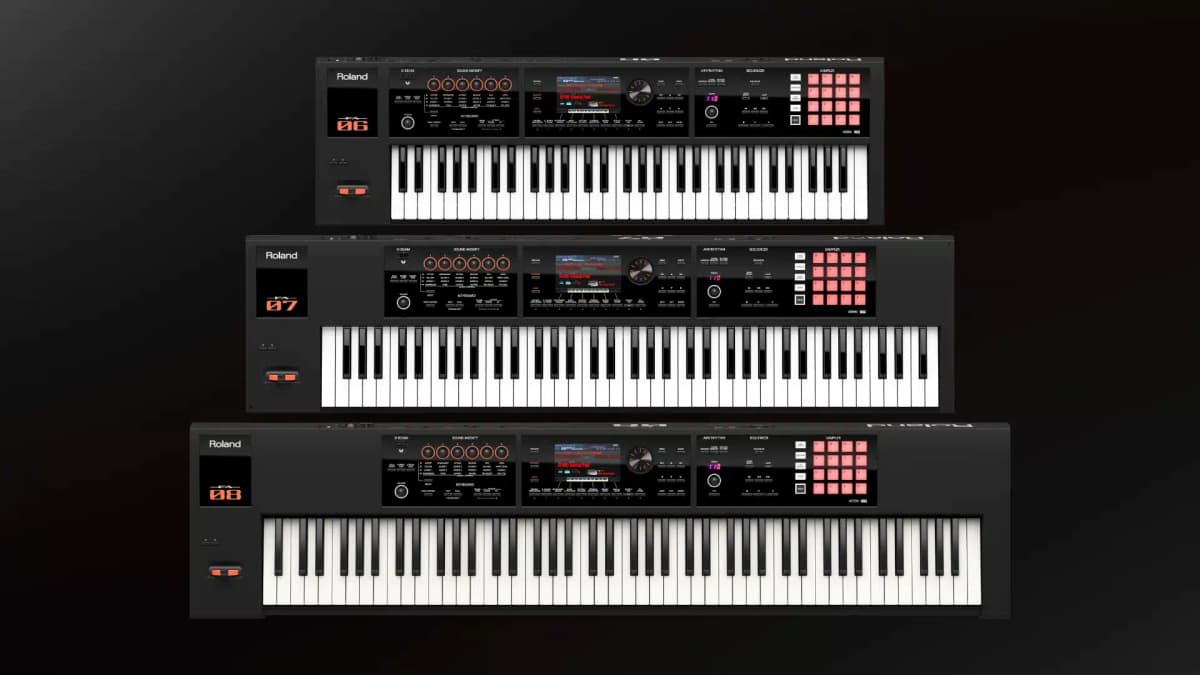
The Roland FA series is a family of music workstations built around the sound engine of the Integra-7 module. Roland announced the 61-key Roland FA-06 and the 88-key, weighted FA-08 at Winter NAMM in January 2014, and added the 76-key FA-07 in June 2017. All three share more than 2,000 tones, including SuperNATURAL Acoustic, SuperNATURAL Synth and XV-5080 PCM sounds, with 128-voice polyphony, 16 parts, a 16-track loop-recording sequencer, an SP-404SX-style sampler on 16 pads, and a USB audio interface. At a glance the FA matters because it brought Roland’s flagship sound set into a light, comparatively affordable keyboard after the heavy and expensive Fantom-G, and became one of the company’s most widely used working instruments of the 2010s.
Table of Contents
Roland FA-06 sound and character
The FA sounds like a condensed Integra-7, which is to say clean, detailed and very broad. Sound On Sound’s Gordon Reid listed the factory content as 1,115 SuperNATURAL Synth tones, 100 SuperNATURAL Acoustic tones, 897 XV patches, 256 General MIDI 2 tones and drum kits. MusicRadar’s FA-08 review rated the pianos, electric basses, strings, woodwinds and acoustic guitars as excellent and on a par with the Integra-7 and the Jupiter-50 and Jupiter-80.
The SuperNATURAL Acoustic tones are the core of the Roland FA-06’s reputation. They respond to velocity and articulation more smoothly than conventional multisample layers, and Keyboard magazine’s review, republished by MusicRadar, singled out the library and the SuperNATURAL velocity response as the Roland FA-06’s main strength. The XV and PCM banks supply the classic Roland side, including sounds associated with the D-50 and the TR-808 and TR-909.
The Roland FA-06 side is punchy and dance-oriented. MusicTech’s Andy Jones praised the rich bottom end and the leads and found the Roland FA-06 section weighted toward heavier dance music rather than strange evolving pads. MusicRadar noted that the SuperNATURAL synth engine lacks the modeled filter types of the newer Jupiter models, and that the tonewheel organ has no dedicated chorus and vibrato.
Effects carry much of the polish: every one of the 16 parts has its own multi-effect (68 types, including a vocoder) and EQ, plus six compressor and EQ units for drum parts, global chorus and reverb, and Total Effects such as a DJ-style looper and isolator. The result is a modern, hi-fi, production-ready Roland sound rather than a characterful one, with limits that show mainly when polyphony runs short on heavy layers.
Features and architecture
- Manufacturer: Roland Corporation, Japan
- Year introduced: Roland FA-06 and FA-08 announced at Winter NAMM, January 2014; FA-07 announced June 20, 2017 (not 2016, as some lists give)
- Production years: from 2014; Roland now lists the series as discontinued, but no official end date is published
- Synthesis type: SuperNATURAL Acoustic, SuperNATURAL Synth and SuperNATURAL Drum modeling plus PCM synthesis, all derived from the Integra-7
- Category: music workstation in three keyboard sizes
- Polyphony: up to 128 voices, varying with sound generator load
- Multitimbrality: 16 parts in a Studio Set
- Original price: Roland FA-06 $1,399 list and about $1,199 street; FA-08 $2,099 list, with street prices reported between $1,799 and $1,899; FA-07 about $1,499 street; UK launch prices of £825 (Roland FA-06) and £1,299 (FA-08)
- Current market price: used Roland FA-06 units list around $650 to $700 on Reverb; FA-08 listings range more widely, from about $650 upward
- Oscillators: more than 2,000 preset tones; two virtual wave expansion slots for free Axial and Roland expansion libraries loaded from USB memory
- Filter: per-partial filters in the PCM and SuperNATURAL Synth engines; no modeled filter types
- LFOs: per-tone LFOs in the Roland FA-06 engines
- Envelopes: per-partial pitch, filter and amplitude envelopes
- Modulation system: six assignable Sound Modify knobs with a 6 x 4 parameter matrix, D Beam, pitch/mod lever, two assignable switches and pedal inputs
- Sampling: SP-404SX-based phrase sampler, 16 pads x 4 banks per song, 8-voice sample polyphony, 16-bit/44.1kHz, WAV, AIFF and MP3 import, stored on SD/SDHC card; samples cannot be used as wave data in tones
- Sequencer / arpeggiator: 16 MIDI tracks with non-stop loop recording and step recording, SMF import and export, WAV export to SD card; arpeggiator, Rhythm Patterns and Chord Memory
- Effects: 16 multi-effects (68 types), 16 part EQs, 6 drum COMP+EQ units, 29 Total Effects types, chorus, reverb, input reverb, master compressor and EQ
- Memory: SD card storage (a 4GB card was included); 512 Studio Set slots
- Keyboard: FA-06 61-key synth action; FA-07 76 keys, described by Roland as semi-weighted and by some retailers as synth action; FA-08 88-key Ivory Feel-G weighted action; velocity sensitive, no aftertouch
- Inputs / outputs: main L/Mono and R outputs, mono sub output, 1/4-inch mic/guitar input, 3.5mm stereo line input, headphones, hold and two control pedal jacks
- MIDI / USB: MIDI In and Out; USB to computer for audio and MIDI with one-button DAW Control; USB host port for memory
- Display: 5-inch color graphic LCD, not touch-sensitive
- Dimensions / weight: FA-06 1,008 x 300 x 101 mm and 5.7 kg; FA-08 about 1,415 x 340 x 142 mm and 16.5 kg
- Power: external 9V DC adapter
Strengths
- The sound set is first-rate for the price. Inheriting the Integra-7’s SuperNATURAL and XV content gave a mid-priced workstation pianos, basses and acoustic instruments that reviewers ranked with Roland’s flagships.
- It is genuinely portable. At 5.7 kg the Roland FA-06 is a fraction of the weight of the Fantom-G, and even the FA-08 is about half the weight of the Fantom-G8, according to Sound On Sound.
- The sequencer is fast. Non-stop loop recording across 16 tracks made it, in Gordon Reid’s words, an excellent scratchpad, and finished parts can be exported as WAV stems or MIDI.
- The pad sampler is immediate. Based on the SP-404SX and stored on SD card with no load time, it works well for loops, one-shots and backing tracks on stage.
- It integrates easily with a computer. The USB audio interface, the DAW Control button and, from version 2.0, a built-in Ableton control map made it a useful studio hub.
- Roland supported it for years. Version 2.0 added Tone Remain and master control functions, and the current system program is version 2.03.
Limitations
- There is no aftertouch on any model, a significant omission on a workstation intended for live playing.
- The I/O is minimal. Sound On Sound criticized the lack of an XLR input and individual part outputs, and the use of an external power supply rather than an IEC socket.
- The 5-inch screen gets crowded, particularly in sequence editing, and there is no touchscreen or official computer editor.
- The sampler is a phrase player, not a full sampler. Samples cannot be mapped across the keyboard or used as partials, which Yamaha’s MOXF allowed.
- The pads are basic. Keyboard magazine found them not velocity-sensitive in use, despite Roland’s launch material describing velocity-sensitive pads.
- Polyphony of 128 voices runs out quickly with layered SuperNATURAL sounds, so voice reserve settings matter.
- The FA-08’s action divided reviewers. MusicRadar found its key return sluggish for fast synth, organ and clavinet parts, and Sound On Sound found it too slow for rapid hi-hat rolls.
Historical context
Roland’s workstation line had reached a costly peak with the Fantom-G of 2008, while the company’s SuperNATURAL technology moved into the Jupiter-80, the Jupiter-50 and the Integra-7 rack module of 2012. The FA series was the logical consolidation: take the Integra-7’s sound content, add the sampling approach of the SP-404SX and a simple loop sequencer, and put them in a light chassis priced against Korg’s Krome and Yamaha’s MOXF, the two rivals MusicRadar named in its verdict.
Roland’s press release of January 15, 2014 introduced the Roland FA-06 and FA-08 with identical feature sets. Bonedo’s NAMM report noted that prices and availability had not yet been announced, and reviews followed from March 2014. Sound On Sound’s August 2014 review summed up the Roland FA-06 as competitively priced and portable, with cost-driven compromises in controllers and I/O.