

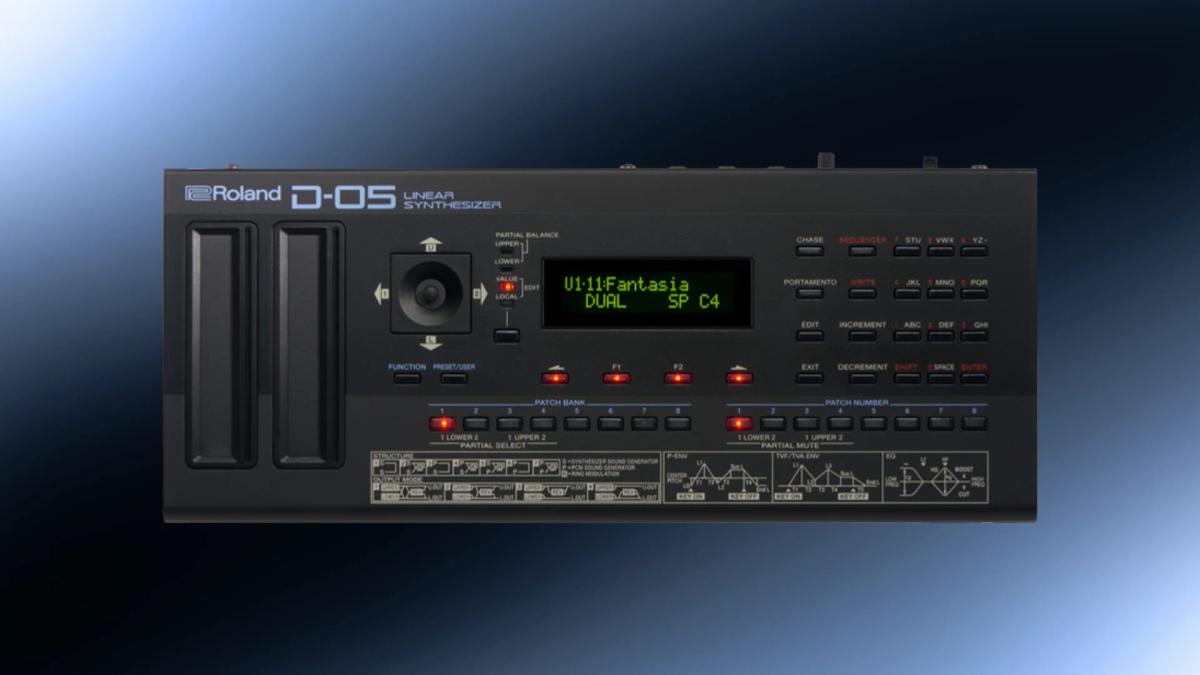
The Roland D-05 is a compact digital synthesizer module from Roland’s Boutique series that recreates the 1987 Roland D-50 and its Linear Arithmetic engine. Roland announced it in September 2017, and it reached stores the following month. Instead of the Analog Circuit Behavior modeling used for the earlier analog-inspired Boutiques, the D-05 relies on a technology Roland calls Digital Circuit Behavior (DCB), paired with the original D-50 PCM attack and loop samples. A single unit offers the D-50’s full 16-voice polyphony, two tones per patch, the original structures, chorus, reverb and EQ, and the joystick for balancing tones. Roland also added a 64-step polyphonic sequencer, an arpeggiator, USB audio and MIDI, and battery power. Six banks of factory presets, including the contents of the old D-50 memory cards, and 512 user slots made it the most direct way to get the late-1980s D-50 sound into a modern studio.
Table of Contents
Roland D-05 sound and character
The D-05 sounds like a D-50, and most reviewers agreed on that point. Gordon Reid, testing it side by side with an original for Sound On Sound, found the factory patches indistinguishable from the 1987 instrument, citing classics such as Fantasia, Digital Native Dance and Glass Voices. His summary was blunt: “I could immediately say that the D-05 is a D-50.” Si Truss of MusicRadar reached a similar conclusion and suggested that even experienced D-50 owners would struggle to pick the two apart in a blind test. He also pointed out why: recreating an instrument that was already digital is a more tractable problem than modeling analog circuitry.
The character itself is the character of Linear Arithmetic synthesis. Each sound can start with a short sampled transient, such as a breathy chiff, a mallet strike or a bowed scrape, and then move into a sustained tone generated by the synthesizer section or by a looped PCM wave. Layering two tones per patch, with chorus and reverb on top, produces the glassy bells, airy pads and evolving textures that defined many records and film scores of the late 1980s. MusicRadar described the patches as having an otherworldly complexity well suited to ambient and cinematic work, while noting that the PCM content ties the sound strongly to its era.
That period flavor cuts both ways. Dave Gale, reviewing the Boutique modules for MusicTech, liked the sharp, clear sound and found that some patches came close to an analog quality, but he also called the D-05 a date-stamped product whose appeal depends on wanting that specific late-1980s palette. The famous presets, Fantasia above all, are so widely recognized that they can read as quotation rather than as fresh material. Programmers who dig into the synthesized partials and the resonant filter can move away from the factory clichés, and the result can be warmer and more analog-leaning than the presets suggest.
Roland reproduced some of the original’s quirks along with the tone. Sound On Sound noted that the D-05 keeps the D-50’s original output resolution as an option, alongside a higher-resolution “clear” mode carried over from Roland’s later VC-1 D-50 card for the V-Synth, though the reviewer found the difference subtle. The PCM partials draw on the D-50’s original set of 100 waves, without the extra waveforms Roland later added to the V-Synth XT. The small internal speaker on the underside is useful only for checking that the unit is working; serious listening needs headphones or monitors.
Much of the D-05’s expressive range comes from how its two tones interact. Each patch pairs an Upper and a Lower tone, and each tone combines two partials through one of seven structures, some of which add ring modulation for metallic, bell-like timbres. The joystick shifts the balance between the tones in real time, and the three Chase modes play the tones in sequence for echo-like or rhythmic effects. Nine key modes, according to Sound On Sound, cover single-tone, layered, split and monophonic setups, so the same patch can sound broad and lush in one mode and focused in another. Velocity and aftertouch respond as they did on the D-50, while two ribbons on the left of the panel take over pitch bend and modulation.
Features and architecture
- Manufacturer: Roland Corporation
- Year introduced: 2017 (announced in September 2017, released in October 2017)
- Production years: 2017 to an undocumented end date; Roland now lists the D-05 as discontinued
- Synthesis type: Linear Arithmetic (LA) synthesis, recreated with Roland’s Digital Circuit Behavior (DCB) technology and the original D-50 PCM attack and loop samples
- Category: Compact digital synthesizer module (Roland Boutique series)
- Polyphony: 16 voices in Whole mode; 8 voices in Dual or Split modes
- Multitimbrality: Two parts; the Upper and Lower tones can be split across the keyboard or addressed on separate MIDI channels
- Original price: About $349 in the US and £349 in the UK at launch
- Current market price: No longer sold new; used units in October 2026 cluster around $450, with individual asking prices varying widely
- Oscillators: 32 partials in total; each tone uses up to two partials, each either a synthesized waveform or one of the D-50’s 100 PCM waves
- Filter: Resonant low-pass Time Variant Filter (TVF) on synthesized partials, with its own envelope
- LFO: Three LFOs, as on the D-50
- Envelopes: Pitch envelope plus TVF and Time Variant Amplifier (TVA) envelopes
- Modulation system: Seven structures for combining two partials by mixing or ring modulation; joystick for balancing Upper and Lower tones; two ribbon controllers for pitch bend and modulation; velocity and aftertouch response; Chase modes for sequenced tone playback
- Sequencer / arpeggiator: 64-step polyphonic sequencer with 64 pattern memories, storing tempo, gate, shuffle and patch changes; arpeggiator with one- and two-octave up, down and up-down modes, step values from quarter notes to sixteenth-note triplets, and hold; both sync to MIDI clock
- Effects: Chorus and EQ per tone, plus reverb/delay per patch
- Memory: 384 preset patches (6 banks of 64), 512 user patches (8 banks of 64) and 64 patterns; original D-50 patches can be loaded
- Keyboard: None built in; compatible with the optional K-25m 25-key velocity-sensitive keyboard unit and the DK-01 Boutique Dock
- Inputs / outputs: 3.5 mm stereo output, 3.5 mm headphone output, 3.5 mm stereo mix input; built-in speaker
- MIDI / USB: 5-pin MIDI In and Out (no Thru); Micro-B USB port for audio, MIDI and power, allowing the D-05 to act as a computer audio interface
- Display: 16-character, two-line LCD
- Dimensions / weight: 300 x 128 x 46 mm; about 900 g including batteries
- Power: Four AA batteries (alkaline or rechargeable Ni-MH, about five hours on Ni-MH) or USB bus power (500 mA)
Strengths
- The sound is a faithful D-50. Side-by-side tests in Sound On Sound and MusicRadar found the D-05 practically indistinguishable from the 1987 original.
- One unit offers full polyphony. Unlike the four-voice launch Boutiques, the D-05 delivers all 16 voices without chaining a second module.
- The preset library is vast. The factory banks include the original D-50 sounds, the content of the rare D-50 memory cards and a new bank, alongside 512 user locations.
- The sequencer and arpeggiator add something genuinely new. The sequencer is polyphonic, patterns store tempo and patch changes, and both follow MIDI clock, which the original D-50 never did.
- Real-time editing works with the PG-1000. Sound On Sound found that the vintage programmer could sweep parameters on held notes, something a D-50 itself cannot manage.
- It is small, solid and self-powered. The metal panel, battery operation and built-in speaker make it easy to carry, especially in the K-25m.
- USB audio simplifies a basic setup. The single Micro-B port carries audio, MIDI and power, so the module can record directly into a computer.
Limitations
- Programming on the panel is slow. MusicTech likened editing to “keyhole surgery,” and MusicRadar also found the button-based interface fiddly.
- The connections are consumer grade. Mini-jack audio sockets and USB power led Sound On Sound to judge the module unsuitable for regular stage use.
- The joystick feels fragile. MusicRadar described it as small and somewhat flimsy, a notable weakness on an instrument where tone balance is central.
- The display is cramped. The two-line LCD shows far less than the D-50’s screen, which makes deep editing even more menu-bound.
- Some sequencer settings are not saved. Sound On Sound noted that step order, start and end points and muted-step handling are lost between patterns.
- MIDI control is limited. Like the D-50, the D-05 responds to only a modest set of control change messages, so most editing depends on SysEx-capable tools.
- Ground loops are possible over USB. Sound On Sound heard hum when the mix input and USB connection shared a computer, which battery power solved.
Historical context
The instrument behind the D-05 arrived in 1987, when the D-50 became Roland’s first major digital synthesizer and one of the defining sounds of the period. Its Linear Arithmetic approach combined short sampled attack transients with subtractive synthesis for the sustained portion of a sound, a practical workaround for the expensive memory of the time. At launch it cost roughly $1,895 to $2,095 in the US and £1,445 in the UK. Its factory patches, authored by Eric Persing and Adrian Scott, included Fantasia and Digital Native Dance, and the instrument was used by artists ranging from Prince and Jean-Michel Jarre to Enya and the Pet Shop Boys. Roland also offered the PG-1000 programmer and the D-550 rack version.