

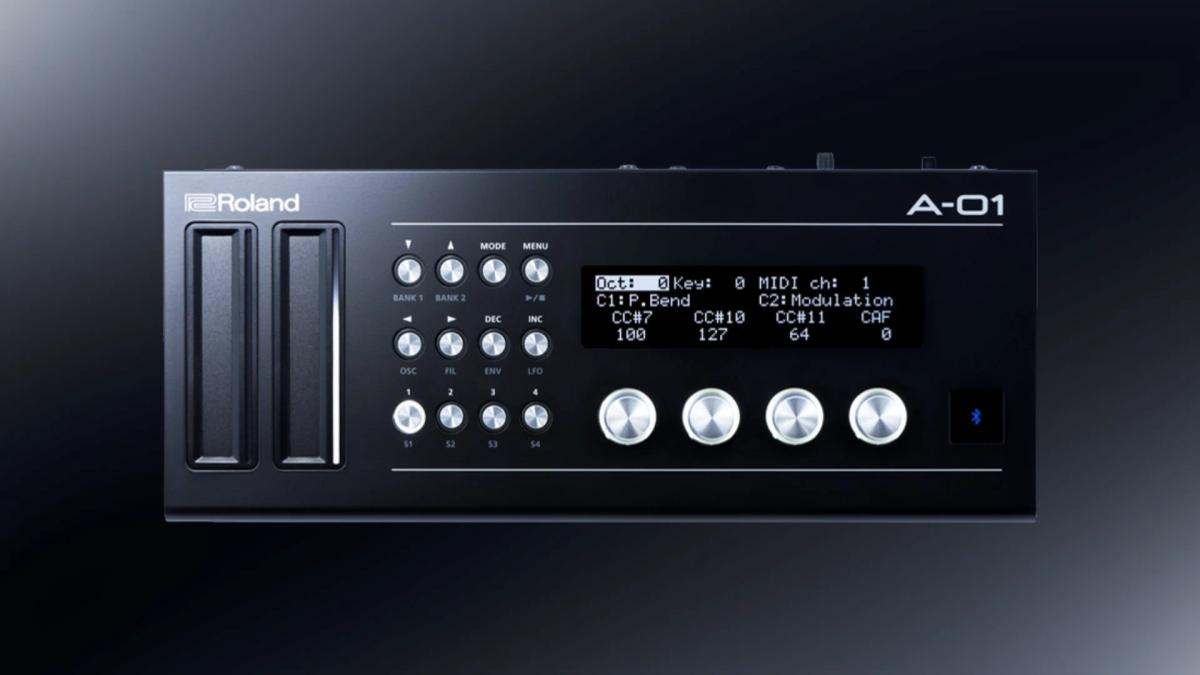
The Roland A-01 is a compact MIDI and CV/Gate controller, 16-step sequencer and monophonic synthesizer built into a metal case the size of a Roland Boutique module. Roland announced it on January 19, 2016, at the NAMM Show in Anaheim, and by the end of that month Synthtopia reported it on sale in the A-01K bundle with the K-25m keyboard dock. Its sound comes from an 8-bit CPU running a subtractive synth engine with one oscillator, a multimode filter and a 10-bit digital-to-analog converter, written by former Roland engineer Akira Matsui as a project he built at home. Around that engine Roland placed standard MIDI, USB MIDI, Bluetooth LE MIDI, CV and Gate outputs, two ribbon controllers and an unusually large graphic display. What makes the A-01 interesting is that combination: few devices this small tried to connect computers, phones, vintage synths and modular gear at once.
Table of Contents
Roland A-01 sound and character
The voice of the A-01 is small by design. In Roland’s own interview with its creator, Akira Matsui explains that the engine runs on an 8-bit CPU with only 8 KB of memory, computes everything at a 48 kHz rate and feeds a deliberately lo-fi 10-bit converter. He stresses that the oscillator genuinely oscillates rather than replaying stored samples, and that the noise source is generated the same way. Noise, he says, was the most expensive part of the design in processing terms, and he spent effort making it pleasant enough to shape. Roland presents the result as a vintage digital take on virtual analog synthesis, and that is a fair summary of how it behaves: the architecture is analog-style subtractive synthesis, but the grain of the output belongs to early microprocessor hardware.
The signal path is a single oscillator offering sawtooth, square, pulse and noise, followed by a filter that emulates state-variable designs and then an amplifier stage. Bonedo’s review lists low-pass, band-pass and high-pass modes plus a bypass setting, with dedicated knobs for cutoff, resonance, envelope depth and LFO depth. The LFO offers sine, square, sawtooth and random shapes, and Matsui notes that its rate can be pushed high enough to produce FM-like, overtly digital modulation. He describes the envelope as an attempt to reproduce the behavior of a classic resistor-and-capacitor analog envelope, and he says the final tuning of the engine was done by ear, through trial and error, within the 8 KB limit.
Reviewers heard the character clearly and judged it differently. Marcus Schmahl, writing for Bonedo in March 2016, found the sound gritty and pared back, exactly what one would expect from an 8-bit source. He admitted it was not personally to his taste, called the 16 factory presets modest but illustrative, and missed polyphony most when trying piano-like sounds. Robin Lee of Juno Daily was warmer, hearing plenty of crunch and edge and recommending the engine for basses, leads and sound effects, while noting that the conversion resolution is not high. Matsui himself points users toward the sawtooth patches, which he describes as having a persistent tone that might satisfy anyone who simply loves that waveform.
Much of the A-01’s musical identity comes from pairing the engine with its sequencer. According to Juno Daily, each of the 16 steps can be tied or slid, and filter cutoff and resonance can be set per step, which suits short, acidic or game-like phrases. Matsui singles out the sequencer’s shuffle function as one of the best-designed parts of the finished product. The graphic display shows the output waveform in real time, a small detail that makes filter and pulse-width changes visible as well as audible. In 2018 Synthtopia featured a video of chiptune-style music made on the A-01, which is a reasonable indication of where its sound naturally sits: closer to home computer music than to the warm analog modeling of the other Boutique models.
Features and architecture
- Manufacturer: Roland Corporation
- Year introduced: 2016 (announced January 19, 2016, at the NAMM Show in Anaheim)
- Production years: 2016 to an end date Roland has not published; the product is now listed as discontinued
- Synthesis type: digital subtractive synthesis emulated on an 8-bit CPU (described by Roland as vintage digital virtual analog), with a 10-bit D/A converter
- Category: MIDI and CV/Gate controller, step sequencer and sound module (Roland Boutique series)
- Polyphony: monophonic (one voice)
- Multitimbrality: none for the internal engine
- Original price: launch reports differed; Fact Magazine quoted $599 at the announcement, while Synthtopia reported a US street price of $399 for the A-01K bundle with the K-25m in late January 2016; a UK launch price for the A-01 alone was not found in the sources consulted
- Current market price: used only; roughly $165 on average for the A-01 module on Reverb, per Equipboard in October 2026
- Oscillators: one oscillator with sawtooth, square and pulse waveforms (Juno Daily mentions pulse-width modulation), plus a computed noise source
- Filter: emulation of state-variable filter designs with low-pass, band-pass and high-pass modes or off; cutoff, resonance, envelope depth and LFO depth controls
- LFO: one LFO with sine, square, sawtooth and random waveforms; rate extends to FM-like speeds
- Envelopes: ADSR envelope modeled on a classic resistor-and-capacitor analog envelope (Juno Daily lists one ADSR)
- Modulation system: LFO and envelope routed to the filter; two assignable ribbon controllers for pitch bend, modulation, sound preview, channel and polyphonic aftertouch, CC and SysEx; assignable dials
- Sequencer / arpeggiator: 16-step sequencer with tie, slide, per-step filter cutoff and resonance, shuffle and external tempo sync; drives the internal engine or external gear via MIDI and CV/Gate; no arpeggiator documented
- Effects: none listed in Roland’s specifications
- Memory: 16 controller patches (4 x 4 banks), 16 synth tones (8 x 2 banks), 16 sequencer patterns (8 x 2 banks)
- Keyboard: none built in; docks with the optional K-25m (25 velocity-sensitive mini keys), sold as the A-01K bundle
- Inputs / outputs: MIDI IN and OUT, CV OUT and GATE OUT (stereo mini jacks), PHONES (stereo mini jack), built-in 0.5 W speaker
- MIDI / USB: 5-pin MIDI IN/OUT, USB Micro-B (MIDI), Bluetooth LE MIDI
- Display: 192 x 40 graphic LCD that can show the output waveform
- Dimensions / weight: 300 x 128 x 46 mm; 950 g (2 lb 2 oz)
- Power: four AA batteries (Ni-MH or alkaline, about 12 hours continuous on Ni-MH) or USB bus power (500 mA)
Strengths
- It bridges almost every kind of connection in one small box. MIDI DIN, USB MIDI, Bluetooth LE MIDI and CV/Gate let it link a laptop, a tablet, older MIDI synths and modular gear from the same unit.
- The CV and Gate outputs work with real analog hardware. Bonedo found them reliable with semi-modular synths and noted that output voltage levels can be adjusted in the preferences.
- The ribbon controllers are genuinely flexible. Both are freely assignable, and Bonedo reported that the illuminated strips respond directly and that the left one can also be used to play notes.
- The display is large and informative. Bonedo praised its 192 x 40 graphic screen as genuinely large compared with the displays on the other Boutique models, and it can draw the output waveform as well as parameters.
- The internal engine has a distinct voice. Its gritty 8-bit grain suits basses, leads, effects and chiptune-style lines, and it does not imitate any other instrument in the series.
- The build is solid and fully portable. A metal top, four AA batteries or USB power and a built-in speaker make it usable almost anywhere, as both Bonedo and Juno Daily noted.
Limitations
- The synth is strictly monophonic. Roland’s specifications describe a single-voice engine, and Bonedo counted the lack of chords among its main drawbacks.
- Sequencer programming is slow. Steps are edited through menu pages rather than one button per step, a workflow both Bonedo and Juno Daily found less convenient than on the other Boutique models.
- Sequences cannot be recorded in real time. Juno Daily noted that patterns must be entered step by step, which slows down capturing a played idea.
- Memory is small. Each mode stores only 16 slots, and Bonedo listed the 16 internal synth patches as a limitation.
- Setup involves menu diving. Juno Daily described configuring MIDI channels and assignments as a task that demands patience.
- Audio resolution is limited. The 10-bit converter is intentional, but it means the internal engine is not a clean or wide-range sound source.
- The panel labels are hard to read in dim light. Bonedo pointed out that the dark button legends lose contrast on stage or in a dark room.
Historical context
Roland launched the Boutique series in 2015 with three reduced-size modules modeled on classic instruments: the JU-06, the JX-03 and the JP-08, the last based on the Jupiter-8. As Peter Kirn reported for CDM at the time, these used Roland’s Analog Circuit Behavior modeling, offered four voices each, ran on batteries or USB power and could dock into an optional mini keyboard. The A-01 arrived a few months later and broke that pattern. It used the same case size and the same K-25m dock, but it was not a recreation of any vintage instrument. Roland’s product page says only that its engine echoes the concept of the Boutique family, and the unit’s main job was control rather than sound generation.
The engine’s history is the most unusual part of the story. According to Roland’s interview, Akira Matsui joined the company in 1977 and worked on the SYSTEM-700 and the System-100, early GR-series guitar synthesizers including the GR-700, the VS series and the JX-3P, which was the first synthesizer for which he programmed a microprocessor. He retired in 2013. He then built the 8-bit synth as a home project, partly to see how far a cheap 8-bit processor and 8 KB of memory could be pushed at a time when powerful processors had made conventional digital synths easy to build. He showed it at Maker Faire Tokyo in 2014, where a Roland staff member noticed it, and the design eventually became the A-01’s internal sound generator. Roland’s press materials and several launch reports, including Gearnews, described it as the work of the engineer behind the JX-3P.