

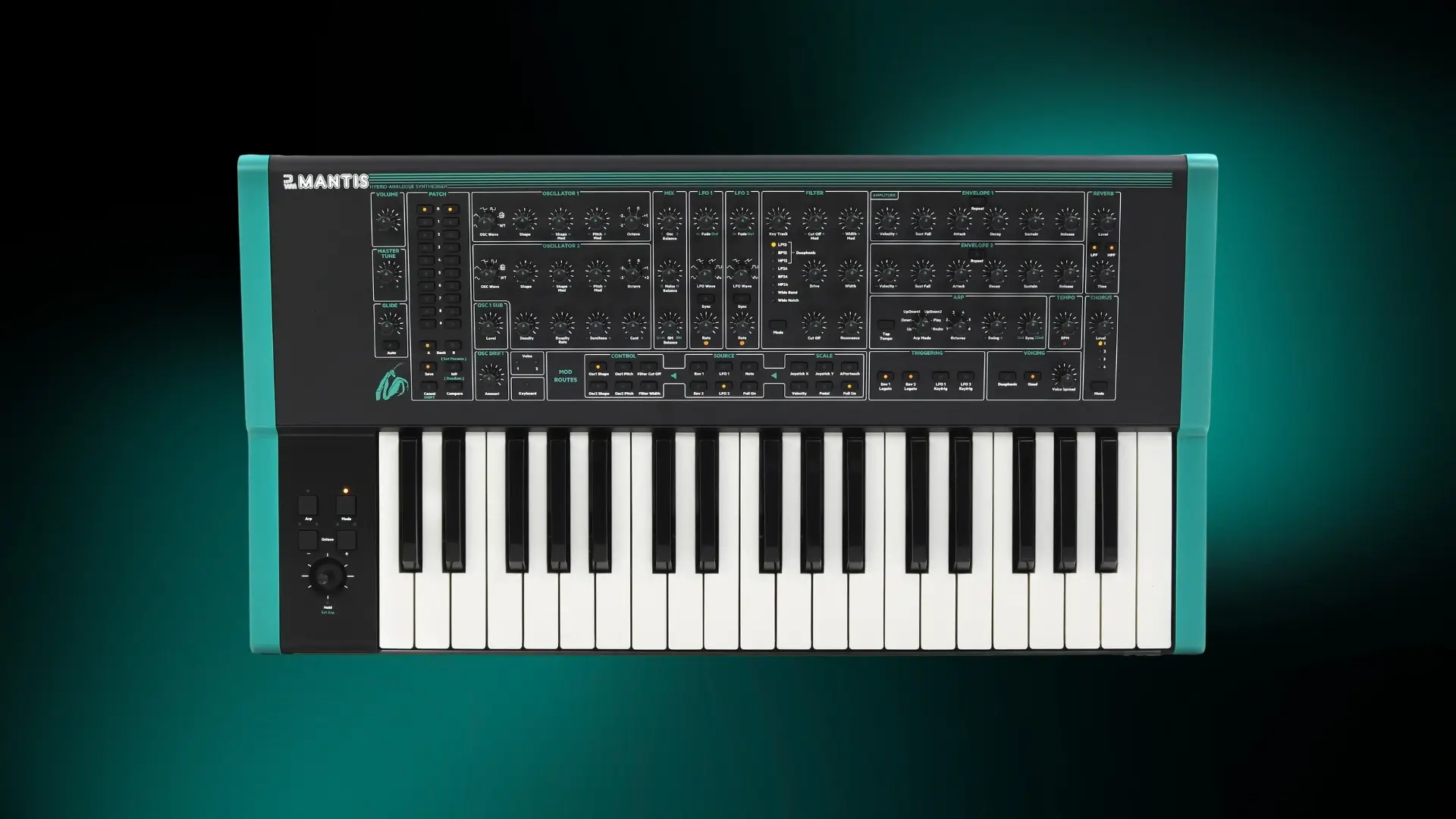
The PWM Mantis is a British-designed hybrid keyboard synthesizer introduced publicly at Superbooth 2023 and available through retailers from 2024. It combines mathematically generated digital oscillators with an analog signal path, dual multimode analog filters, patch memory, USB-C MIDI, and a 37-key keyboard with velocity and aftertouch. Its deeper importance is historical: it was developed from work by the late Chris Huggett, the designer associated with the EDP Wasp and OSC OSCar, and later firmware updates made the PWM Mantis more explicitly connected to the OSCar lineage.
Table of Contents
PWM Mantis sound and character
The PWM Mantis does not sound like a polite virtual-analog instrument trying to disappear into a mix. Its identity comes from the tension between clean, deliberately shaped digital oscillators and a more physical analog treatment stage. The oscillators give it a precise, sometimes glassy harmonic edge, while the filters and VCAs pull that material into a warmer, more unstable, more tactile domain.
Its strongest sounds are thick mono leads, animated duophonic textures, wiry basses, harmonic digital-analog hybrids, resonant filter sweeps, and pads that feel more eccentric than lush. The oscillator section can move beyond basic subtractive synthesis because its wave-shaping, additional wave types, ring modulation, noise, oscillator drift, and detune behavior make the raw sound more complex before it reaches the filter. That matters musically: the PWM Mantis does not depend only on filter movement for interest. Much of its character begins at the oscillator stage.
The dual-filter architecture gives the instrument much of its personality. Low-pass, band-pass, and high-pass operation in 12 dB and 24 dB configurations can make it behave like a familiar subtractive synth, but the wider series and parallel-style filter behavior points toward the OSCar tradition, where filter topology becomes part of the instrument’s identity rather than just a tone-control stage. The result is neither a straight vintage recreation nor a clean modern polysynth. It is sharper, stranger, and more idiosyncratic than that.
Features and architecture
- Manufacturer: PWM, Paul Whittington Music / Paul Whittington Group.
- Year: Announced at Superbooth 2023; retail availability followed in 2024.
- Production years: Current model; retailer availability began in 2024 and the instrument remains available new.
- Synthesis type: Hybrid digital/analog subtractive synthesis.
- Category: 37-key hybrid keyboard synthesizer with mono, duophonic, and four-voice modes.
- Polyphony: Current firmware/specification supports four-voice polyphony via Quad mode, with two analog signal paths; the instrument was originally presented and reviewed primarily as a duophonic hybrid synth.
- Original price and current market price: Original MSRP was $1,499 / €1,599 including VAT / £1,349 including VAT. Current new pricing varies strongly by retailer and region, with recent UK prices substantially below the original launch price, while US retail pricing has remained closer to $1,349. Used examples appear, but the used market is still relatively thin.
- Oscillators: Two oscillators plus sub-oscillator and detune oscillator per voice; waveforms include sine, triangle, saw, pulse, organ, Mantis special wavetable material, and OSCar-derived wavetables after the later firmware update.
- Filter: Two analog multimode state-variable VCA filters with overdrive, one per signal path, offering low-pass, band-pass, and high-pass modes in 12 dB and 24 dB configurations, plus additional wide band and wide stop configurations.
- LFOs: Two LFOs with four waveshapes, sync, rate control, fade in/fade out, and one-shot operation.
- Envelopes: Two independent ADSR envelopes; ENV 1 is normalized to amplitude, with Sustain Fall, Repeat, and positive/negative velocity control.
- Modulation system: Six selectable modulation control parameters, six selectable modulation sources drawn from envelopes and LFOs, and scaling options for modulation depth behavior.
- Sequencer / arpeggiator: Arpeggiator with six types: Up, Down, Up/Down 1, Up/Down 2, Played, and Random; sync rates from seconds to 32nds; tap tempo; positive and negative swing; auto clock sync; latch via joystick hold; six-octave range.
- Effects: Digital reverb and chorus, with controls for reverb time, level, high-pass filtering, low-pass filtering, chorus level, and chorus type.
- Memory: 200 patches, with 100 factory presets and 100 user presets; all patches are stored in RAM and can be overwritten.
- Keyboard: 37 full-size semi-weighted velocity-sensitive keys with channel aftertouch and octave shift.
- Inputs / outputs: DC 9V input, sustain pedal input, continuous pedal input, stereo 1/4-inch line outputs with L/Mono and R, and stereo 1/4-inch headphone output.
- MIDI / USB: USB-C plus MIDI In, Out, and Thru.
- Display: No conventional screen; the instrument uses panel controls and indicator LEDs.
- Dimensions / weight: 618 x 320 x 112 mm; 5.34 kg.
- Power: 9V DC power supply, 600 mA.
Strengths
- A distinctive hybrid voice: The PWM Mantis is not simply “digital oscillators through an analog filter” as a generic formula. Its mathematically generated oscillator design, drift behavior, wave-shaping, ring modulation, and later OSCar-derived waveform set give it a more individual harmonic vocabulary than many compact analog-style synths.
- Historically meaningful design DNA: The instrument’s connection to Chris Huggett, the Wasp, and the OSCar gives it a stronger historical identity than most boutique polysynths. This is not nostalgia as surface styling; the architecture itself carries the argument.
- Flexible filter behavior: The dual analog filter system is central to its value. It can cover conventional subtractive duties, but the series/parallel-inspired wider modes make it more architectural and less predictable.
- Performance-friendly format: The 37-key full-size keyboard, aftertouch, joystick, arpeggiator, patch memory, stereo output, and USB-C MIDI make it practical as a compact performance instrument rather than merely a desktop sound module with keys attached.
- Improved long-term value through firmware: The later updates changed the story of the instrument. Quad mode and OSCar-derived waveforms made the PWM Mantis more substantial than its initial duophonic positioning suggested.
- Character over neutrality: The PWM Mantis is attractive precisely because it does not behave like a neutral studio utility. It rewards musicians looking for imperfect, animated, British-flavored hybrid sound rather than a broad all-purpose workstation.
Limitations
- The voice architecture is not as straightforward as a conventional four-voice polysynth: Although current firmware supports four-voice polyphony, the instrument still has two analog signal paths, so expectations should be shaped around its hybrid mono/duo/quad architecture rather than around a classic one-filter-per-voice analog polysynth.
- It is not a deep workstation or sequencing hub: The arpeggiator is useful and musical, but the PWM Mantis is not designed around an onboard step sequencer, multitrack sequencing, sampling, or workstation-style production tools.
- The interface has tradeoffs: Reviews have noted small labeling and compact controls. That does not ruin the instrument, but it means the panel is more dense than luxurious.
- Market positioning has been uneven: The launch price placed it near more established alternatives, while later discounts changed its perceived value. That can be good for buyers, but it also shows that the market has not fully settled on where the PWM Mantis belongs.
- Not the safest choice for generic polyphonic duties: Musicians looking mainly for broad pads, bread-and-butter brass, modern workstation layers, or lush eight-voice analog polyphony may find the PWM Mantis too idiosyncratic and too architecturally specific.
- Documentation and naming can create confusion: Early coverage described it as duophonic, later firmware pushed four-voice operation, and some retailer pages still reflect older or simplified specifications. Buyers should confirm firmware status and current feature set.
Historical context
The PWM Mantis arrived during a period when the synthesizer market was crowded with analog reissues, boutique recreations, compact desktop modules, and hybrid instruments trying to balance vintage appeal with modern control. PWM’s earlier Malevolent had already positioned the company around characterful analog/hybrid instruments rather than safe mainstream workstations. The PWM Mantis then occupied a different middle ground: less raw than a small semi-modular monosynth, but more eccentric than a conventional virtual-analog poly.
Its historical weight comes from Chris Huggett. Huggett’s work on instruments such as the EDP Wasp and OSC OSCar gave British synthesizer history a particular flavor: experimental, economical, sometimes strange, and not always aligned with the American or Japanese idea of what a “proper” synth should be. The PWM Mantis uses that legacy without pretending to be a museum replica. It takes Wasp-like hybrid thinking, OSCar-style filtering, modern patch memory, USB-C integration, and performance controls, then compresses them into a contemporary keyboard instrument.
The later firmware story is also important. The addition of four-voice operation and OSCar-derived wavetable material made the PWM Mantis less like a finished 2023/2024 product and more like a platform being pulled deeper into the Huggett/OSCar lineage. That shift matters because it changed the cultural framing: the PWM Mantis became not just “Chris Huggett’s last synth project,” but a living continuation of one of the more unusual branches of British synth design.