

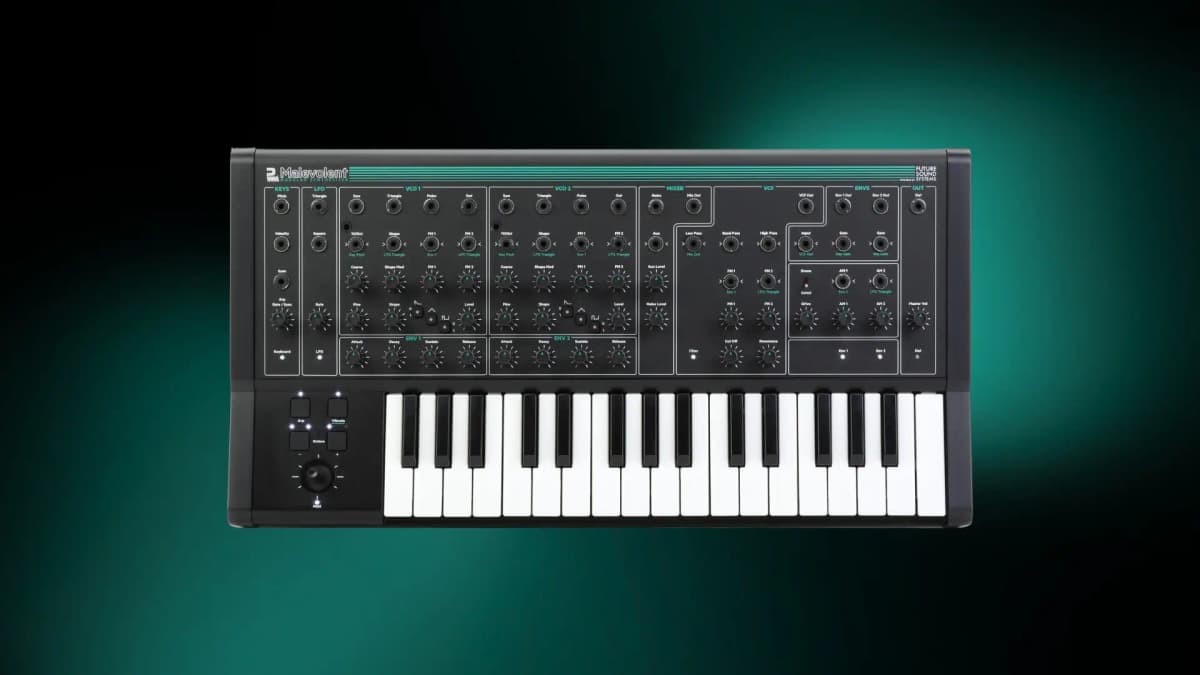
The PWM Malevolent is a 32-key, semi-modular analog monosynth introduced at Superbooth 2021 as the debut instrument from PWM, the British company founded by Paul Whittington. Built around a pure analog signal path designed with Future Sound Systems, it combines two VCOs, a multimode 2-pole filter, two ADSR envelopes, a patchable architecture, an arpeggiator, USB-C connectivity, and a deliberately hot, driven sound. Its importance is not that it reinvented subtractive synthesis, but that it arrived as a compact, modern British analog instrument with a strong sonic attitude at a time when many affordable semi-modular synths were trying to balance accessibility, portability, and modular openness.

Table of Contents
PWM Malevolent sound and character
PWM Malevolent is not a polite analog monosynth. Its identity sits closer to the abrasive side of British and Japanese semi-modular history than to smooth American vintage warmth. The sound is raw, saturated, unstable in personality, and often aggressive before any external processing is added. Reviewers repeatedly describe it as gritty, hot, driven, and characterful, which is not incidental: the architecture encourages the oscillators, filter, and VCA to push against one another rather than remain cleanly separated.
The two VCOs are central to that behavior. Each oscillator offers saw, triangle, and pulse waveforms, with shaping and modulation facilities that make the sound feel more torn and animated than merely “fat.” The oscillator levels can drive the signal hard, and the filter responds in a way that makes gain staging part of the musical result rather than a background technical detail. This means PWM Malevolent is especially strong at basses, leads, overdriven sequences, drones, metallic FM-like gestures, distorted effects, and unstable modular-style textures.
Its 2-pole multimode filter also shapes the PWM Malevolent’s personality. In musical terms, it is not only a subtractive tone control; it is part of the aggression engine. Low-pass patches can snarl, resonance can become wild, and the band-pass and high-pass options expand the PWM Malevolent beyond ordinary monosynth bass duties when patched deliberately. The result is a synth that can do classic subtractive lines, but its most convincing voice appears when it is pushed into rougher territory.
That makes PWM Malevolent culturally interesting. It does not chase the dream of a perfectly recreated vintage classic. Instead, it belongs to a more contemporary lineage of small analog instruments that embrace imperfection, voltage control, saturation, and hands-on performance as creative values. It feels less like a museum object and more like a small machine built to misbehave productively.
Features and architecture
- Manufacturer: PWM, also known as Paul Whittington Music.
- Year introduced: 2021, shown at Superbooth 2021.
- Production years: No formal end date is published. It has been commercially available since late 2021 and remains listed new by retailers in 2026.
- Synthesis type: Analog subtractive synthesis with semi-modular patching.
- Category: 32-key semi-modular analog monosynth.
- Polyphony: Monophonic. The architecture allows patching for individual pitch control of each VCO and gate control of each envelope, but it is not a conventional polyphonic synthesizer.
- Original price and current market price: Launch pricing was announced around €579.99 including VAT and £499.99 including VAT, while PWM’s own specification page later listed MSRP as $629.99, €629.99 including VAT, and £559.99 including VAT. In 2026, new prices commonly appear below MSRP, with U.S. listings around $549 and some online price aggregators showing lower new-sale signals around the $389 to $401 range.
- Oscillators: Two voltage-controlled oscillators with saw, triangle, and pulse outputs, mix output per oscillator, coarse and fine tuning, waveform shaping, pulse-width modulation input, 1V/oct pitch input, two frequency-modulation inputs, shape modulation amount, FM amount controls, and individual oscillator level.
- Filter: Multimode 2-pole VCF with low-pass, band-pass, and high-pass inputs, cutoff, resonance, and two frequency-modulation inputs with amount controls. Retail and review sources identify it as a 12 dB/octave Sallen-Key-style multimode filter.
- LFOs: One analog LFO with triangle and square wave outputs, plus joystick-linked vibrato behavior separate from the analog LFO.
- Envelopes: Two ADSR envelopes with individual controls, gate inputs, and envelope outputs.
- Modulation system: 38 patch points, divided into 19 inputs and 19 outputs, using 3.5 mm patching. It supports Eurorack-compatible 1V/oct integration and includes USB-MIDI to CV/gate conversion.
- Sequencer / arpeggiator: No onboard sequencer. The arpeggiator offers six modes: up, down, up/down 1, up/down 2, played, and random. It can synchronize automatically to analog clock, MIDI, or USB-MIDI clock, includes latch, rate/sync control, and a six-octave range.
- Effects: No conventional onboard effects section. The VCA includes overdrive, and retailers classify the onboard drive behavior as distortion.
- Memory: No patch memory or preset storage.
- Keyboard: 32 velocity-sensitive mini keys, octave shift over plus or minus four octaves, local off mode, and pitch, velocity, and gate outputs.
- Inputs / outputs: 3.5 mm patchbay, auxiliary audio input with level control, rear-panel line output, headphone output, analog clock input and output, pitch output, velocity output, gate output, and envelope/LFO/oscillator patch connections.
- MIDI / USB: 5-pin DIN MIDI input and output, USB-C for USB-MIDI, and USB-MIDI to CV/gate conversion.
- Display: No display.
- Dimensions / weight: Unboxed dimensions are 490 x 250 x 80 mm, with a weight of 2.61 kg. Boxed dimensions are 690 x 320 x 160 mm, with a boxed weight of 3.70 kg.
- Power: USB bus power or external 9V DC, 600 mA power supply. The package includes a USB-C cable and power supply.
Strengths
- A strong sonic identity rather than neutral analog correctness: PWM Malevolent’s main virtue is its attitude. It is useful when a track needs abrasion, movement, instability, and saturation rather than another rounded vintage bass or polite lead.
- True semi-modular usefulness: The normalized signal path makes it playable without patch cables, but the 38 patch points let it move into modular territory when the user wants more complex routing.
- Excellent modular bridge for a keyboard synth: The combination of USB-MIDI, MIDI DIN, analog clock, pitch, velocity, gate, and Eurorack-compatible patching makes it practical as a small command center for other voltage-controlled gear.
- Expressive performance controls: The joystick, arpeggiator, latch functions, octave range, velocity output, and patchable modulation give it more performance value than a basic desktop monosynth.
- Compact but not merely minimal: It is small, USB-C powered, and light, but it still offers two VCOs, two envelopes, oscillator shaping, FM inputs, a multimode filter, overdrive, and external signal input.
- Good fit for aggressive electronic styles: Industrial, techno, darkwave, electro, noise-leaning ambient, experimental bass, and raw synthwave textures are more natural territories for Malevolent than clean pop-polysynth duties.
Limitations
- Monophonic by design: It cannot replace a polysynth or a chord machine. Its patchable oscillator independence is interesting, but it should not be confused with practical polyphony.
- Mini keys and no aftertouch: The keyboard is usable and velocity-sensitive, but players who care about full-size key feel may prefer to control it from another keyboard.
- No patch memory: Every sound is physical-panel and patch-cable dependent. That is philosophically consistent, but inconvenient for live sets requiring instant recall.
- No onboard delay, chorus, or reverb: The overdrive is part of the voice, but atmospheric, spatial, and polished sounds will require external effects.
- Not the best choice for clean analog tones: Its gain structure and filter behavior favor heat and saturation. Users wanting restrained, glassy, or highly polished analog sounds may find it too unruly.
- Limited modulation compared with larger semi-modular systems: The single main LFO, lack of broader utility modules, and absence of a sequencer mean that complex evolving patches may need external modular gear.
- Precision can be touchy: Reviewers have noted that small modulation amounts and parameter scaling can be difficult to dial in with extreme subtlety.
- Some filter modes require more intentional patching: The architecture rewards users who understand the panel and patchbay rather than those expecting every variation to be one knob away.
Historical context
PWM Malevolent appeared in 2021, a moment when the semi-modular market had become one of the most active entry points into hardware synthesis. Instruments such as the Moog Mother-32, Moog Grandmother, Behringer Neutron, and Pittsburgh Modular Microvolt had already shown that musicians wanted analog immediacy without fully committing to Eurorack cost and complexity. PWM Malevolent entered that conversation from a distinctly British angle.
PWM was a new company, and PWM Malevolent was its first product. That matters because debut synths often reveal a manufacturer’s philosophy before branding becomes polished or predictable. In this case, the philosophy was clear: make a self-contained analog instrument, keep it patchable, give it a keyboard, make it portable, and allow the sound to become dangerous rather than overly refined.
The collaboration with Future Sound Systems gave PWM Malevolent additional credibility. FSS was already associated with modular and semi-modular designs that value voltage, distortion, and character over clean neutrality. Source Distribution also identifies the PWM Malevolent as a collaboration between PWM, Future Sound Systems, and Supperware. That collaborative origin explains why PWM Malevolent feels less like a conventional entry-level keyboard and more like a compact modular voice with a playable interface attached.