

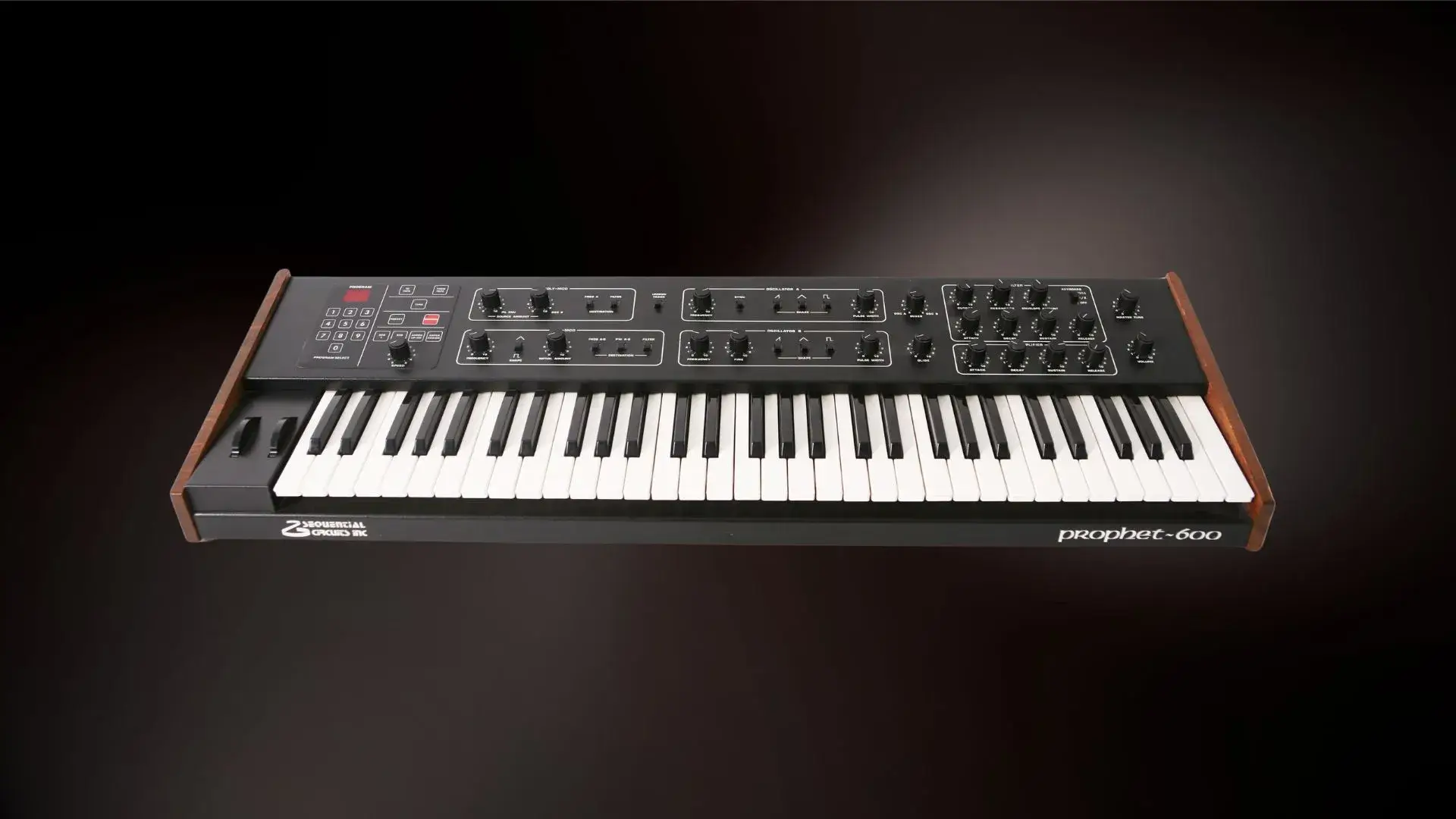
The Sequential Circuits Prophet-600 is a six-voice analog polysynth introduced in late 1982 and produced into the mid-1980s, conceived as a more accessible sibling to the Prophet-5 but destined to matter for a different reason as well: it became the first commercially available synthesizer with built-in MIDI. That alone would secure its place in synth history, yet the instrument is more interesting than a simple milestone. The Prophet-600 combines dual-VCO analog tone, patch memory, an onboard arpeggiator, and a real-time polyphonic sequencer with an early microprocessor-controlled architecture that gives it a distinct personality: powerful, slightly rough, sometimes stubborn, but rarely bland.
Table of Contents
Prophet-600 sound and character
The Prophet-600 does not really sound like a budget Prophet-5, and that difference is central to its identity. Where the Prophet-5 is often described in terms of polish, sweep, and prestige, the Prophet-600 tends to present itself with a more direct, leaner, and sometimes grainier voice. That is not a flaw to be politely excused; it is part of why the instrument remains memorable.
In practice, the Prophet-600 excels at brassy stabs, wiry pads, dry strings, muscular unison leads, drones, sync sweeps, and rawer basses than its family name might initially suggest. Its two-oscillator-per-voice structure gives it the harmonic heft expected from an early Sequential polysynth, but the digitally controlled side of its architecture also contributes to the slightly stepped, rigid, or edgy behavior that players often hear in the envelopes and panel response on stock units. The result is a sound that feels less silky than the canonical Prophet-5 mythology and more immediate, tense, and sometimes more aggressive.
That tonal tension is one of the Prophet-600’s real strengths. Its filter can move from warm and rounded into harder, more cutting territory, and the instrument’s sync and Poly-Mod behavior can push it into tones that feel vividly early-80s: dramatic, synthetic, and unashamedly electronic. This is not the kind of synthesizer that flatters every patch equally. It rewards players who like a bit of friction in the sound.
Features and architecture
- Manufacturer: Sequential Circuits
- Year introduced: 1982
- Production years: 1982–1985
- Synthesis type: Analog subtractive, with microprocessor-controlled architecture
- Category: Polyphonic keyboard synthesizer
- Polyphony: 6 voices
- Original price: US$1,995 list price
- Current market price: Typically around the mid-three-figure to mid-four-figure used range in USD depending on condition, service history, originality, and whether it has a GliGli or later CPU/firmware upgrade
- Oscillators: 2 VCOs per voice; saw, pulse, and triangle waveforms; oscillator sync; cross-mod / Poly-Mod options
- Filter: Curtis low-pass filter / VCA voice architecture using CEM3372-based signal processing
- LFOs: 1 LFO in the original instrument
- Envelopes: 2 ADSR envelopes per voice, one for filter and one for amplifier
- Modulation system: LFO plus Sequential’s Poly-Mod structure, routing oscillator B and the filter envelope to oscillator A frequency or filter cutoff
- Sequencer / arpeggiator: Built-in arpeggiator with Up/Down and Assign modes; real-time polyphonic sequencer with roughly 400-note capacity shared across two sequence banks
- Effects: None onboard
- Memory: 100 patch memories, plus cassette storage for programs and sequences
- Keyboard: 61 keys
- Inputs / outputs: Audio out, headphone-capable output jack, footswitch input, filter CV input, cassette in/out, MIDI in/out
- MIDI / USB: MIDI in and out; no USB
- Display: 2-digit program display
- Dimensions / weight: Approximately 953 × 305 × 115 mm; about 9.5 kg
- Power: Internal power supply with line-voltage selection for 110V or 220V operation
Strengths
- Historically decisive design: It is not just an early MIDI synth but the first commercially available synthesizer to ship with built-in MIDI, which gives it importance beyond brand lore.
- A distinctly raw Sequential sound: The Prophet-600 does not simply mimic the Prophet-5 at lower cost; it has its own harder-edged tonal identity that works especially well for brassy attacks, rough pads, sync leads, and moodier analog textures.
- Straightforward front-panel logic: Compared with many later menu-driven polysynths, the Prophet-600 remains readable and musically direct. Its structure is easy to grasp, which helps it function as both a serious instrument and a strong teaching synth.
- Useful onboard performance tools: The arpeggiator and built-in real-time polyphonic sequencer make it more compositionally active than many of its analog contemporaries.
- Patch memory plus analog voice path: For players working in the early 1980s, the combination of analog sound, programmable memories, and MIDI was unusually practical.
- Strong modding and repair culture: The instrument has remained alive partly because specialist parts suppliers, restoration technicians, and the GliGli firmware community have given it a second technical life.
Limitations
- Stock operating feel can be slow: The original Z80-controlled implementation is historically fascinating but can make the synth feel less immediate and less smooth than later analog polysynths.
- Envelope behavior is part of the debate: On original units, the envelopes and parameter stepping are a recurring complaint, especially for players expecting Prophet-5 fluidity.
- No onboard effects and no stereo architecture in stock form: It is a mono-output vintage polysynth, so players often rely on external chorus, delay, or reverb to widen it.
- Basic early MIDI implementation: Its MIDI significance is enormous, but its original implementation is not remotely modern in scope or convenience.
- No velocity or aftertouch on the keyboard: Expressive performance has to come from programming, playing technique, and wheels rather than keybed nuance.
- Vintage ownership realities: Membrane controls, tuning drift, aging components, and service needs are part of the package unless the instrument has been properly restored.
Historical context
The Prophet-600 arrived at a transitional moment. Sequential had already changed the history of synthesizers with the Prophet-5, but by the early 1980s the market was shifting. Players still wanted programmable analog polyphony, yet pressure was increasing for instruments that were more affordable, more connected, and more practical in evolving studio setups.
That is where the Prophet-600 fits. It was designed as a more attainable Prophet-family instrument, but it also became the vehicle through which Dave Smith’s MIDI work entered commercial reality. The famous 1983 NAMM demonstration that connected a Prophet-600 to a Roland Jupiter-6 now reads like a canonical turning point, but the instrument itself also reflects a broader industrial transition: from the self-contained analog synth to the interconnected electronic studio.
In other words, the Prophet-600 belongs to two histories at once. It is part of Sequential’s attempt to widen access to programmable polyphonic synthesis, and it is part of the emergence of MIDI as the universal language of electronic instruments. That double identity is why it remains more important than its market reputation sometimes suggests.