

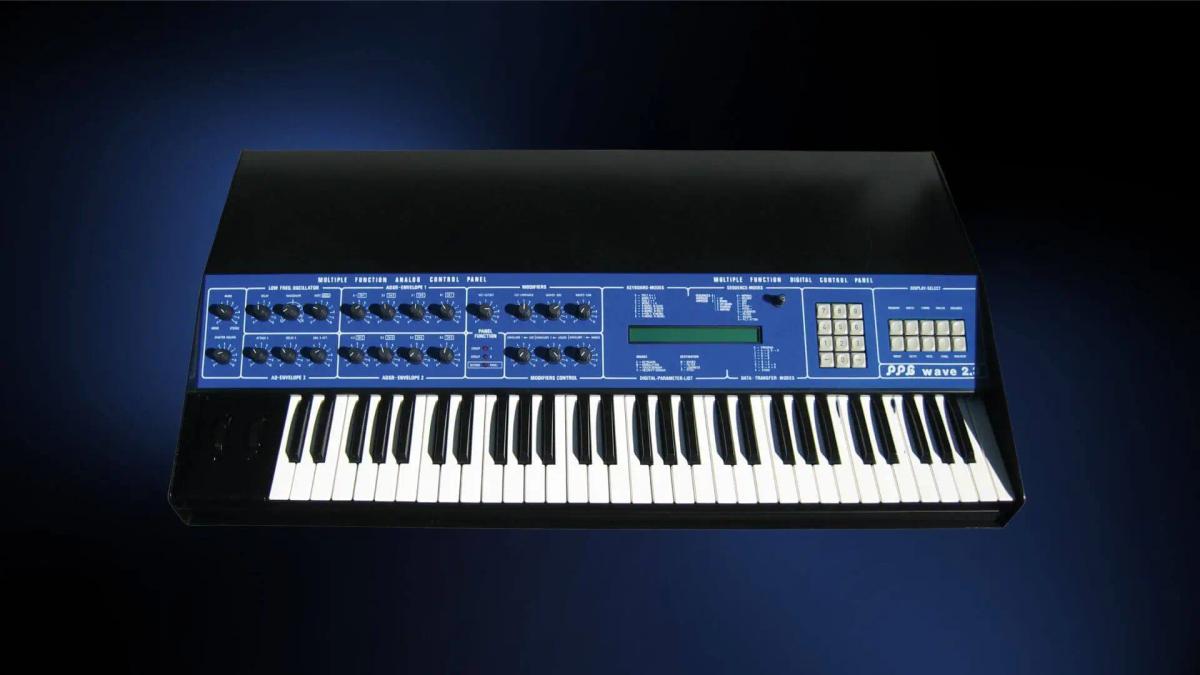
The PPG Wave is a family of German hybrid synthesizers introduced in 1981 and developed through the Wave 2, Wave 2.2, and Wave 2.3 revisions that remained in production until 1987. What made it special was not simply that it was digital, but that it fused digitally generated wavetable oscillators with analog filters and VCAs in a form that musicians could actually play, program, and integrate into records. In practical terms, it helped move wavetable synthesis from an experimental concept into one of the defining sonic languages of 1980s electronic music.
Table of Contents
PPG Wave sound and character
In use, the PPG Wave sounds neither purely digital nor comfortably analog. Its identity comes from the friction between those two worlds. The oscillator section produces bright, harmonically shifting tones that can feel glassy, metallic, vocal, hollow, bell-like, or coldly luminous, while the analog filtering stage pulls those raw edges into something fuller, more muscular, and more playable. That combination is the entire point of the PPG Wave. Without the wavetable side, it would not have had its spectral motion; without the analog side, it would have risked sounding merely brittle.
That is why the PPG Wave became so effective at sounds that needed both movement and authority. It excels at choirs that feel synthetic rather than imitative, at metallic mallet tones with a frozen shimmer around the attack, at pads that do not merely sit behind a track but seem to glow inside it, and at brasses, basses, and leads that cut with a peculiar hard-edged clarity. The Wave can sound elegant, but it rarely sounds polite. Even when it is warm, there is usually some grain, some aliasing, some jagged spectral fingerprint that reminds you this is not a traditional subtractive polysynth.
The later Wave 2.3 sharpened that identity in a particularly interesting way. Its sample side became cleaner when used with the Waveterm B, yet its internal wavetable playback still retained the rougher 8-bit character people associate with classic PPG timbre. That matters because the PPG Wave’s reputation was never based on technical cleanliness alone. Part of the appeal is that the sound feels computational, but not sterile. It has thrust, edge, and a kind of animated instability that later digital synths often tried to smooth away.
Features and architecture

- Manufacturer: Palm Products GmbH (PPG), Germany.
- Year introduced: 1981 for the original Wave 2; major revisions followed with the Wave 2.2 in 1982 and the Wave 2.3 in 1984.
- Production years: 1981 to 1987 for the PPG Wave family.
- Synthesis type: Hybrid wavetable synthesis using digital oscillators into analog filter and amplifier stages.
- Category: Polyphonic keyboard synthesizer; the Wave 2.3 also moved toward workstation-style use through multitimbrality and system integration.
- Polyphony: 8 voices.
- Original price and current market price: The Wave 2.3 retailed at £3,995 including VAT in 1984. In the current vintage market, serviced examples commonly appear in the high four-figure to five-figure range, with recent asking prices around the upper teens in euros and some strong 2.2 examples listed well above £16,000.
- Oscillators: Original Wave 2 used one digital wavetable oscillator per voice; Wave 2.2 and 2.3 expanded this to two oscillators per voice.
- Filter: Analog 24 dB/oct low-pass filter; the original Wave 2 used CEM 3320 filters, while the 2.2 and 2.3 used SSM 2044 filters.
- LFOs: 1 LFO.
- Envelopes: Two ADSR envelopes in the earlier architecture, with an additional AD envelope on the Wave 2.3.
- Modulation system: Wavetable position could be controlled manually or by envelope, alongside conventional pitch, filter, and amplifier shaping; later models also benefited from aftertouch, wheels, and deeper system-level routing through the display structure.
- Sequencer / arpeggiator: Onboard sequencer throughout the series; later documentation commonly lists an 8-track sequencer plus arpeggiator on the mature models.
- Effects: None onboard.
- Memory: Commonly documented at 200 patches on the later series.
- Keyboard: 61 full-size keys with aftertouch.
- Inputs / outputs: Stereo outputs, eight separate audio outputs, headphone output, sustain input, CV and trigger connections, cassette interface, and the proprietary communications bus for linking with PPG system components.
- MIDI / USB: MIDI was added in 1984 on the Wave 2.3 and was later available through upgrades or retrofit paths for some 2.2 systems; there is no USB.
- Display: LCD alphanumeric display with page-based parameter access.
- Dimensions / weight: Accessible primary sources are inconsistent on exact measurements, but the PPG Wave is unmistakably a large, heavy vintage keyboard rather than a compact modern synth.
- Power: Internal mains supply with 110V/220V switching documented in service materials.
Strengths
- A genuinely distinctive sonic identity: the PPG does not merely sound like an old digital synth; it sounds like wavetable motion being pulled through an analog frame, which gives it a mix of brightness, punch, and body that remains difficult to fake convincingly.
- Historically important architecture that is still musically relevant: two oscillators per voice on the 2.2 and 2.3, analog filtering, wavetable scanning, and system expansion made it far more than a curiosity.
- Excellent mix presence: the PPG Wave has a way of occupying space with unusual harmonic information, which is one reason its choirs, bells, pads, and leads became so memorable in 1980s productions.
- A bridge between performance synth and computer music system: the core keyboard was already substantial, but linked with Waveterm, PRK, or EVU hardware it expanded into something closer to a high-end production environment.
- The analog stage keeps the instrument from sounding clinically digital: this is central to why so many players still prefer PPG-style timbre to later, cleaner wavetable implementations.
- The Wave 2.3 added genuinely useful advances rather than superficial updates: multitimbrality, MIDI, and better sample handling made it more adaptable in serious studio use.
Limitations
- It is expensive to buy and expensive to keep healthy: this is now a rare collector-level instrument, and ownership often implies service, shipping risk, and specialist repair costs.
- The interface can be demanding: even admirers of the PPG Wave have long described it as powerful but not easy, especially once the broader PPG ecosystem enters the picture.
- Eight voices can feel tight by modern standards: for lush layered arrangements, the voice count is part of the PPG Wave’s charm but also one of its practical limits.
- No onboard effects: this is not a flaw in historical context, but it does mean the raw sound often benefits from external treatment in modern production.
- Variant differences matter: the original Wave 2, the 2.2, and the 2.3 are related but not interchangeable in feature set, filter choice, and workflow, so buyers need to know which machine they are actually chasing.
- Its reputation can lead to mythmaking: the PPG is important, but it is not magically good at everything. Its strengths are strongest when a track benefits from overt timbral personality.
Historical context
The PPG Wave makes the most sense when viewed as Wolfgang Palm’s answer to the limitations of earlier digital synthesis. The preceding Wavecomputer 360 had already introduced the idea of wavetable-based sound generation, but its sound and workflow were not yet positioned to win over a broad group of keyboard players. The PPG Wave series changed that by giving those digital waveforms an analog destination. Palm later said that adding the VCF was a response to users who wanted that familiar analog behavior, and that this combination of new waveforms and analog filtering is what made the instrument take off.
The timing mattered. In the early 1980s, the PPG Wave market was still defined largely by analog thinking, but studios were also beginning to chase more complex, more programmable, and more futuristic timbres. The original Wave 2 arrived in 1981 as a serious alternative to conventional oscillator design. The Wave 2.2 then expanded the concept with two oscillators per voice and a more mature panel approach. The Wave 2.3, introduced in 1984, went further by adding MIDI, eight-part multitimbrality, and deeper integration with the Waveterm environment.
That placed the PPG in a fascinating market position. It was not a mass-market digital keyboard in the later DX7 sense, and it was not as financially unreachable as a full Fairlight system, though a complete PPG setup could still become very expensive. It occupied the space of a premium European instrument for musicians who wanted the future, but still wanted hands-on synthesis rather than a purely computer-terminal experience.