

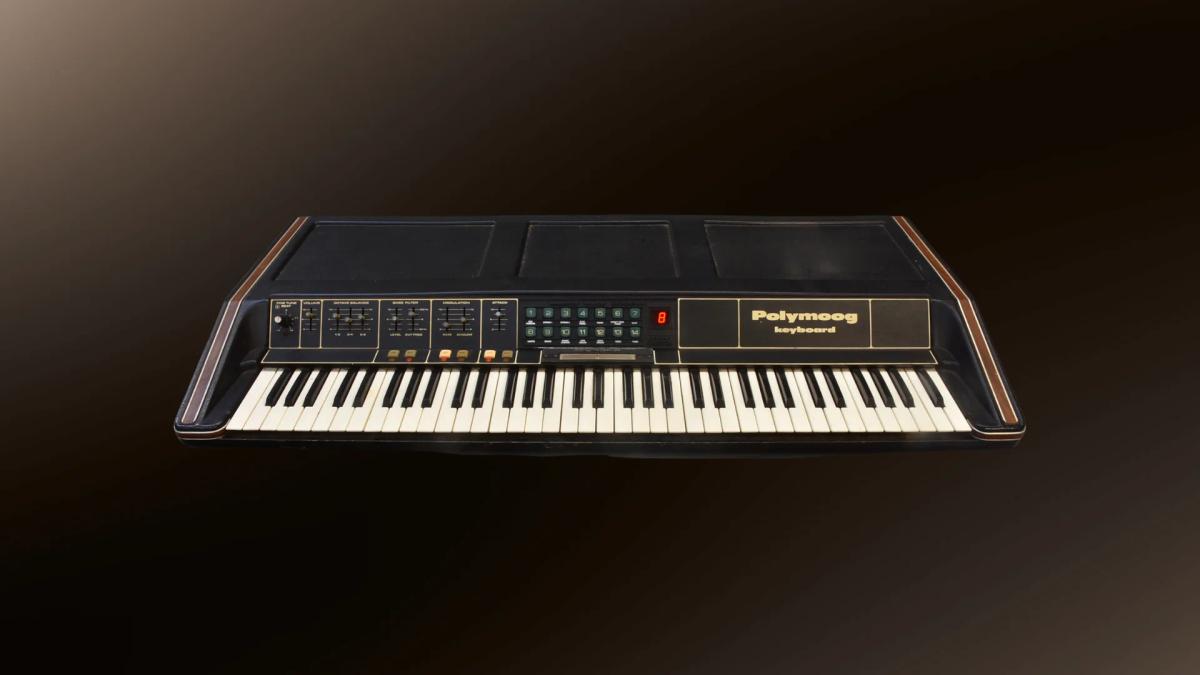
The Polymoog Keyboard, model Polymoog 280a, is the preset version of the Polymoog that Moog Music introduced in 1978 and built until 1980. It kept the original instrument’s 71-note, velocity-sensitive keyboard, its fully polyphonic divide-down engine and its large cabinet, but replaced most of the programmable panel with 14 fixed presets and a handful of sliders. Moog renamed the earlier, editable model (the 203a) the Polymoog Synthesizer, and positioned the Keyboard as a cheaper instrument for players who wanted sounds rather than synthesis. That plan produced a curious result: the stripped-down model is the one that gets remembered, largely because of a single new preset, Vox Humana, and the records Gary Numan made with it in 1979.
Table of Contents
Polymoog 280a sound and character
The Polymoog 280a sounds like what it is: a Polymoog with its voicings fixed at the factory. Underneath, every key has its own note, derived by dividing down banks of master oscillators, and each note passes through its own articulator circuit before reaching a set of preset filters. The result is the smooth, organ-like density of the Polymoog family, with every note of a chord sounding at once and no voice stealing, but the character of each sound is set by the selected preset rather than by the player.
Vox Humana is the reason most people seek one out. It is a soft, choir-like tone with a slow, wavering movement, closer to a string machine or a theatre organ stop than to a conventional synth pad. Alex Ball, who sampled it note by note for the Bob Moog Foundation, described it as synthetic but somehow organic, and that ambiguity is its appeal: it reads as strings, voices and electronics at the same time. Gear4music’s analysis of Numan’s sound describes the effect as warbly and string-like and notes that copying it on other synths needs several LFOs working together, a clue to how much movement is built into the preset.
The other 13 presets cover the territory of a late-1970s home or stage keyboard: two strings, electric piano, piano, honky tonk, clav, harpsichord, brass, chorus brass, pipe organ, rock organ, vibes and funk. Vintage Synth Explorer lists Vox Humana, the second string, the electric and honky tonk pianos, chorus brass and rock organ as the additions over the Synthesizer’s eight modes. The pianos and percussive sounds are period approximations rather than convincing imitations; the sustained sounds, particularly the strings and Vox Humana, are where the Polymoog 280a earns its place.
In practice it is a vintage, warm and slightly unstable instrument with a narrow but distinctive palette. It is not a sound-design tool. Its value lies in a few specific timbres that are difficult to reproduce exactly on anything else.
Features and architecture
- Manufacturer: Moog Music, Inc. (then owned by Norlin)
- Year introduced: 1978
- Production years: 1978 to 1980
- Synthesis type: analog, divide-down polyphonic with per-key articulators and preset filtering
- Category: preset polyphonic keyboard; a simplified companion to the Polymoog Synthesizer 203a
- Polyphony: fully polyphonic across all 71 keys
- Original price: $3,995 in the United States in 1979, against $5,295 for the Polymoog Synthesizer; Sound On Sound gives a UK launch price of £2,295
- Current market price: not tracked separately in Reverb’s price guide; the few units that surface are mostly sold privately or through vintage dealers, often needing service, and asking prices vary too widely to give a reliable range
- Oscillators: divide-down tone generation from top-octave sources, providing pulse and sawtooth waveforms for every key; MM5823-type divider chips
- Filter: fixed preset filters per sound; the main preset filter cannot be adjusted from the panel, only through an external controller; a separate filter serves the bass section; published panel descriptions also mention high-pass filtering
- LFOs: one LFO with rate and depth controls (some listings also mention an LFO attack or delay control)
- Envelopes: preset contours with a front-panel attack adjustment
- Presets: 14 (Vox Humana, String 1, String 2, Electric Piano, Piano, Honky Tonk, Clav, Harpsi, Brass, Chorus Brass, Pipe Organ, Rock Organ, Vibes, Funk)
- Voice modes: the lower two octaves can be split off to play a separate bass sound
- Editing: limited to octave balance, attack, LFO rate and depth, volume and tuning; no equivalent of the 203a’s VAR programmable mode
- Sequencer / arpeggiator: none
- Effects: none onboard
- Memory: no user memory; presets are fixed in hardware
- Keyboard: 71 weighted, velocity-sensitive keys, the same keyboard and case as the 203a
- Inputs / outputs: rear-panel audio outputs and control connections, including support for Moog’s Polypedal controller (model 285a); the full jack complement is not consistently documented in published sources
- MIDI / USB: none; the Polymoog 280a predates MIDI
- Display: none; presets are selected with front-panel buttons
- Dimensions / weight: large flat-topped cabinet designed to carry another synthesizer on top; Vintage Synth Explorer gives 82 lb (37 kg) for the Polymoog
- Power: internal mains power supply
Strengths
- Vox Humana is a genuinely distinctive sound. It is the best-known Polymoog voicing of all, and it exists only on the Keyboard model, not on the 203a.
- Polyphony is complete. Every one of the 71 keys can sound at once, so dense chords and two-handed parts never run out of voices.
- Velocity sensitivity was unusual for a polyphonic instrument of its era and gives the presets more dynamic response than most string machines of the time.
- It is immediate. Pressing a preset button and playing was exactly what Moog intended, and for players who wanted a reliable stage palette the narrow controls were a deliberate simplification.
- The bass split lets the lower two octaves carry a separate bass voice, which makes it more useful as a single keyboard on stage.
- It was considerably cheaper than the Synthesizer at launch, and because it was long regarded as the lesser model it has historically traded for less on the used market.
Limitations
- Programming is almost entirely gone. With no VAR mode and only a few sliders, the sounds can be adjusted but not built, which Gearnews singles out as the decision that made the Polymoog 280a a preset box.
- The main preset filter cannot be changed from the panel, so tonal variation depends on the factory voicings or on external control.
- Reliability is poor. The Polymoog family is notorious for failures, and owners on the Moog forum describe overheating components and smoking boards; Sound On Sound’s Gordon Reid joked about its failure rate.
- Repairs involve many custom and aging parts, including divider chips and the per-key Polycom circuits, and technicians willing to work on it are scarce.
- It is very heavy and bulky, which limits its practicality for touring today.
- Several presets, particularly the pianos, sound dated and approximate next to later instruments.
- There is no MIDI, no patch memory and no straightforward way to integrate it with a modern setup without modification.
Historical context
By 1978 Moog Music was a division of Norlin, and the original Polymoog, designed largely by Dave Luce and introduced in 1975, had found a market among professional keyboardists while gaining a reputation for complexity and unreliability. Norlin’s response was to split the line. The existing instrument was renamed the Polymoog Synthesizer and kept its full panel, while a new, cheaper Polymoog Keyboard was offered as a preset instrument for players who saw the Polymoog as a sophisticated electronic keyboard rather than a synthesizer.
The Polymoog 280a used the same case and keyboard as the 203a. Moog removed the right-hand control panel, reduced the left-hand panel to a few sliders, and replaced the eight modes and the programmable VAR mode with 14 presets. Six of them were new, including Vox Humana. In 1979 the Keyboard listed at $3,995, well below the Synthesizer, and it could be paired with Moog’s optional Polypedal controller (model 285a).