

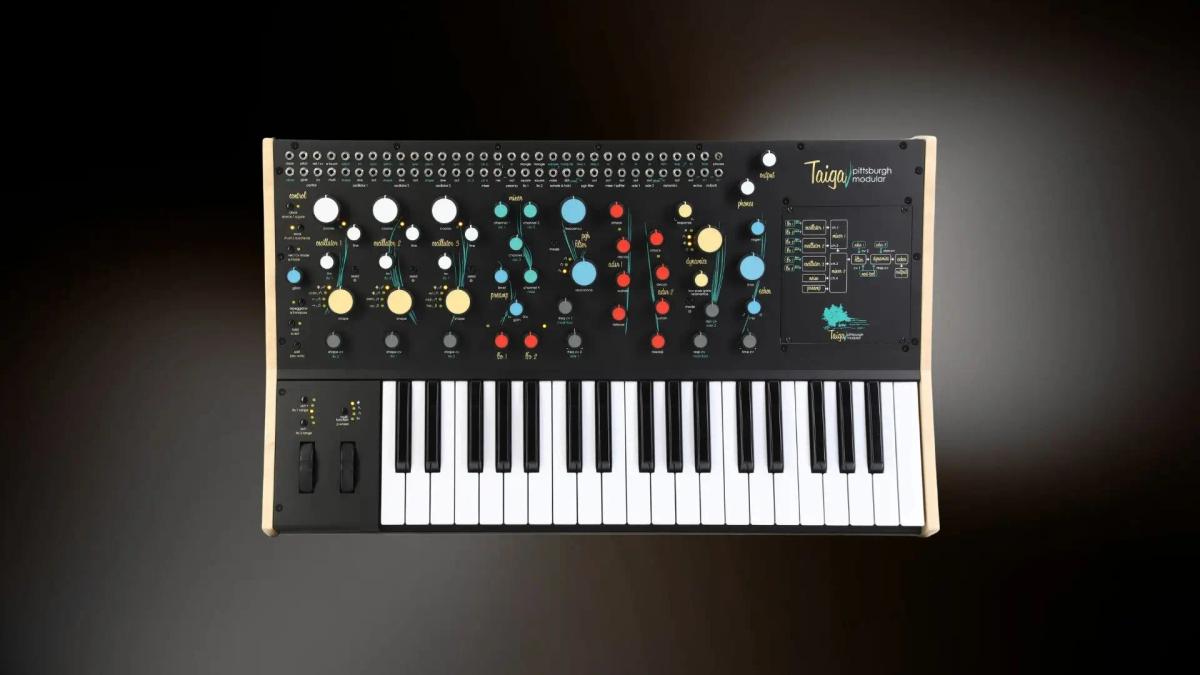
The Pittsburgh Modular Taiga Keyboard is a 37-key semi-modular analog paraphonic synthesizer introduced in March 2024. It expands the earlier Pittsburgh Modular Taiga Keyboard desktop concept into a larger performance instrument with full-size keys, velocity, aftertouch, pitch and modulation wheels, a 64-point patch bay, analog oscillators with waveshaping and wavefolding, a multimode Pittsburgh filter, a Dynamics Controller, analog bucket-brigade delay, and a 24 HP powered Eurorack expansion bay. Its importance lies less in being another analog keyboard and more in how it turns modular thinking into a self-contained performance object: playable without patch cables, but designed to become stranger the moment patching begins.
Table of Contents
Pittsburgh Modular Taiga Keyboard sound and character
The Taiga Keyboard does not sound like a conventional vintage monosynth enlarged into a modern chassis. Its identity comes from tension: it has the immediate vocabulary of subtractive analog synthesis, but its oscillators push beyond ordinary saw, square, triangle, and sine behavior through waveshaping and wavefolding. That gives the Pittsburgh Modular Taiga Keyboard a more elastic harmonic personality than many traditional mono or paraphonic synths. Bass patches can be thick and unstable, but the machine is equally comfortable producing metallic, folded, brassy, vocal-like, or unstable tones that sit closer to modular sound design than to preset-driven keyboard synthesis.
Its three oscillators are central to that character. Because each oscillator includes shaping and folding possibilities, the harmonic complexity does not depend only on filter resonance or external distortion. The sound can become animated at the source, before the filter has even begun to sculpt it. This matters musically: the Pittsburgh Modular Taiga Keyboard can create tones that feel internally alive, with movement built into the waveform rather than added later as an effect.
The Pittsburgh filter gives the instrument a smoother counterweight to the oscillators. Instead of making the Pittsburgh Modular Taiga Keyboard simply abrasive, the filter helps turn folded and frequency-modulated material into something playable. The result is not a polite analog sound, but it is not purely hostile either. It can growl, buzz, and splinter, yet it also has a rounded, gummy quality that keeps complex patches from immediately becoming unusable.
The Dynamics Controller is equally important. By operating as a VCA or low-pass-gate-style section, it gives the Taiga Keyboard a more physical sense of decay and contour. In low-pass gate use, the sound can lose brightness as it fades, which makes plucked, struck, and percussive patches feel less like ordinary envelope-controlled synthesizer tones and more like animated acoustic gestures. This is one reason the Pittsburgh Modular Taiga Keyboard often feels more organic than its specifications suggest.
The onboard analog delay extends that personality rather than polishing it. It is not a pristine digital ambience engine. It is darker, more textural, and better understood as part of the Pittsburgh Modular Taiga Keyboard’s analog behavior. It can thicken leads, smear drones, or push patches toward noisy atmospheres. In practice, the Taiga Keyboard excels at basses, unstable leads, folded drones, expressive arpeggios, semi-modular percussion, animated sequences, and hybrid tones that sit between East Coast subtraction and West Coast wavefolding.
Features and architecture
- Manufacturer: Pittsburgh Modular Synthesizers.
- Year introduced: 2024.
- Production years: 2024 to present.
- Synthesis type: semi-modular analog synthesis with digital control utilities.
- Category: 37-key paraphonic analog keyboard synthesizer with Eurorack expansion.
- Polyphony: paraphonic rather than true polyphonic; the reliable description is a three-oscillator architecture routed through shared downstream shaping, filtering, dynamics, and delay sections.
- Original price: suggested retail price of $1,299 in the United States.
- Current new price signal: commonly listed around $1,299.99 in the United States, with some European pricing below that depending on retailer and currency.
- Current used market signal: early used-market estimates are lower than new price, but the long-term market is still forming.
- Oscillators: three analog VCOs with sine, triangle, saw, and pulse/square-related source shapes, plus proprietary waveshaping and six-stage wavefolding behavior.
- Filter: analog multimode Pittsburgh filter with low-pass, band-pass, and high-pass operation; some retailer specifications identify it as a Steiner-Parker-style multimode design.
- LFOs: two analog LFOs with triangle and square waveforms.
- Envelopes: two ADSR envelope generators.
- Modulation system: 64-point patch bay, CV access to major sections, MIDI-to-CV/gate functionality, sample and hold, random generation, clocking tools, and multifunction modulation tied to the performance controls.
- Sequencer / arpeggiator: 32-step sequencer/arpeggiator, clock generator, clock divider, tap tempo, and random sequencing functions.
- Effects: analog bucket-brigade delay.
- Memory: not a preset-storage instrument; no display-based patch memory or media-card storage is part of the published specification.
- Keyboard: 37 full-size keys with velocity and aftertouch.
- Performance controls: pitch wheel and modulation wheel.
- Inputs / outputs: stereo 1/4-inch main outputs, 1/8-inch audio outputs, 1/8-inch headphone output, 64 patch points, clock input/output, CV/gate connectivity, and external audio/preamp functionality.
- MIDI / USB: DIN MIDI in and out, plus USB-B for MIDI and firmware.
- Display: none.
- Dimensions / weight: approximately 631 × 383 × 130 mm; approximately 7.7 kg.
- Power: included 15 V DC power supply.
- Expansion: 24 HP powered Eurorack bay with limited module depth.
Strengths
- The Pittsburgh Modular Taiga Keyboard has a genuinely distinctive oscillator section. Its waveshaping and wavefolding give it a broader harmonic range than a standard three-oscillator analog subtractive synth, making it strong for sounds that need internal movement rather than simple oscillator stacking.
- The larger keyboard format makes the Pittsburgh Modular Taiga Keyboard concept more performable. Full-size keys, aftertouch, pitch and modulation wheels, wider knob spacing, and rear-panel MIDI/audio connections make it feel less like a module that happens to make sound and more like an instrument designed to be played.
- The 24 HP Eurorack expansion bay is unusually consequential. It lets the instrument become a personalized semi-modular system without requiring a separate case, which is useful for adding a fourth oscillator, alternate filter, sampler, sequencer, utility module, or effect.
- The filter and Dynamics Controller prevent the Pittsburgh Modular Taiga Keyboard from becoming merely aggressive. The filter’s smooth behavior and the low-pass-gate-style dynamics section allow complex oscillator material to remain musical, percussive, and physically expressive.
- It works without patching but rewards patching deeply. That balance matters because it gives the player an immediate starting point while preserving the exploratory logic of modular synthesis.
- The analog delay is not just an accessory. Its darker bucket-brigade character complements drones, leads, and unstable textures in a way that fits the Pittsburgh Modular Taiga Keyboard’s overall sonic identity.
- The patch bay gives the instrument utility beyond itself. It can function as a sound source, processor, modulation hub, or bridge between MIDI, CV, and Eurorack systems.
Limitations
- It is not a true polyphonic synthesizer. Players expecting independent voices with separate filters, envelopes, and amplifiers will find the paraphonic behavior more limited and sometimes less predictable.
- There is no preset memory. This is philosophically consistent with the Pittsburgh Modular Taiga Keyboard, but it makes fast recall difficult in studio or live situations where exact patch recreation matters.
- The absence of a display keeps the interface tactile, but it also means that deeper digital-control behaviors and multifunction settings may require learning rather than visual confirmation.
- The 24 HP Eurorack bay is useful, but it is not a substitute for a full modular case. Module depth, power needs, and available horizontal space all constrain what can realistically be installed.
- The Pittsburgh Modular Taiga Keyboard can have a learning curve. Its strongest sounds often come from understanding oscillator shaping, folding, dynamics, and patch routing rather than simply turning up a familiar sawtooth bass patch.
- Some players may find the price difficult to justify if they only want a conventional analog mono/paraphonic keyboard. Much of the value lies in the modular architecture, not in standard keyboard-synth convenience.
- It is physically larger and heavier than the desktop Taiga, so the performance advantages come with reduced portability.
Historical context
Pittsburgh Modular has long occupied a particular space in the Pittsburgh Modular Taiga Keyboard world: not a mass-market keyboard brand, and not merely a boutique clone-maker, but a company rooted in Eurorack and experimental analog design. The original Taiga desktop, introduced before the keyboard version, already represented a consolidation of several Pittsburgh ideas: complex analog oscillators, the Pittsburgh filter, the Dynamics Controller, analog delay, internal normalization, and modular patch access.
The Pittsburgh Modular Taiga Keyboard appeared in 2024 at a moment when the market was saturated with two opposite tendencies. On one side were compact analog keyboards and desktop synths built for immediate subtractive use. On the other were Eurorack systems whose openness often came at the cost of accessibility, portability, and coherence. The Pittsburgh Modular Taiga Keyboard sits between those poles. It answers a practical question: what if a modular-minded analog instrument could be self-contained, playable, and expandable without abandoning the patch-cable mentality that gives modular synthesis its depth?
It is not a reissue, and it is not a nostalgia instrument. Its historical role is different. Rather than reconstructing a 1970s monosynth, it absorbs older synthesis languages — subtractive filtering, wavefolding, low-pass-gate behavior, analog delay, control-voltage patching — and reorganizes them into a modern performance keyboard. That makes it part of a broader 2020s movement toward hybrid instruments that translate modular ideas into more focused hardware forms.