

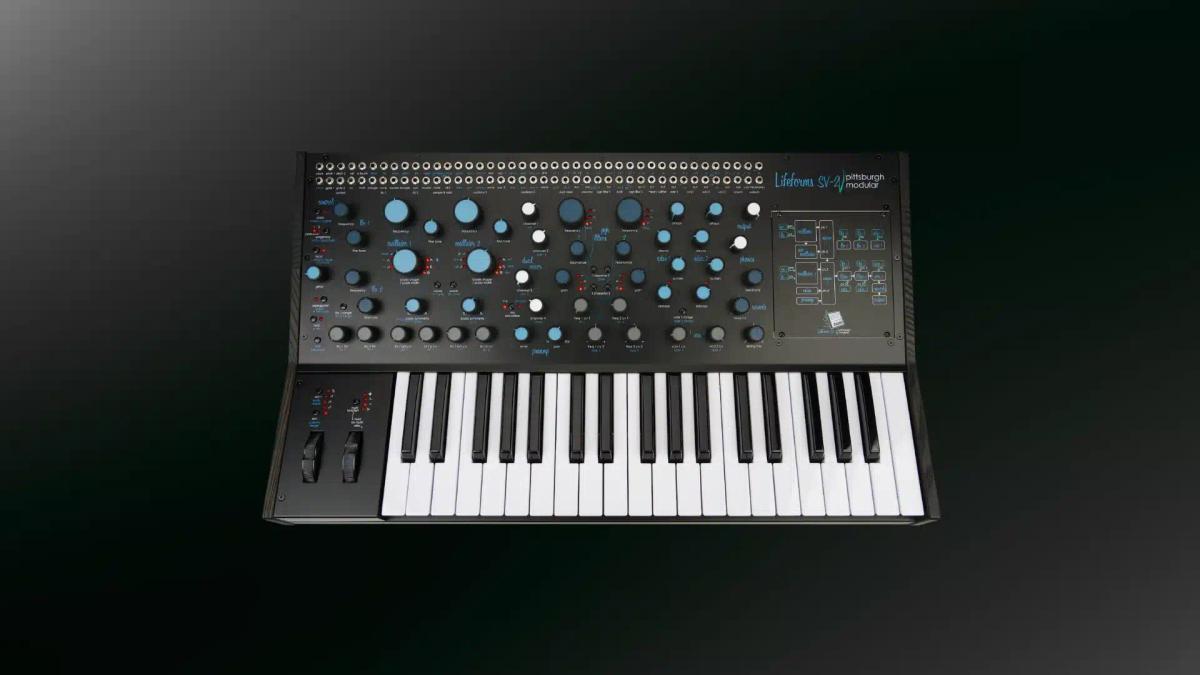
The Lifeforms SV-2 is a 37-key semi-modular analog synthesizer that Pittsburgh Modular launched on August 11, 2026, at $1,499 in the United States and €1,599 in Europe. It is the successor to the Lifeforms SV-1 of 2016, but the company describes it as a complete architectural redesign rather than an update: two thru-zero triangle-core oscillators, two state-variable multimode filters with character modes, six saturation stages, two ADSRs, an arpeggiator and an analog spring reverb, all exposed on an 84-point patch bay with a 24hp Eurorack expansion bay. It plays monophonically, paraphonically at the press of a button, or as a full duophonic instrument when patched, and it is Pittsburgh’s most direct statement of East Coast subtractive design in a keyboard.
Table of Contents
Lifeforms SV-2 sound and character
Pittsburgh Modular positions the Lifeforms SV-2 as East Coast subtractive synthesis with modern additions, and the launch demos bear that out: the Lifeforms SV-2 is built around oscillators into filters into envelopes, with gain staging as a central part of the character. Nick Batt of Sonic State, reviewing it the day after launch, called it a really nice synth that works to Pittsburgh’s strengths and highlighted the range of flavors that comes from the filters responding strongly to gain, drive and character settings, from clean tones to heavily saturated ones.
The oscillators are new. Each is a triangle-core design with thru-zero FM, phase modulation, linear FM and hard sync, and the company claims they stay in tune even under extreme frequency modulation, which matters on an analog synth that invites FM patching. Alongside sine, triangle and saw, the waveforms include Pulse Symmetry, which adds a second dimension to pulse-width modulation, Blade, a proprietary sawtooth variant carried over in spirit from the SV-1 and said to produce a dense, natural chorusing, and a Random output. A square-wave sub-oscillator one and two octaves down and analog white noise complete the sources.
The filters are the other half of the sound. Two Pittsburgh state-variable filters offer highpass, bandpass, lowpass, combo and random responses, and two character modes reshape the filtered wave: Warped changes the waveform’s shape without altering its harmonic content, while Warped and Rectified folds half the wave back for a harsher result. Pre-filter overdrive of up to 5x, a preamp of up to 30x, switchable saturation points in the mixer and a saturation stage in the spring reverb mean there are six places to add drive in a single patch.
The result sits on the modern side of analog: clean and precise when needed, but designed to be pushed. It is not a vintage clone, and its strengths lie in bass, leads, FM timbres and evolving patched sounds rather than polyphonic pads, which its two voices cannot provide.
Features and architecture
- Manufacturer: Pittsburgh Modular Synthesizers, Pittsburgh, Pennsylvania
- Year introduced: 2026; teased in early August and launched on August 11, 2026, with immediate availability
- Production years: 2026 to present
- Synthesis type: analog subtractive with thru-zero FM and phase modulation
- Category: semi-modular analog keyboard synthesizer with a normalized internal signal path and Eurorack expansion
- Polyphony: monophonic, one-button paraphonic, or full duophonic when patched; the two LFOs can track pitch as third and fourth oscillators
- Original price: $1,499.99 in the United States and €1,599 in Europe
- Current market price: about $1,500 new from US dealers in October 2026 (Vintage King lists $1,499.99, Thomann’s US store $1,539), with new units on Reverb from around $1,429
- Oscillators: 2 thru-zero triangle-core VCOs with sine, triangle, saw, Pulse Symmetry, Blade and Random waveforms; thru-zero FM, linear FM, phase modulation and hard sync; square-wave sub-oscillator at minus one and minus two octaves; analog white noise
- Mixer: dual mixer configurable as one 5-channel mixer, two independent 2-channel mixers or other combinations, with twin switchable saturation points and a variable preamp up to 30x
- Filter: 2 Pittsburgh state-variable multimode filters with highpass, bandpass, lowpass, combo and random responses; Warped and Warped and Rectified character modes; pre-filter overdrive up to 5x on each; dual cutoff modulation inputs
- LFOs: 2 voltage-controlled triangle-core LFOs with triangle, saw and square, linear FM, reset and high/low ranges; usable at audio rate
- Envelopes: 2 analog ADSRs with new response curves and short and long range modes
- Modulation system: 84-point patch bay plus a patchable sample and hold, a 2-channel audio/CV mixer and splitter, and a digital modulation tool with manual control, clock-synced LFO, decay envelope and random level
- Sequencer / arpeggiator: arpeggiator with multiple modes, octave ranges and random functions; no step sequencer
- Effects: analog spring reverb with tonal tilt EQ, feedback up to self-oscillation and preamp saturation
- Memory: no patch memory
- Keyboard: custom 37-key keybed with pitch and mod wheels; Thomann lists it as touch-sensitive without aftertouch, while Sonic State describes the Taiga-type keybed with channel aftertouch, and velocity is available as a patchable output
- Expansion: 24hp Eurorack expansion bay with three power headers, insertable anywhere in the signal path
- Inputs / outputs: two 6.3mm line outputs, 3.5mm headphone output and patch bay inputs and outputs for every section
- MIDI / USB: 5-pin MIDI in and out plus a USB port
- Display: none
- Dimensions / weight: 630 x 381 x 120mm at the rear (57mm at the front); Thomann lists 8.4kg
- Power: external 15V DC center-positive supply, included
Strengths
- The oscillator core is the main advance over the SV-1. Thru-zero FM and phase modulation on analog triangle-core oscillators, with the company’s claim of stable tuning under heavy FM, open timbres that most subtractive keyboards in its class cannot reach.
- Gain staging is built in as a sound-design tool. Six saturation and overdrive points let one patch move from clean to aggressive without external pedals.
- Two multimode filters with character modes give real variety, from parallel or stereo filtering to waveform reshaping that goes beyond a single low-pass voice.
- It works without cables but rewards patching. The normalized path makes sound immediately, and the 84-point patch bay exposes every section for modular use.
- The 24hp Eurorack bay makes the Lifeforms SV-2 extensible, allowing a sequencer, extra oscillator or effect to sit anywhere in the signal path.
- The analog spring reverb, with its own saturation and self-oscillating feedback, adds a characterful space that is rare on instruments of this type.
Limitations
- It is at most a two-voice instrument, so chords and pads are outside its scope.
- There is no patch memory, which makes recalling complex patched sounds a matter of notes and photographs.
- Unlike the SV-1 and the Taiga, it is available only as a keyboard; there is no desktop or Eurorack version for players who already own a controller.
- At around $1,500 it costs more than the Taiga Keyboard, and Synth Anatomy and some forum users judged the price high for a monophonic and duophonic synth.
- Published keyboard specifications are inconsistent on aftertouch, so buyers who rely on pressure should confirm the behavior before purchase.
- There is no step sequencer onboard; sequencing requires the arpeggiator, an external device or a module in the expansion bay.
- It is large for a three-octave synth, at about 63cm wide and 8.4kg, which limits its appeal as a portable instrument.
Historical context
Pittsburgh Modular grew from Richard Nicol’s interest in the alien sounds of 1980s industrial records into a Eurorack company based in Pittsburgh’s Homewood neighborhood. Nicol told public radio station WYEP that he sold 110 units straight away to his first two dealers and initially built every unit himself, and that he committed to the business full time around 2012. The company peaked at 11 employees, and after a partnership with Cre8audio around 2021 it largely handed manufacturing to that firm and concentrated on design, with circuit designer Michael Johnsen as a central figure.
The Lifeforms SV-1 set the template the Lifeforms SV-2 builds on. Released in August 2016, the SV-1 Blackbox was a $699 desktop semi-modular in a steel enclosure with two oscillators, including a blade waveform, a state-variable filter, dual sub-oscillators, a four-channel mixer, an envelope, LFO, sample and hold and a MIDI-to-CV converter with arpeggiator, across 53 patch points; the voice module could be removed and mounted in a Eurorack case. The company describes it as one of its most successful synths. In 2024 Pittsburgh added a keyboard to its line with the Taiga Keyboard, covered separately on this site, which introduced the 37-key case, patch bay and 24hp Eurorack bay format that the Lifeforms SV-2 now shares.