Homeโ€บArticlesโ€บDid Pink Floyd use a Moog synthesizer? Rick Wright&#821โ€ฆ
Articles

Did Pink Floyd use a Moog synthesizer? Rick Wright’s synths album by album

Yes, Pink Floyd used a Minimoog, most famously on Wish You Were Here, but their early synth sound came from EMS. Here is which synths appear on which albums.

Bernardo de Azevedo
Bernardo de Azevedo
ยท Updated
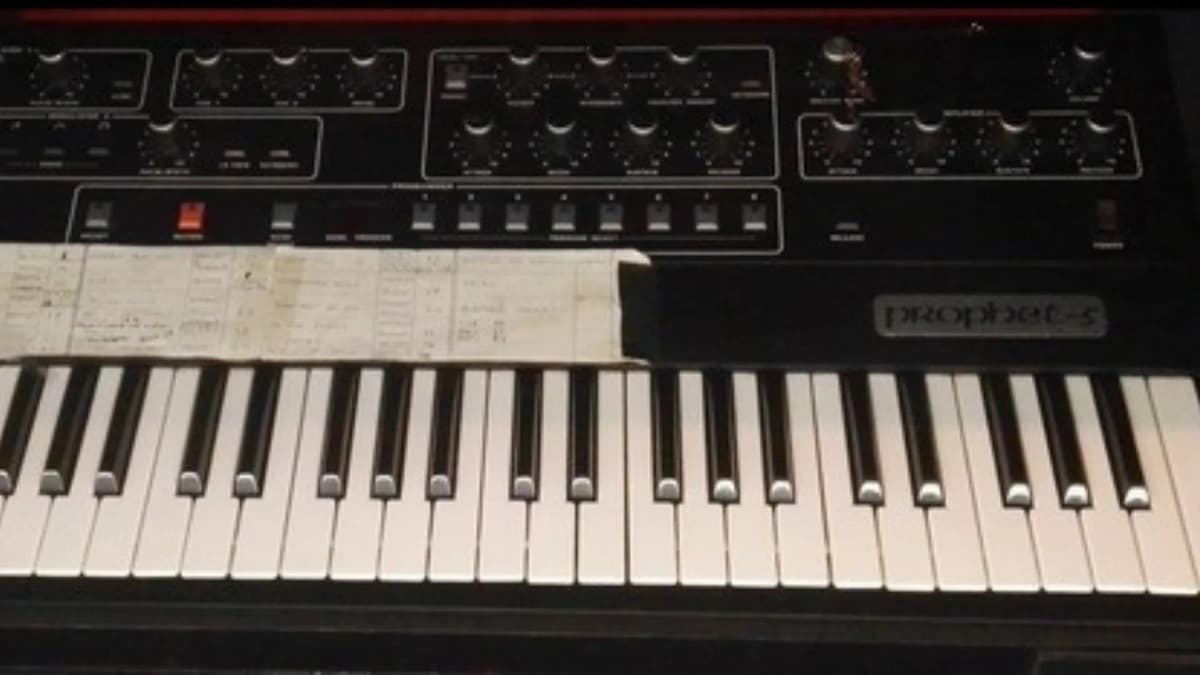
Prophet-5 synthesizer with a setlist taped on top, linked to Pink Floyd keyboardist Richard Wright

Did Pink Floyd use a Moog? Yes, specifically the Minimoog, but later than many people assume. Rick Wright brought a Minimoog to the Wish You Were Here sessions in 1975, and it carries the brassy lead lines in “Shine On You Crazy Diamond”; it also turns up on Animals. The band’s earlier synth sounds, including the pulsing sequence on The Dark Side of the Moon’s “On the Run”, came from British EMS synths rather than Moog.

Pink Floyd’s keyboard rig changed a lot over two decades, and the details are easy to blur. Below is what the sources we checked actually support, album by album, plus the points where they disagree.

Pink Floyd’s synths at a glance

Instrument Album(s) Example tracks
EMS VCS3 Meddle (1971), The Dark Side of the Moon (1973) Wind at the start of “One of These Days”; “Brain Damage”, “Any Colour You Like”
EMS Synthi A / Synthi AKS The Dark Side of the Moon “On the Run”, “Time”
Minimoog Wish You Were Here (1975), Animals (1977) “Shine On You Crazy Diamond”
ARP String Ensemble (Solina) Wish You Were Here, Animals “Shine On You Crazy Diamond”, “Sheep”
Sequential Circuits Prophet-5 The Wall (1979) “Run Like Hell”, “Don’t Leave Me Now”, “Vera”
Roland JX-10 and Kurzweil K250 A Momentary Lapse of Reason (1987) “Signs of Life”, “Learning to Fly”

Before the synths: organ and echo

In the late 1960s Rick Wright’s sound was built on a Farfisa Combo Compact organ, often run through a Binson Echorec delay. Those swirling, echoing textures defined early Floyd long before any synthesizer arrived. When synths did come in, they came from London rather than from Moog’s factory in New York State.

The EMS years: Meddle and The Dark Side of the Moon

The band’s first synthesizer was an EMS VCS3, the small, pin-matrix instrument that Peter Zinovieff’s company launched in 1969. Gearnews credits it with the wind effect that opens “One of These Days” on Meddle. The VCS3 had no built-in keyboard and was notoriously hard to keep in tune, but it excelled at effects and at processing other sounds, which suited Pink Floyd perfectly. Our VCS3 story covers the instrument’s wider history.

On The Dark Side of the Moon, EMS gear is all over the record. The best-known example is “On the Run”, where a rapid sequenced pattern races underneath sound effects. Sources name the instrument slightly differently.

Gearnews says the band used the EMS Synthi AKS, whose keyboard lid contains a built-in sequencer, for “On the Run”, and considers it very likely that the Synthi plays the solo on “Any Colour You Like”. Wikipedia’s album article credits a Synthi A on “Time” and “On the Run”, and a VCS3 on “Brain Damage” and “Any Colour You Like”.

The Synthi A and AKS share the same core electronics, so the difference is mostly about which case and keyboard were involved, but the sources do not agree on every track.

What none of the reliable sources we checked support is a Moog on Dark Side. If you have read that the album’s famous synth parts are Moog sounds, that appears to be a mix-up.

The Minimoog arrives: Wish You Were Here

By the time Pink Floyd started Wish You Were Here at Abbey Road, Wright had expanded his setup. MusicRadar reports that he brought a Minimoog and an ARP String Ensemble to the sessions, alongside the band’s EMS Synthis. Gearnews likewise says the Minimoog took lead synth duties on the album, especially in “Shine On You Crazy Diamond”.

The clearest Moog moment is in the opening suite of “Shine On”, where Wright plays a lyrical, brass-like Minimoog line. MusicRadar ranked that sound among its greatest synth sounds of all time and pointed to the third section of the piece as the Minimoog passage. Live for Live Music describes Wright switching between Minimoog, ARP String Ensemble, piano and clavinet across the track, which is a fair summary of how layered the arrangement is.

The Minimoog was a natural choice in 1975. It was portable, it stayed in tune far better than the VCS3, and its pitch wheel made expressive lead playing easy. For the background on why it became the standard lead synth of the decade, see our Minimoog story and our profile of the Minimoog Model D.

“Welcome to the Machine” and “Have a Cigar” are also full of synthesizer parts, and you will find many confident claims online about exactly which instrument plays what. We could not confirm a reliable track-by-track breakdown for those songs, so we leave the attributions out rather than guess.

Animals: Minimoog and string synth

Gearnews places the Minimoog on Animals (1977) too, where it works around David Gilmour’s guitar rather than leading, and credits the Solina String Ensemble on the album, naming “Sheep” as a highlight. The Solina design was licensed to ARP, which sold it as the ARP String Ensemble in many markets, so the two names in different sources refer to the same instrument. It was a fully polyphonic string machine, something no Minimoog or VCS3 could offer.

The Wall and the Prophet-5

For The Wall (1979), the rig changed again. Gearnews says the band leaned heavily on the Sequential Circuits Prophet-5, the first fully programmable polyphonic synth, with its best-known moment being the oscillator-sync lead in “Run Like Hell”. It also appears on “Don’t Leave Me Now” and “Vera”. Our Prophet-5 story explains why that instrument took over so many studios at the end of the 1970s.

The later years

On A Momentary Lapse of Reason (1987), Gearnews points to a Roland JX-10 (the Super JX) on “Signs of Life” and “Learning to Fly”, alongside a Kurzweil K250 sampler. By then the Moog era of the band was long over, though the Minimoog lines from Wish You Were Here remain the band’s most recognisable synth sound.

So, did Pink Floyd use a Moog?

Yes, but the Moog in question is the Minimoog, and its key appearances are on Wish You Were Here and Animals. The sources we found give no evidence that the band used a big Moog modular system. Their signature early electronic sounds belong to EMS, and their late-1970s sound to Sequential. If you want to hear Pink Floyd’s Moog, start with the slow lead lines of “Shine On You Crazy Diamond”.

FAQ

What synth did Pink Floyd use on “On the Run”?

An EMS synth with a sequencer. Gearnews names the Synthi AKS, while Wikipedia lists a Synthi A; both are versions of the same EMS design, not a Moog.

What synth plays the lead in “Shine On You Crazy Diamond”?

Rick Wright’s Minimoog provides the brass-like lead synth line, supported by an ARP String Ensemble, piano and other keyboards.

Did the Beatles use a Moog?

Yes. The Beatles used a Moog modular synthesizer on several tracks of Abbey Road (1969), years before Pink Floyd’s Minimoog. We tell that story in how the Beatles met the Moog.

Which Pink Floyd member played synthesizer?

Mostly Rick Wright, the band’s keyboard player, although the EMS instruments were used as studio tools by the whole band.

Related articles

Sources

Image credits: Prophet-5 photo by Michele Brina, Wikimedia Commons, CC BY-SA 4.0. The photo was cropped to fit the featured image.


Bernardo de Azevedo
Written by
Bernardo de AzevedoFounder & Editor

His connection with music began at age 6, in the 1980s, when his father introduced him to Jean-Michel Jarre's Rendez-Vous on vinyl. He works professionally in the legal field, while synthesizers became his space for abstraction and creative exploration. Founder of The Synth Source.