Home›Synths›OSC OSCar: The British hybrid monosynth that put additi…
Synths

OSC OSCar: The British hybrid monosynth that put additive waveforms under a rubber shell

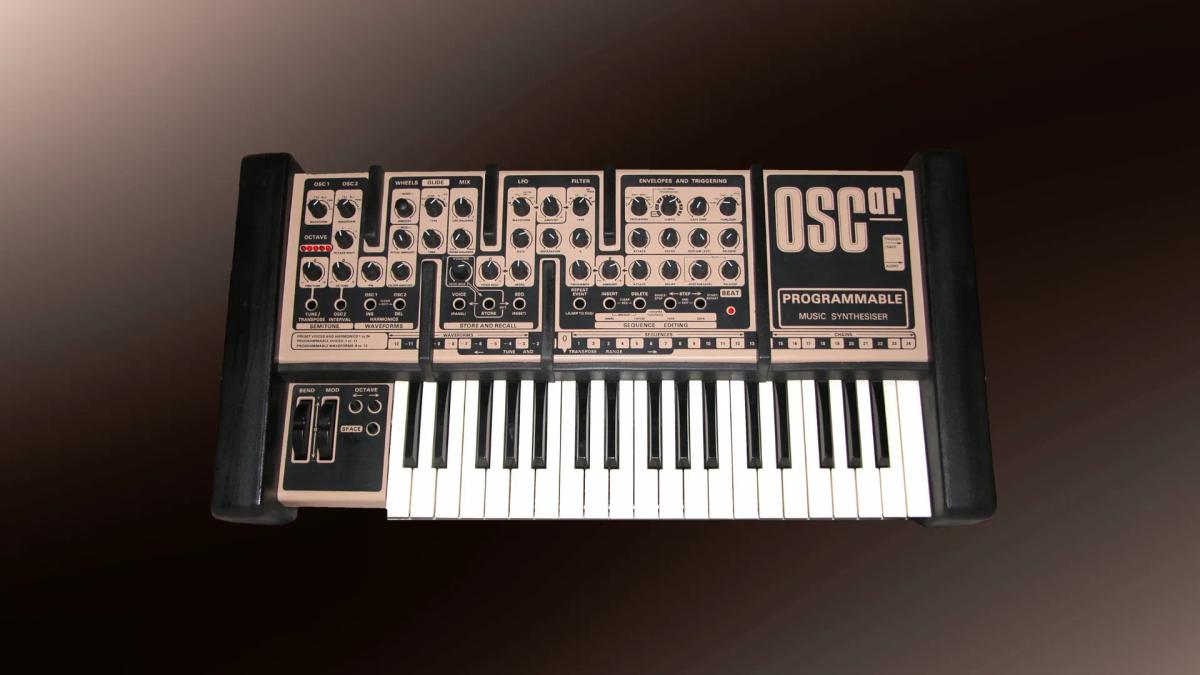
The OSCar is a monophonic, duophonic-capable hybrid synthesizer released in 1983 by the Oxford Synthesiser Company, the small firm Chris Huggett set up after the collapse of Electronic Dream Plant, maker of the Wasp.

Bernardo de Azevedo
Bernardo de Azevedo
· Updated
OSC OSCar: The British hybrid monosynth that put additive waveforms under a rubber shell

The OSCar is a monophonic, duophonic-capable hybrid synthesizer released in 1983 by the Oxford Synthesiser Company, the small firm Chris Huggett set up after the collapse of Electronic Dream Plant, maker of the Wasp. It paired two oscillators computed in software by a Z80 processor with a pair of analog 12 dB/oct filters, and added things almost no monosynth of its day offered: patch memory, a step sequencer, an arpeggiator, and user waveforms built additively from up to 24 harmonics.

Wrapped in black plastic and thick rubber end cheeks designed by Anthony Harrison-Griffin, it looked unlike anything else on the market, and it sounded different too, which is why it ended up on records by Ultravox, Stevie Wonder, and Jean-Michel Jarre.

Sound and character

The OSCar’s sound sits between analog weight and digital precision. Its digitally generated oscillators are clean and stable, sometimes slightly glassy on their own. What makes them heavier is the filter drive: set with the Volume knob and saved as part of each patch, it pushes the filters into a thicker, saturated response that 1983 reviewers compared to the warmth of a Minimoog. Co-developer Paul Wiffen has described a mark at about two-thirds of the knob’s travel beyond which the instrument stops getting louder and simply overdrives harder.

The filters are the other half of the character. Two 12 dB/oct analog filters combine as a 24 dB/oct low-pass or high-pass, or work as a band-pass, and a Separation control pulls their cutoffs apart. In band-pass mode that produces two resonant peaks and a vocal, formant-like quality that a single-filter Moog or Roland monosynth does not offer.

The additive waveforms add a third dimension: stacked, stored harmonics give organ-like or reedy timbres closer to early digital polysynths than to a classic subtractive mono. Wiffen points out that they are clearly audible in the breaks of Ultravox’s “Love’s Great Adventure.”

Basses are firm, overdriven leads are gritty, and sequenced lines are crisp. The recurring reservation, from 1985 reviews to modern retrospectives, is that the envelopes are not especially snappy.

Features and architecture

  • Manufacturer: Oxford Synthesiser Company (OSC), Oxford, England
  • Year introduced: 1983
  • Production years: 1983 to 1986, the span given by most sources
  • Production run: commonly cited as around 2,000 units, although one modern review gives a lower figure of about 1,000
  • Designers: Chris Huggett (electronics and software), Paul Wiffen (sounds and development), Anthony Harrison-Griffin (industrial design)
  • Synthesis type: hybrid digital/analog subtractive with additive waveform creation
  • Category: programmable keyboard monosynth with duophonic mode
  • Polyphony: monophonic; Duo mode splits the two oscillators so they can play separate notes while sharing the filter and amplifier envelopes
  • Original price: £499 including VAT in 1983 UK reviews; a January 1985 review lists £625; Wiffen later recalled an RRP of £599
  • Processor: Z80, with behavior defined in firmware
  • Oscillators: 2 digital oscillators with triangle, sawtooth, square, variable pulse, and automatic PWM waveforms; independent tuning and transpose; mixable noise
  • Additive synthesis: user waveforms built from up to 24 harmonics, each one selected from the keyboard and raised in level with repeated key presses and stored in waveform memories
  • Filter: two analog 12 dB/oct filters, combined for 24 dB/oct low-pass or high-pass, or used as band-pass; Separation control offsets the two cutoffs; resonance; programmable filter overdrive
  • LFOs: 1 main LFO with triangle, sawtooth (ramp), square, and random/sample-and-hold shapes, plus internal modulation used for PWM
  • Envelopes: 2 ADSR envelopes (filter and amplifier) with repeat and retrigger options and a delay function on the filter envelope
  • Modulation system: front-panel routing via rotary switches, programmable pitch-bend and mod-wheel settings, six glide modes including portamento and glissando
  • Sequencer / arpeggiator: step-time sequencer with 12 sequences that can be chained across 10 chain positions, rests, note lengthening, and program changes; arpeggiator with up, down, and up/down directions; external clock via the trigger input
  • Effects: none onboard
  • Memory: original models offered 24 presets and 12 user patches; MIDI-era models made all 36 locations user-programmable; waveforms and sequences also stored; data could be dumped to cassette; memory held by an internal battery
  • Keyboard: 37 keys (three octaves, C to C), not velocity sensitive, also used as a data entry pad during programming
  • Inputs / outputs: audio output that also drives high-impedance headphones and doubles as the cassette save/load connection; external trigger input
  • MIDI / USB: no MIDI on the first units; a MIDI version followed and could be retrofitted to earlier ones; no USB
  • Display: no alphanumeric display; status shown through LEDs, including octave indicators used during programming
  • Dimensions / weight: approximately 73 × 37 × 12 cm and about 8 kg

Strengths

  • The filter section is genuinely distinctive. Separation between two resonant filters gives the OSCar vocal and formant-like band-pass tones that most monosynths, then and now, cannot produce.
  • Programmable filter drive gives it a second personality. The same instrument can be clean and precise or thick and saturated, and the setting is saved with the patch.
  • Additive waveform design was rare on any synth in 1983 and essentially absent from monosynths. Electronics & Music Maker noted that the smallest polyphonic offering a comparable feature at the time was the PPG Wave 2.2.
  • It was one of the most complete performance packages of its generation: memory, sequencer, arpeggiator, chaining, and duophonic play in one portable keyboard.
  • Digitally generated oscillators stay in tune, which made the OSCar dependable for sequenced bass and for recording, at a time when analog monosynths often drifted.

Limitations

  • It is fundamentally monophonic. Duo mode helps, but the two voices share envelopes and filtering, so it is not a substitute for a polysynth.
  • The interface is direct for basic sounds but cryptic for deeper functions. Reviewers from 1983 onward pointed to many rotary switches and a complex procedure for sequencing and waveform editing.
  • Envelope attacks are soft by the standards of the fastest analog designs, which limits the snappiest percussive sounds.
  • The three-octave keyboard is light and not velocity sensitive, and the raised rubber end cheek makes the pitch and mod wheels awkward to reach.
  • Early units lacked MIDI, and the original memory system relied on cassette storage and a backup battery; replacing the battery erases all user data.
  • Age is now a serious issue. Rubber parts can crack, deform, or warp, knobs can drift, and many surviving units need professional servicing.

Historical context

The OSCar emerged from the wreckage of Electronic Dream Plant. Adrian Wagner had set up EDP, with Huggett as a director, to manufacture Huggett’s Wasp, released in 1978 for £199: an inexpensive plastic-cased synth with digital oscillators and an analog filter. The first company was wound up by 1980 and a second EDP was in receivership by the end of 1981, so Huggett regrouped with Wiffen, while Harrison-Griffin, who had already designed the casing of EDP’s Gnat, took on the industrial design.

According to Wiffen, the goal was a programmable alternative to the Minimoog, since Moog’s own Source had failed to capture that sound. Ironically, a modern retrospective says the prototype was built inside a Source case, and a 2004 Sound On Sound letter described a hand-wired, Source-cased unit, identical to an OSCar, that its owner believed was a prototype. The Source was also the only other programmable monosynth Music UK could name in its May 1983 review.

The timing was awkward. In 1983, programmable polysynths were becoming affordable and MIDI was arriving. The OSCar’s answer was to make the monosynth smarter rather than cheaper: memory, sequencing, and waveform creation that rivals did not offer, at £499 through dealers such as Rod Argent’s Keyboards and Rose-Morris. Music UK’s Dave Crombie called it “Britain’s last hope” in synthesizers, a phrase that captures how far Japanese and American manufacturers dominated the market by then.

The instrument evolved quickly. Paul Colbert’s 1985 One Two Testing review covered a “mark seven” version with MIDI and concluded that “at this price, the Oscar simply has no competition.” A polyphonic rackmount version, the ASG, was ordered by Hans Zimmer, but the investment to produce it fell through, and OSCar production ended in the mid-1980s.

Legacy and significance

The OSCar matters because it showed that a monosynth could be a computer instrument without losing physical character. Its oscillators were software, its sequencer was firmware, and its memories lived in battery-backed RAM, yet the sound reached the listener through analog filters driven hard enough to growl. That hybrid logic became one of the most fertile ideas in later synthesizer design.

It is also the pivot of Chris Huggett’s career. The line runs from the Wasp to the OSCar, then through a decade of operating-system code for Akai’s S1000-series samplers, to Novation, where he designed the Bass Station and the Supernova, and finally to PWM’s Mantis, the last instrument he worked on before his death in 2020.

The OSCar also had a long second life in dance music. Its stable oscillators, programmable drive, and built-in sequencer made it a natural fit for bass-driven electronic music, and a mono from 1983 ended up associated with S’Express, Tim Simenon of Bomb the Bass, Orbital, and Underworld. Its look has lasted too: Harrison-Griffin’s rubber casework divided opinion in 1983, yet it is now the first thing most people recall.

Artists, users, and curiosities

Ultravox are the band most closely tied to the OSCar. According to Wiffen, an overdriven lead patch he built in emulation of Billy Currie’s sound impressed the band enough that they ordered three units, one each for Currie, Midge Ure, and Chris Cross. The OSCar became the main instrument on “Love’s Great Adventure,” and Wiffen also lists Band Aid’s “Do They Know It’s Christmas?” among the records it played on. John Foxx is also listed among early users.

Stevie Wonder used it for the bass line of the 1987 single “Skeletons,” doubled with an Elka Synthex via MIDI, and Wiffen recalls Wembley Arena soundchecks where crew and band came under the stage to find the source of the bass and were surprised it was not the Synclavier. Jean-Michel Jarre used it for the solo at the climax of the “Revolutions” overture, and his keyboardist Dominique Perrier is also named among its users.

Geoff Downes of Buggles and Asia, Keith Emerson, and Tim Simenon of Bomb the Bass also used it, and it supplied the bass line on S’Express’s “Theme From S-Express.” Vintage Synth Explorer adds Hardfloor, BT, Ozric Tentacles, and Sneaker Pimps, and both it and GForce name Orbital and Underworld.

The name joined the company’s initials to an “ar,” which Wiffen links to the “Model A” designation, and the first review warned that a large French order had swallowed most of the initial production run.

The latest chapter belongs to PWM. GForce had already emulated the instrument as impOSCar, but PWM, which built the Mantis with Huggett, won the rights and trademark to the OSCar name in early 2025. Its Mantis 2.0 firmware added wavetables derived from the OSCar’s oscillators, and in September 2025 it announced an OSCar “Re-birth.” At Superbooth 2026 PWM showed a newer prototype that runs Huggett’s original firmware, decoded from its Z80 assembly code and ported to a modern system, and said it hoped to have it ready by NAMM in January 2027.

OSCar market value

  • Current market position: a rare, collectible British vintage monosynth valued for both sound and design
  • New price signal: none for the original; PWM’s planned limited OSCar reissue has no confirmed price, with earlier coverage estimating around £2,500 and PWM saying price and run size will depend on interest
  • Used market signal: a 2020s review reported Reverb listings roughly between 4,500 and 8,000 in USD or EUR, with some higher, and suggested about 6,000 as a realistic figure for a cosmetically good, professionally overhauled unit
  • Availability: hard to find; with production commonly put at around 2,000 units, listings are infrequent
  • Buyer notes: MIDI-equipped units are the practical choice; check rubber parts for cracks and warping, knobs for drift, the backup battery, the high C key for side-panel interference, and the loosely fitted MIDI strip
  • Support ecosystem: professional overhauls are recommended; impOSCar, the Mantis OSCar mode, and the planned reissue keep the sound in use
  • Market character: collectible and firmly established, closer to a cult classic than to a player’s bargain
  • Long-term position: likely stable to rising given its rarity, though a reissue may give players a practical alternative

Conclusion

The OSC OSCar represents a tiny British company trying to make the monosynth smarter just as the industry moved to polyphony. It did not change the market’s direction, but it built something more lasting: a hybrid voice with digital stability, additive waveforms, a characterful dual filter, and enough drive to sound physical. The OSCar matters because it proved that a digitally minded monosynth could have one of the most recognizable voices of its decade.

Sources

  1. Life of OSCar, Sound On Sound
  2. Oxford Synthesiser Company OSCar, Vintage Synth Explorer
  3. OSCar Synthesizer: a unique fetish synth from the UK, Greatsynthesizers
  4. The Oscar (Music UK, May 1983), Muzines Magazine Archive
  5. OSCar Synthesiser (Electronics & Music Maker, August 1983), Muzines Magazine Archive
  6. Oscar Synth (One Two Testing, January 1985), Muzines Magazine Archive
  7. RIP Chris Huggett: great British synth designer, Sound On Sound
  8. EDP Wasp (Retrozone, February 1995), Sound On Sound
  9. Crosstalk: A MOSCar or an Ooog? (June 2004), Sound On Sound
  10. impOSCar, GForce Software
  11. PWM wins rights to OSCar name, Sonic State
  12. OSCar company is now part of PWM, Synth Anatomy
  13. PWM Mantis 2.0 hybrid synthesizer gets OSCar mode and free GForce impOSCar promo, Synth Anatomy
  14. PWM OSCar Re-birth, Gearnews
  15. Superbooth 2026: PWM OSCar Synthesizer, Sonic State

Bernardo de Azevedo
Written by
Bernardo de AzevedoFounder & Editor

His connection with music began at age 6, in the 1980s, when his father introduced him to Jean-Michel Jarre's Rendez-Vous on vinyl. He works professionally in the legal field, while synthesizers became his space for abstraction and creative exploration. Founder of The Synth Source.