

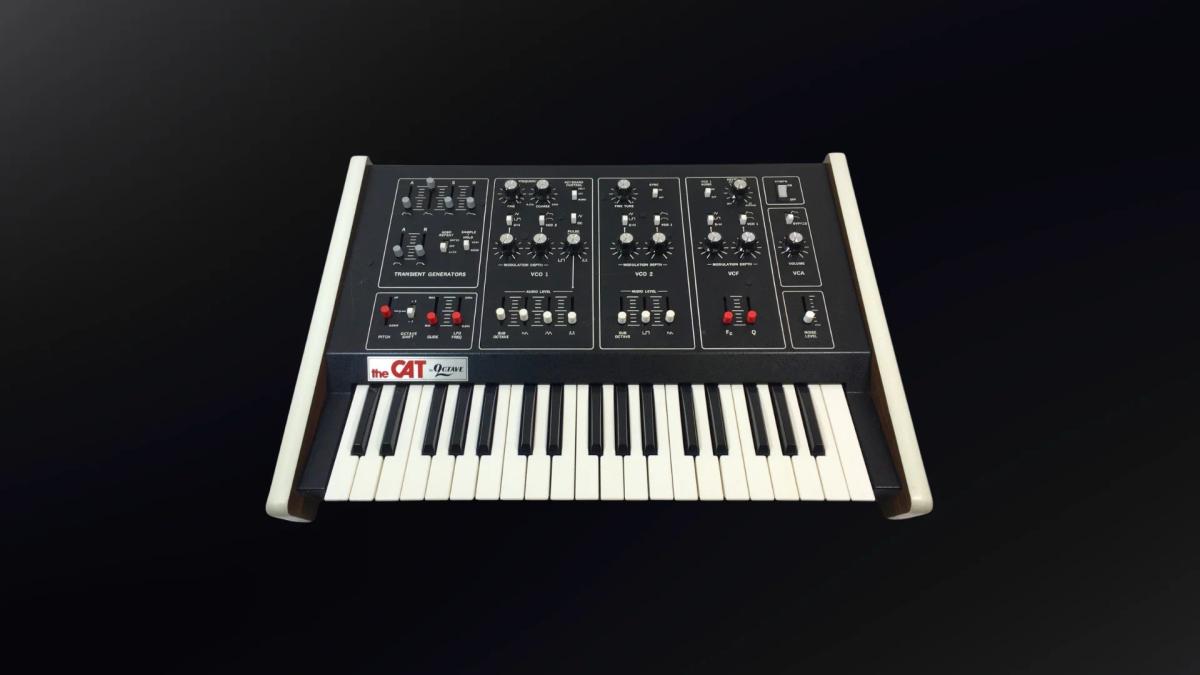
The Octave Cat is a two-oscillator analog keyboard synthesizer that Octave Electronics of New York introduced in 1976, designed by a team led by a 22-year-old engineer, Carmine Bonanno. It offered two VCOs with mixable waveforms and sub-oscillators, a resonant 24dB/octave low-pass filter, ADSR and AR envelopes, sample and hold, cross-modulation and a 37-note duophonic keyboard, at a launch price of $599. That was roughly half of what the Minimoog or ARP Odyssey cost, and it made the Octave Cat one of the first serious performance synths within reach of working musicians. It also put Octave in direct conflict with ARP, and through its SRM and SRM II revisions it stayed in production until 1981.
Table of Contents
Octave Cat sound and character
The Octave Cat is best known for growl. Sound On Sound’s Gordon Reid described it as a superb-sounding instrument with a bite comparable to the best Moogs and ARPs, and singled out squelchy basses and cutting leads as its strengths. Much of that comes from the filter: a fully resonant four-pole low-pass that can be pushed into self-oscillation and that Reid treated as the star of the design. It tracks aggressive envelope sweeps well, and resonant patches keep enough low end to work as bass.
The oscillator section gives it a broader palette than its size suggests. Instead of the Odyssey’s waveform switches, each oscillator has level sliders, so sawtooth, square, triangle and pulse on VCO 1 can be blended with sawtooth and square on VCO 2, plus sub-oscillators an octave below. Seven waveforms can be mixed at once. Stacked in mono mode, the two oscillators produce a thick, slightly detuned bass or lead; switched to duophonic mode, each VCO becomes a separate voice, which thins the sound, as Vintage Synth Explorer points out. Sync, cross-modulation and audio-rate frequency modulation add metallic and clangorous tones.
Opinions on its character vary. Reid found that, unlike the Odyssey, the Octave Cat could also sound warm and mellow, while GForce’s history argues that it lacks some of the Odyssey’s raw edge. Both views fit an instrument that sits between the Moog and ARP sound worlds: rounder than a classic Odyssey, more aggressive than many budget monosynths of the late 1970s.
Its weak spot is imitative synthesis. Reid noted that convincing acoustic imitations were hard to get, and with a single LFO, two envelopes and no memory, the Octave Cat favors bass, leads, effects and sequenced lines over detailed orchestral patches.
Features and architecture
- Manufacturer: Octave Electronics, Inc., New York; later Octave-Plateau Electronics after the 1979 merger with Plateau Electronics
- Year introduced: 1976; orders were taken at the 1976 NAMM show and shipments began later that year
- Production years: 1976 to 1981, across the original Cat, the Cat SRM (1977) and the Cat SRM II (1978, though some references give 1979)
- Synthesis type: analog subtractive
- Category: portable, pre-wired keyboard synthesizer with mono and duophonic modes
- Polyphony: duophonic, with a mono/off/poly switch for VCO 1’s keyboard tracking; Vintage Synth Explorer states that the very first Cats were purely monophonic, but Sound On Sound, Perfect Circuit and Bonanno himself describe duophony as part of the original design
- Original price: $599 in the United States
- Current market price: a working unit typically sells for around $1,500 to $2,600 depending on version and condition, based on Reverb listings and UK dealer Soundgas
- Oscillators: 2 VCOs; VCO 1 offers sawtooth, square, triangle and variable pulse with pulse width modulation, VCO 2 offers sawtooth and square; each has sub-oscillator outputs and level sliders so up to seven waveforms can be mixed; sync, cross-modulation and frequency modulation in either or both directions
- Filter: 24dB/octave resonant low-pass that self-oscillates; sources disagree on the chip, with Perfect Circuit describing a discrete original, the SSM2040 in the SRM and the SSM2044 in the SRM II, while Cherry Audio describes the SSM2040 as the original filter; optional factory mods added a high-pass mode and a 12/24dB switch
- LFOs: one LFO; the SRM added a delay that fades the LFO in after a key press
- Envelopes: one ADSR (on sliders) and one AR, which Octave called transient generators; the ADSR can repeat in auto or gated mode, clocked by the LFO
- Modulation system: sample and hold sourcing noise or VCO 1, LFO, envelopes and cross-modulation routed to oscillators, filter and amplifier
- Sequencer / arpeggiator: none; repeating envelopes and sample and hold supply rhythmic movement
- Effects: none onboard
- Memory: no patch memory
- Keyboard: 37 keys, no velocity or pressure sensitivity; glide and octave shift switches; the SRM added a two-note memory so the second oscillator no longer jumped to the remaining note on release
- Controllers: Bonanno has said he regretted leaving out pitch and mod wheels, and offered the separate CATstick joystick controller from around 1979; accounts of panel controllers differ between versions
- Inputs / outputs: twin audio outputs, external audio input and twin pedal inputs; CV and gate appeared on later units, the SRM II improved separate CV and gate for upper and lower notes
- MIDI / USB: none; the instrument predates MIDI
- Display: none
- Dimensions / weight: compact three-octave cabinet with wooden end cheeks; published dimensions and weight are not consistently documented
- Power: internal power supply wired for local mains voltage; UK units run on 240V
Strengths
- It undercut the competition dramatically. At $599 it delivered a two-oscillator, duophonic architecture comparable to instruments costing roughly twice as much.
- The waveform mixer is more flexible than the Odyssey’s. Level sliders for each waveform and sub-oscillator let players build composite tones that a switch-based panel cannot.
- The filter is strong and musical, self-oscillating and resonant enough for squelchy bass and screaming leads while keeping low-end weight.
- Modulation goes further than its size suggests. Cross-modulation, sync, sample and hold and audio-rate frequency modulation give it a reach into metallic and effects territory.
- The repeating ADSR clocked by the LFO turns the envelope into a rhythmic source, useful for pulsing patches without a sequencer.
- The panel is clear and sturdy, with sliders that GForce’s history judged tougher than the Odyssey’s, which makes it fast to program and easy to read on stage.
Limitations
- There is no patch memory, so every sound has to be set by hand.
- Duophonic mode splits the two oscillators into separate voices, so two-note playing comes at the cost of the thick stacked tone.
- Modulation is limited to one LFO and two envelopes, and there is no ring modulator, pink noise or high-pass filter on a standard unit, all of which the Odyssey offers.
- Early units have no CV or gate sockets, and later ones use stereo quarter-inch jacks with a non-standard 7.5V gate that Sound On Sound found unreliable with other synths.
- The keyboard has no velocity or aftertouch, and the original design lacks the pitch and mod wheels its designer later regretted omitting.
- Like most analog synths of its age, oscillators drift, sliders and pots can crackle after disuse, and a vintage example often needs keyboard bushings, a recapped power supply and calibration.
- The three versions differ in keyboard behavior, filter circuitry and interfacing, which makes buying more complicated than the single model name suggests.
Historical context
Carmine Bonanno came to synthesis through Wendy Carlos’s Switched-On Bach, learned circuit design from the Electronotes newsletter and built his own modular system while working as an organ repairman for the distributor Syn-Cordion. He saw that performance synths such as the Minimoog and ARP Odyssey were too expensive for many musicians, built a prototype, and convinced Syn-Cordion’s owners to back production. Octave Electronics was founded in 1975, and Bonanno has said that he designed the circuitry, chassis and panel himself, drawing on his modular, with the Minimoog and Odyssey as references.
The Octave Cat took orders at the 1976 NAMM show and shipped later that year. Its resemblance to the Odyssey, which ARP had launched in 1972, was obvious, and ARP engineer Philip Dodds later called it a knock-off. ARP took legal action, and accounts differ on its basis: Bonanno has said that the dispute concerned ARP’s patent on duophonic keyboard technology, and that ARP dropped the case after he showed prior art. The Cat SRM, the Series Revision Model, appeared in 1977 with a two-note memory keyboard, LFO delay and an external control input for VCO 1; GForce notes that the claim that the redesign was forced by the dispute is unconfirmed. The single-oscillator Kitten joined it around the same time.