

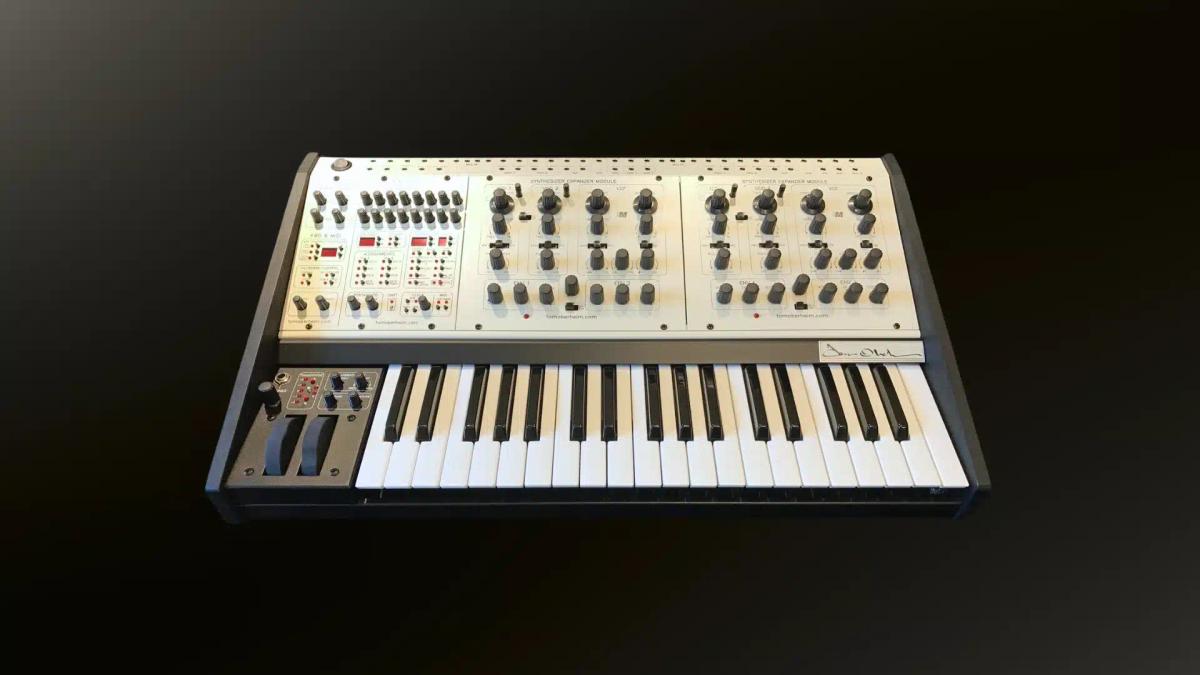
The Oberheim Two Voice Pro is a duophonic analog keyboard synthesizer that Tom Oberheim announced in March 2012, began delivering in small numbers in 2014, and built until 2018 under the Tom Oberheim name through his company Marion Systems. It pairs two reissued SEM (Synthesizer Expander Module) voices, each with two oscillators and a 12dB/octave multimode filter, with a 37-key velocity- and aftertouch-sensitive keyboard, a two-row 16-step sequencer, and a 56-point patch bay. A signed Special Edition followed in 2021, the first Tom Oberheim instrument sold under the Oberheim name since the 1980s. At a glance, it matters as the designer’s own return to the 1975 Oberheim Two Voice Pro, which he has repeatedly called his favorite of all his synthesizers, with the performance features the original lacked.
Table of Contents
Oberheim Two Voice Pro sound and character
The Oberheim Two Voice Pro sounds like two SEMs, and that is the point. Each voice has two oscillators feeding a two-pole state-variable filter, and the result is the broad, buzzy, slightly rounded tone that gave Oberheim its early reputation. MusicRadar’s Dan Goldman described the sonics as immense and authentic, and Sound On Sound’s Gordon Reid judged the SEM sound highly enough to call the instrument capable of superb results. Because the filter rolls off at 12dB per octave rather than 24, the top end stays open even when the cutoff is low, which makes brass, strings and wide pads easier to get than on a four-pole design.
The filter’s continuous Mode control is the SEM’s signature. It sweeps from low-pass through notch to high-pass, with band-pass on a separate switch, so a single knob can hollow out or thin a sound in ways that a fixed low-pass filter cannot. Greatsynthesizers’ Theo Bloderer singled out this sweep as the feature that most separates the SEM from its contemporaries, and it is a large part of why two voices can sound like more: set one SEM to low-pass and the other to notch or band-pass, pan them apart, and the Oberheim Two Voice Pro produces a stereo image with real depth.
There are limits to the palette. The ADS envelopes, with decay doubling as release, are smooth rather than snappy, and Bloderer found the Oberheim Two Voice Pro warmer but less sharp than an ARP 2600 and less suited to percussive, clicky sounds. Each SEM’s own LFO offers a single waveform. Reid also noted that the Oberheim Two Voice Pro is slightly noisier than some modern designs, with a faint whistle audible when the VCA is open and the oscillators are off. The overall character is vintage and organic rather than clinical: it rewards slow, layered parts, duophonic counterpoint and sequenced figures more than aggressive modern bass.
Features and architecture
- Manufacturer: Tom Oberheim (Marion Systems); the 2021 Special Edition carried the Oberheim badge
- Year introduced: announced in March 2012; a first run of 25 units began delivery in the United States in spring 2014
- Production years: 2014 to 2018, with a limited, signed Special Edition run announced in March 2021
- Synthesis type: analog subtractive
- Category: duophonic semi-modular keyboard synthesizer with built-in sequencer
- Polyphony: two voices (one per SEM); Unison, two-voice polyphonic, Rotate, SEM A First and Split modes, last-note priority
- Original price: $3,495 in the United States; £3,299 in the UK per Sound On Sound (MusicRadar quoted £3,199); the Special Edition was reported at $4,995
- Current market price: recent dealer listings in the UK have sat around £3,300 before VAT, and owners reported Reverb sales near $2,800 around 2020; current listings are scarce
- Oscillators: four VCOs, two per SEM, each producing sawtooth or variable-width pulse; oscillator sync; a global knob detunes both VCO2s together
- Filter: one 12dB/octave state-variable multimode filter per SEM, sweeping continuously from low-pass through notch to high-pass, with a band-pass switch
- LFOs: one per SEM with a single fixed waveform (Sound On Sound and MusicRadar describe it as sine, some references list triangle), plus a separate global vibrato LFO controllable by mod wheel or aftertouch
- Envelopes: two per SEM (filter and amplifier), each attack, decay and sustain, with decay also setting release
- Modulation system: per-SEM routing of envelope and LFO to pitch and filter, two sample-and-hold sources, velocity and aftertouch CV outputs, plus the patch bay
- Sequencer / arpeggiator: two-row step sequencer (one row per SEM), up to 16 steps, semitone-quantized, with 2-, 3- and 4-way ratcheting, rests, gate length, transpose, song chaining and MIDI clock sync; Sound On Sound counts 100 sequences stored as 50 pairs
- Effects: none
- Memory: no patch memory; sequences and songs are stored in flash memory
- Keyboard: 37-key Fatar keybed with velocity (selectable curves) and aftertouch; left-hand Bendbox with pitch wheel (1 to 12 semitones), mod wheel, octave transpose, fine tune, VCO2 detune and vibrato controls
- Inputs / outputs: 56 3.5mm patch points on the top panel (19 per SEM plus CV, gate and modulation outputs and two multiples), six quarter-inch jacks on the rear including stereo output and audio inputs, headphone output on the Bendbox
- MIDI / USB: MIDI In, Out and Thru on five-pin DIN; note, velocity, pitch bend, modulation and aftertouch, but no MIDI CC control; no USB
- Display: none; LEDs on the sequencer
- Dimensions / weight: a figure of about 65.5 x 40.5 x 14cm has been reported; official weight figures are not consistently published
- Power: internal universal power supply (100 to 240V AC)
Strengths
- It delivers genuine SEM tone from its designer. The two voices are Tom Oberheim’s own reissued SEMs, so the instrument offers the classic filter character with modern reliability rather than an approximation of it.
- The continuous multimode filter is unusually expressive. Sweeping between low-pass, notch and high-pass on one knob, and setting the two SEMs to different modes, produces movement and stereo depth that a single low-pass voice cannot.
- It adds the performance features the 1975 original lacked. Velocity, aftertouch, pitch and mod wheels, and a dedicated vibrato LFO turn the Oberheim Two Voice Pro concept into an instrument that can be played expressively.
- The sequencer is far more capable than the original’s. Oberheim Two Voice Pro independent 16-step rows, ratcheting, gate length and song chaining make it a self-contained source of interlocking sequenced parts.
- The patch bay makes it a useful hub. With 56 patch points, CV and gate outputs and a MIDI-to-CV function, it can drive or be driven by modular gear and other analog instruments.
- It is compact and practical for its class, with a universal internal power supply and a footprint closer to a large monosynth than a polysynth.
Limitations
- There is no patch memory. Every sound on two separate voices has to be set by hand, which makes recall slow and live sound changes impractical.
- Polyphony is fixed at two. The keyboard decoder only generates CV and gate for two notes, so the Oberheim Two Voice Pro cannot be expanded into a four-voice system by adding SEMs.
- Modulation is basic by modern standards. Each SEM’s LFO has a single waveform, and the envelopes lack a separate release stage.
- The sequencer is powerful but awkward. Greatsynthesizers found it complicated and less flexible than hoped, and some routings mean you cannot play live while the sequencer controls both filters.
- MIDI implementation is thin, with no CC control of parameters, no sustain pedal message and limited clock divisions.
- Build details do not match the price. Reviewers noted small, slightly wobbly knobs and a fine-tune control that is easy to knock, and some owners reported early envelope timing faults that needed repair.
- It was expensive new and remains so used, and the documentation was limited to a brief manual.
Historical context
The Two Voice Pro descends from the Oberheim Two Voice Pro it is named after. Oberheim Electronics built the original Oberheim Two Voice Pro in 1975 by coupling two SEMs to a 37-key keyboard and a small analog sequencer, and it was followed by the Four Voice and Eight Voice; the original is covered separately on this site. The Oberheim company later passed out of Tom Oberheim’s hands, and the brand ended up with Gibson. Working independently, Oberheim restarted SEM manufacture around 2010 with a stand-alone module designed to stay close to the 1970s circuit, and the Oberheim Two Voice Pro was the logical next step.
MusicRadar reported the new Two Voice Pro in March 2012 at a US price of $3,495, but delivery took far longer than planned. Greatsynthesizers reported in April 2014 that a first series of 25 instruments was finally ready, about a year late and initially for the US market only, with wider shipping promised later. The Oberheim Two Voice Pro was shown again at NAMM 2015, and from then on it was sold through dealers internationally. A black version, reviving a color Oberheim had used on a few 1970s SEMs, was announced in June 2016 with only graphic changes. A planned four-voice sibling, the SO4V or Son Of 4-Voice, was shelved indefinitely.
Production of the original run ended in 2018. After Gibson returned the Oberheim name to Tom Oberheim in 2019, he announced a Two Voice Pro Special Edition in March 2021, with the original Oberheim logo badge and his signature on each unit. Wikipedia reports a price of $4,995 for this run. According to Bonedo, the limited batch sold out in a single day, and the company said it was looking into whether more parts could be secured. Oberheim’s later focus moved to the OB-X8 and TEO-5, both covered separately on this site.