

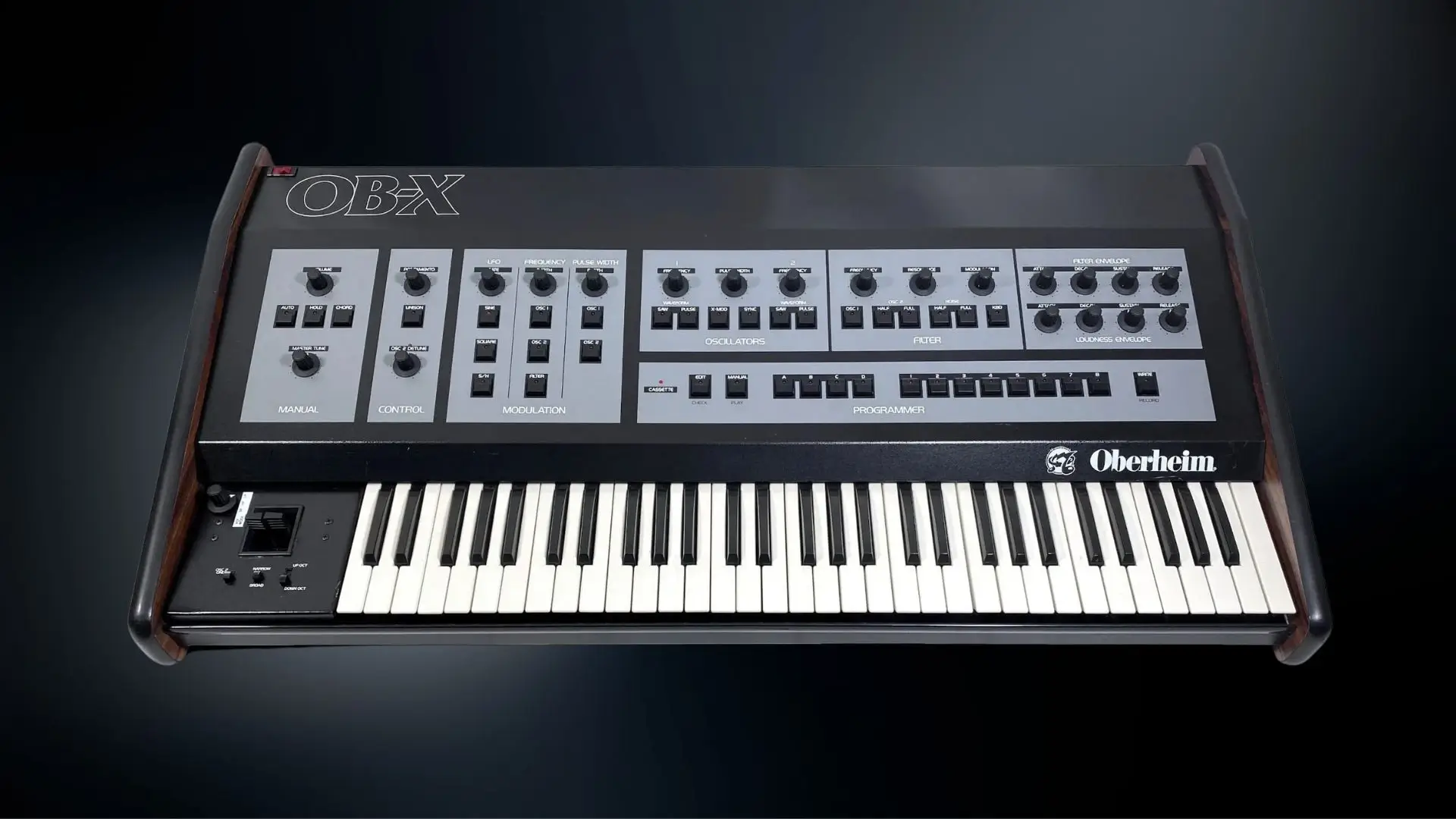
The Oberheim OB-X is a programmable analog polysynth introduced in 1979, at a moment when the market for portable polyphonic synthesizers was rapidly consolidating around instruments that could store sounds and survive real performance use. It was Oberheim’s first instrument in the OB line, available in multiple voice configurations, and it mattered because it translated the company’s earlier SEM-based identity into a more integrated, stage-capable, memory-equipped keyboard without abandoning the broad, muscular tonal character that had already made the Oberheim name distinctive.
Table of Contents
Oberheim OB-X sound and character
In practice, the Oberheim OB-X sounds large, immediate, and unapologetically physical. It is the kind of polysynth that does not merely fill harmonic space; it claims it. Its best-known territory is the classic Oberheim zone of brassy stabs, wide pads, animated unison leads, and thick detuned chords, but the instrument is more flexible than its most famous presets suggest. The combination of two VCOs per voice, a 12 dB low-pass filter, and a modulation structure that includes sample-and-hold, polyphonic portamento, and cross-modulation gives it both weight and edge.
What makes the Oberheim OB-X especially interesting is that it does not sound as polished as later Oberheims. That is precisely part of its identity. Where the OB-Xa and OB-8 often feel tighter, more standardized, and more overtly optimized for the early-1980s mainstream, the Oberheim OB-X retains more of the earlier Oberheim temperament: broad, slightly unruly, and sonically open in a way that often reads as more organic. Its brass patches can hit with authority, but its pads and strings are equally compelling because they do not collapse into bland smoothness. Even when the sound is lush, there is still tension inside it.
That character is not just a matter of nostalgia. It follows directly from the design. The discrete voice architecture and SEM-lineage filter behavior help explain why the instrument is so often described as raw, huge, or alive. The OB-X does not flatter every patch equally, but when a sound suits the architecture, it speaks with unusual conviction.
Features and architecture
- Manufacturer: Oberheim Electronics.
- Year: Introduced in 1979.
- Production years: Short original run beginning in 1979, before the OB-Xa took over in the early 1980s.
- Synthesis type: Analog subtractive synthesis.
- Category: Programmable polyphonic keyboard synthesizer.
- Polyphony: Available in 4-, 6-, and 8-voice configurations.
- Original price and current market price: Period pricing ranged from roughly US$4,595 for a 4-voice model to US$5,995 for an 8-voice model; current vintage-market asking prices vary widely, with lower-condition 4-voice units appearing around the mid-four-figure range and serviced 8-voice examples reaching well into five figures.
- Oscillators: 2 VCOs per voice, with sawtooth or pulse waveforms.
- Filter: 2-pole resonant low-pass filter with a dedicated ADSR envelope.
- LFOs: 1 LFO, with sine, square, and sample-and-hold modulation options.
- Envelopes: 2 ADSR envelopes per voice, one for filter and one for amplifier.
- Modulation system: LFO routing to oscillators and filter, polyphonic sample-and-hold, polyphonic portamento, unison functions, and cross-modulation/polymod-style behavior associated with the Oberheim OB-X.
- Sequencer / arpeggiator: No built-in sequencer or arpeggiator.
- Effects: No built-in effects.
- Memory: 32 programmable memories in the standard documented configuration.
- Keyboard: 61-note, five-octave keyboard.
- Inputs / outputs: Left, right, and mono audio outputs; cassette interface; five foot-control inputs for volume, filter, vibrato, sustain, and program advance; CV/Gate control on voice 1.
- MIDI / USB: None on the original instrument.
- Power: Rear-panel 115/230V power selection.
Strengths
- A genuinely distinctive Oberheim voice: The Oberheim OB-X does not merely sound “vintage”; it sounds specifically Oberheim, with the broad stereo image, blunt-force brass, and expansive pad behavior that later became a recognizable brand signature.
- A stronger bridge between studio sound and stage practicality than the older SEM systems: Patch memory, auto-tuning, and a self-contained keyboard format made it far more practical for repeated live use than assembling polyphony out of separate SEM-derived structures.
- More character than convenience-driven later revisions: Many players are drawn to the Oberheim OB-X precisely because it feels less standardized than the OB-Xa or OB-8. Its rougher edges are part of its expressive value.
- Excellent at musically consequential basics: Big unison leads, stacked chords, synth brass, and moving string/pad textures all emerge from the architecture with very little persuasion.
- Stereo presence that matters in real arrangements: The voice-panning behavior and overall width help the instrument occupy a mix in a way that feels dramatic without necessarily requiring effects.
- A historically important design transition: It marks the point where Oberheim’s earlier modular and SEM-based ideas were consolidated into a programmable polysynth format that could compete directly in the late-1970s professional market.
Limitations
- A vintage instrument with vintage maintenance realities: The same discrete architecture that contributes to the sound also contributes to the need for careful servicing, calibration, and restoration.
- No native MIDI or modern connectivity: Any integration into a contemporary rig depends on retrofit solutions rather than stock functionality.
- No split or layer workflow of later OB designs: If a player wants the more performance-oriented keyboard partitioning and layering associated with later Oberheims, the Oberheim OB-X is not the model that delivers it.
- No onboard effects, no built-in sequencer, no built-in arpeggiator: Its sound is strong enough to justify that minimalism, but the workflow is undeniably more old-school.
- Memory is modest by later standards: Thirty-two programs was valuable in 1979, but it is restrictive when viewed from a modern perspective.
- The market now places it in the expensive, specialist category: It is no longer a pragmatic bargain vintage buy; it is a serious purchase with restoration risk and collector pressure built in.
Historical context
The Oberheim OB-X arrived in 1979 in a market that had changed quickly. The Prophet-5 had already demonstrated that programmability and portability were not optional luxuries but a new professional standard. Oberheim’s earlier SEM-based polyphonic systems had undeniable sonic authority, but they belonged to a more cumbersome model of polyphony. The Oberheim OB-X was the company’s answer: keep the tonal identity, but package it in a form that acknowledged what working musicians now expected from a serious polysynth.
That timing mattered. The late 1970s were not just a period of technical innovation; they were a period of format consolidation. Musicians wanted repeatability, recall, and stage readiness without sacrificing analogue force. The OB-X entered that conversation as a direct assertion that Oberheim could compete on those terms while still sounding unlike everyone else.
It also became the first OB-series synth that could interface with Oberheim’s pre-MIDI system logic, which matters historically because it placed the instrument inside a broader ecosystem rather than leaving it as an isolated keyboard. In other words, the Oberheim OB-X was not merely a product launch; it was the opening chapter of a design language that would define Oberheim’s most famous polyphonic period.