

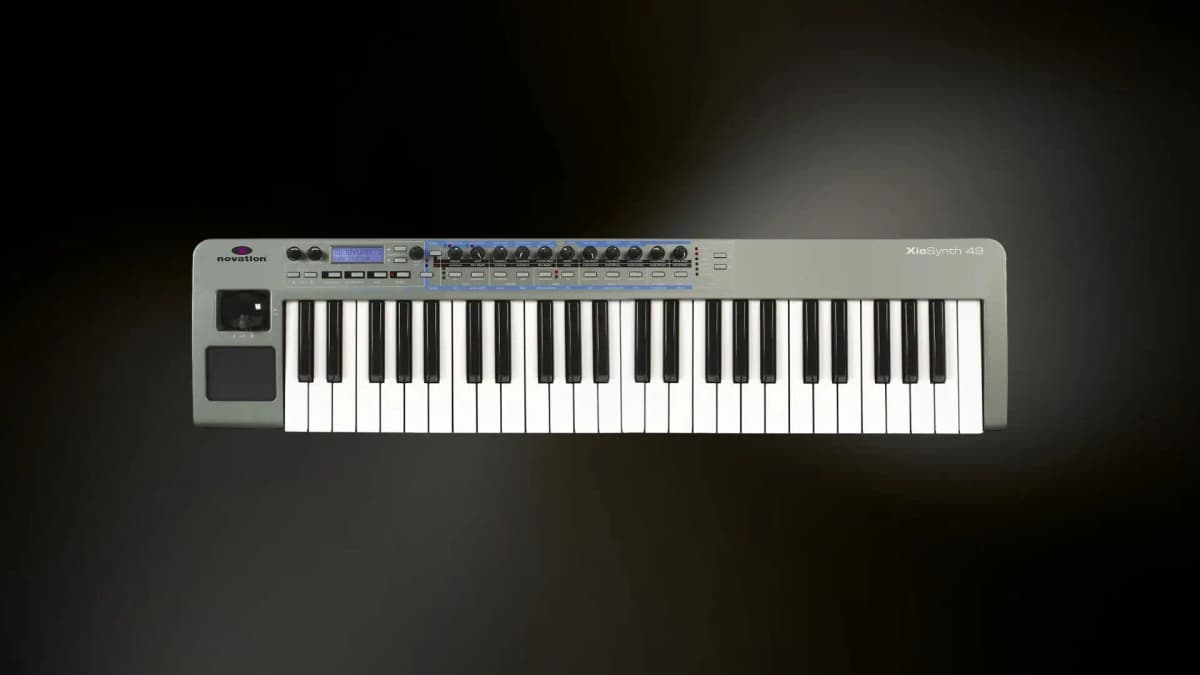
The Novation XioSynth 49 is a 49-key digital virtual-analog synthesizer, USB MIDI controller, and USB audio interface introduced in 2006, at a moment when laptop-based production was becoming normal rather than exotic. It compressed several studio roles into one light keyboard: an onboard subtractive synth, assignable hardware controls, audio inputs, USB audio streaming, battery power, and performance tools such as an arpeggiator and X-Gator rhythmic gate. Its importance is not that it became a classic flagship, but that it showed how mid-2000s synthesizers were beginning to merge instrument, controller, and computer companion into a single portable object.
Table of Contents
Novation XioSynth 49 sound and character
The Novation XioSynth 49 has the clean, bright, slightly glassy character associated with Novation’s digital virtual-analog lineage, but it is not limited to polite trance-era sheen. Its three-oscillator engine, multimode filter, filter overdrive, distortion, oscillator sync, ring modulation, FM routing, noise sources, and wide LFO vocabulary allow it to move from compact basses and sharp leads into metallic tones, synthetic plucks, rhythmic gated patches, and digitally flavored textures.
It does not sound like a large analog polysynth. The tone is more controlled, direct, and digitally stable, with the option to fake some looseness through VCO drift and oscillator detune. Its most convincing territory is not “vintage authenticity,” but portable, programmable virtual analog: tight basses, brisk arpeggios, animated pads, dance-music leads, and quick performance patches that can sit inside a computer-based setup without needing another interface.
The X-Gator is central to the Novation XioSynth 49’s identity. It turns the XioSynth from a simple small VA keyboard into a pattern-oriented instrument, closer in spirit to the loop-driven and MIDI-clocked workflows of the 2000s. Rather than being a conventional note sequencer, it rhythmically gates the Novation XioSynth 49 sound over up to 32 steps, making static patches feel more animated and performance-ready.
Features and architecture
- Manufacturer: Novation.
- Year: Introduced in 2006; Reverb catalogs the Novation XioSynth 49 as a 2007 digital keyboard synth.
- Production years: Introduced in 2006 and later discontinued; the exact end year is not confidently verified, so it is best described as a legacy Novation instrument rather than assigned a speculative production span.
- Synthesis type: Digital virtual-analog subtractive synthesis.
- Category: 49-key keyboard synthesizer, USB MIDI controller, and USB audio interface.
- Polyphony: Official Novation documentation lists the Xio as one-part, 8-voice polyphonic. Some retailer and marketplace listings describe it as 10-voice, but the official user guide is the safer reference.
- Original price and current market price: Contemporary reporting placed the 49-key model around US$399 and UK review pricing at £299 including VAT. It is no longer sold new; used prices are inconsistent and depend heavily on condition, working controls, power supply, and included accessories.
- Oscillators: Three oscillators, 17 waveforms per oscillator, plus noise generator and ring modulator. Waveforms include traditional analog-style waves, noise types, and sampled waves such as organ, electric piano, slap bass, clavinet, and analog bass.
- Oscillator extras: Pulse-width modulation, oscillator sync between oscillators 1 and 2, FM from oscillator 2 to oscillator 3, oscillator drift, preglide, portamento, unison, and start-phase control.
- Filter: Multimode resonant filter with low-pass, band-pass, and high-pass modes, 12 dB / 24 dB slope switching, overdrive, filter-shape control, resonance normalization, velocity response, modulation envelope depth, and LFO modulation.
- LFOs: Two LFOs with 32 waveforms, including conventional shapes, sample-and-hold variants, envelope-like shapes, scale-related shapes, and pattern shapes.
- Envelopes: Amplitude envelope, modulation envelope, and an additional attack/decay envelope.
- Modulation system: Parameter modulation through envelopes, LFOs, velocity, joystick, X/Y touchpad, oscillator and filter routings, plus assignable controller functions in MIDI mode.
- Sequencer / arpeggiator: Arpeggiator with latch and MIDI destination options; X-Gator rhythmic gate with 32-step programming and latch.
- Effects: Delay, reverb, chorus/phaser, distortion, EQ/volume, and stereo panning.
- Memory: Two sound banks of 100 patches each, for 200 onboard synth patches; 16 onboard MIDI controller templates.
- Keyboard: 49 semi-weighted keys, velocity curves, octave buttons, pitch/mod joystick, and X/Y touchpad.
- Inputs / outputs: XLR microphone input with phantom power, unbalanced jack input, stereo line outputs, headphone output, and sustain pedal input.
- MIDI / USB: 5-pin MIDI Out, USB MIDI In/Out, USB 1.1 data connection, and direct USB audio streaming.
- Display: 2 x 16-character backlit LCD.
- Dimensions / weight: 798 x 68 x 190 mm for the 49-key model; approximately 1.6 kg.
- Power: USB power, 6 AA batteries, or 9V DC 600 mA centre-positive external power supply.
Strengths
- It combines three practical roles in one object: synth, controller, and audio interface. That made real sense in the 2000s, when many musicians were building small computer-based studios and wanted fewer boxes on the desk.
- The sound engine is deeper than the small chassis suggests: three oscillators, sync, FM, ring modulation, filter overdrive, 32 LFO waveforms, and multiple envelopes give it more programming range than a simple preset keyboard.
- The X-Gator gives it a distinct rhythmic personality: it encourages gated pads, pulsing basses, clocked textures, and quick pattern-based movement without needing a DAW automation lane.
- The touchpad and joystick make it more performative than its size implies: filter sweeps, modulation gestures, and assignable MIDI control give the Novation XioSynth 49 a tactile quality that many compact synths lack.
- Battery and USB power make it unusually portable: it can work as a standalone synth away from the computer, but also slot directly into a laptop setup.
- Its onboard effects are musically useful: delay, reverb, chorus/phaser, distortion, EQ, and panning allow patches to feel finished enough for sketching, live use, or compact production setups.
- It reflects Novation’s strength in hybrid workflow design: the Novation XioSynth 49 is not just a synth with MIDI bolted on; it was designed around moving between playing, controlling software, routing audio, and performing.
Limitations
- The official polyphony is modest: 8 voices are workable for basses, leads, arps, and simple pads, but dense sustained chords with long releases can expose the limit.
- It is monotimbral: it plays one synth part at a time, so it cannot replace a multitimbral workstation or larger digital synth in complex arrangements.
- The interface is compact but menu-dependent: the front panel gives useful access, but deeper editing requires menu navigation and shared controls.
- The X-Gator is a gate programmer, not a full melodic sequencer: it is excellent for rhythmic animation, but it does not replace a real step sequencer for note programming.
- The audio interface is historically useful but dated: USB 1.1 and legacy driver expectations make it less straightforward in modern computer setups than a current interface.
- The 5-pin MIDI implementation is limited to MIDI Out: it can control external hardware, but it is not a full traditional MIDI interface with both DIN input and output.
- Used units require careful inspection: knobs, buttons, display, power options, joystick, touchpad, audio inputs, and USB behavior matter more than cosmetic condition alone.
- It is often underrated, but not secretly a flagship: its appeal lies in compact utility and character, not in replacing larger Novation instruments such as the Supernova, KS series, or later flagship designs.
Historical context
The Novation XioSynth 49 appeared during a transitional period. Hardware synths were no longer only standalone stage instruments, and MIDI controllers were no longer passive plastic keyboards. By 2006, the laptop, DAW, soft synth, and USB controller had become central to electronic music production. Novation’s response was not to abandon hardware synthesis, but to fold it into a controller-and-interface format.
The XioSynth followed the broader Novation path from instruments such as the K-Station, KS series, and X-Station, but it simplified the idea into a smaller, cheaper, more portable device. Compared with the X-Station, it preserved the idea of a hardware synth plus controller plus interface, but leaned more strongly into compactness and pattern-based immediacy. The X-Gator and filter overdrive helped distinguish it from being merely a reduced X-Station.
Its timing also matters because the mid-2000s compact synth market was crowded with instruments trying to serve beginners, laptop musicians, and gigging electronic performers. The Novation XioSynth 49 did not win history in the way the microKORG did, but it occupied a revealing niche: a British virtual-analog synth built for the USB studio, not just for the keyboard stand.