

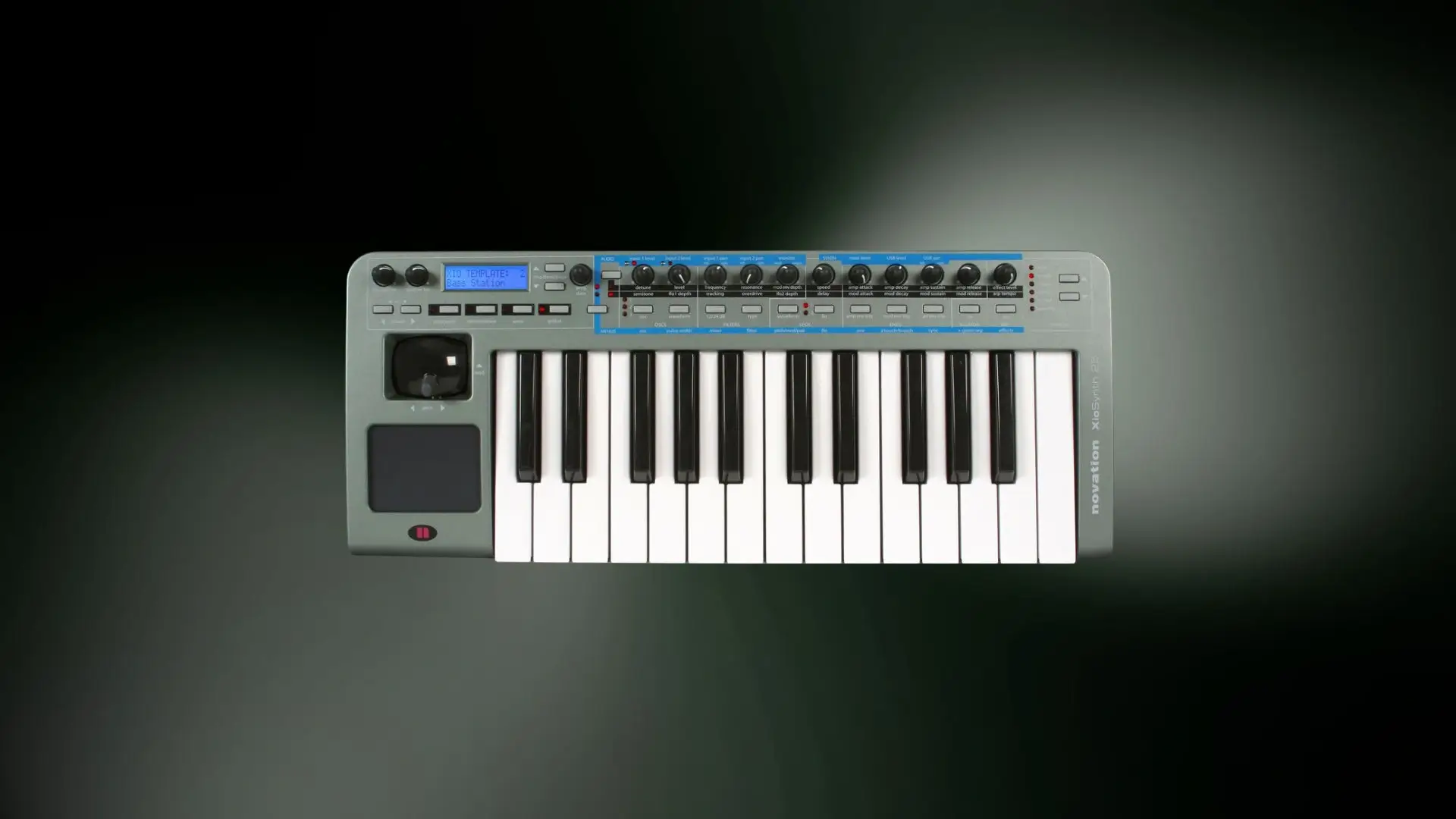
The Novation XioSynth 25 is a compact 25-key virtual-analog digital synthesizer, MIDI controller, and USB audio interface that appeared in the mid-2000s, with availability reported in 2006 and major reviews following in 2007. It condensed several identities into one small instrument: a monotimbral 8-voice synth, a hands-on software controller, a portable recording interface, and a battery-capable performance keyboard. Its importance lies less in brute synthesis power than in the way it captured a specific historical moment, when laptop production, affordable virtual analog, USB audio, and compact hardware control were rapidly merging.
Table of Contents
Novation XioSynth 25 sound and character
The Novation XioSynth 25 sounds like a product of the 2000s virtual-analog era: immediate, bright, rhythmically animated, and more digital-polished than vintage-unstable. It is not a lush analog polysynth in the classic sense, and it does not try to be one. Its personality comes from the Novation-style subtractive engine, the three-oscillator architecture, the multimode resonant filter, the onboard effects, and the way the X-Gator can turn static patches into syncopated rhythmic material.
Its strongest sounds are basses, arpeggiated patterns, sharp electronic leads, motion-heavy sequences, trance-influenced gates, and compact pads that sit easily inside a DAW arrangement. The filter gives it more bite than the older, cleaner side of Novation’s VA lineage, helped by overdrive and the Shape parameter. That matters musically: it lets the XioSynth move from polite British virtual analog into rougher, more club-oriented territory without needing external processing.
There is a slightly compressed, efficient quality to the tone. That can be a limitation if the goal is wide, expensive, analog-style depth, but it is also part of the Novation XioSynth 25’s usefulness. The Novation XioSynth 25 is good at sounds that need to arrive quickly, lock to tempo, and behave inside an electronic production. Its sonic identity is not “vintage romance.” It is small-box digital momentum.
Features and architecture
- Manufacturer: Novation.
- Year: Announced and entering the market in 2006, with prominent reviews appearing in 2007.
- Production years: The exact production span was not reliably published in the checked sources; the Novation XioSynth 25 is now treated by Novation as legacy equipment.
- Synthesis type: Digital virtual-analog subtractive synthesis.
- Category: Compact keyboard synthesizer, MIDI controller, and USB audio interface.
- Polyphony: Official Novation documentation specifies 8-voice polyphony.
- Original price and current market price: Contemporary sources listed the 25-key version at £229 in the UK and around $499.99 list price, with a US street price reported at $299 in 2008. Current used-market signals vary widely, with recent examples around the low-to-mid hundreds of US dollars and Brazilian used listings appearing around R$1,890.
- Oscillators: 3 oscillators with 17 waveforms; the engine also includes noise and ring modulation.
- Filter: Multimode resonant filter with high-pass, low-pass, and band-pass options, 12 dB and 24 dB slope selection, overdrive, and a Shape parameter.
- LFOs: 2 LFOs with 32 waveforms.
- Envelopes: Amplitude envelope, modulation envelope, and an additional attack/decay envelope.
- Modulation system: Modulation envelope routing, LFO routing, oscillator sync, FM between oscillators, ring modulation, assignable X/Y touchpad, pitch/mod joystick, velocity response, and external aftertouch reception.
- Sequencer / arpeggiator: Arpeggiator with latch and X-Gator, a 32-step rhythmic gate programmer with latch and MIDI-syncable behavior.
- Effects: Digital effects section including delay, reverb, chorus, phaser, distortion, panning, EQ, and related processing.
- Memory: 200 synth patches and 16 onboard MIDI control templates, with additional templates and sound resources available through Novation downloads.
- Keyboard: 25 semi-weighted, velocity-sensitive keys; no keyboard aftertouch, though the Novation XioSynth 25 engine can respond to external aftertouch.
- Inputs / outputs: XLR microphone input with selectable phantom power, 1/4-inch unbalanced line/instrument input, stereo line outputs, headphone output, and sustain pedal input.
- MIDI / USB: DIN MIDI Out, USB MIDI 1 in/1 out, and USB 1.1 audio/MIDI connection.
- Display: 2 x 16 character backlit LCD.
- Dimensions / weight: 468 x 68 x 190 mm; 1.4 kg.
- Power: USB power, external 9V DC power supply, or six AA batteries.
Strengths
- It compresses a whole mid-2000s production setup into one object. The XioSynth 25 can act as a synth, controller, USB audio interface, and small standalone mixer, which made sense when many producers were moving between bedrooms, laptops, small studios, and live electronic setups.
- The Novation XioSynth 25 engine is deeper than the small panel suggests. Three oscillators, FM, ring modulation, oscillator sync, multiple waveform types, filter overdrive, and X-Gator movement give it more programming range than a casual glance implies.
- The X-Gator gives the Novation XioSynth 25 a distinct rhythmic identity. Instead of being just another compact VA synth, the Novation XioSynth 25 can impose 16- or 32-step gated motion on patches, making it especially useful for trance, electro, breakbeat, and other pattern-driven electronic styles of the period.
- Hybrid mode is historically important. The ability to use the onboard synth while also controlling software points directly to the computer-centered workflow of the 2000s, where hardware instruments increasingly had to justify their place beside soft synths.
- The X/Y touchpad and joystick encourage performance gestures. Even with a compact keyboard and limited panel space, the Novation XioSynth 25 invites filter sweeps, expressive modulation, and quick timbral changes rather than only static preset playback.
- It remains portable in a practical, not merely marketing, sense. The 1.4 kg weight, 25-key size, USB power, battery option, and integrated audio interface make it genuinely easy to move between setups.
Limitations
- It is monotimbral. The Novation XioSynth 25 can play one synth program at a time, so it cannot replace a multitimbral workstation or larger performance synth.
- Official polyphony is limited to 8 voices. That is enough for many electronic parts, but it restricts sustained pads, layered chords, and dense voicings.
- The 25-key format is useful for portability but restrictive for two-handed playing. It suits bass lines, leads, riffs, and compact chord work more than full keyboard performance.
- There is no keyboard aftertouch. The engine can respond to external aftertouch, but the built-in keybed does not generate it.
- The interface depends on shared controls and menu navigation. The 11 knobs and buttons are flexible, but deeper programming requires mode switching and screen attention.
- It lacks the more generous control surface feel of the X-Station. Compared with its older sibling, the Novation XioSynth 25 sacrifices some directness and physical control in exchange for lower cost and smaller size.
- Its effects cannot be applied to incoming audio. That reduces its usefulness as an external effects processor, even though it works well as an interface and miniature mixer.
- Aging units need careful inspection. As with many compact 2000s devices, used examples should be checked for knob condition, encoder behavior, joystick response, USB reliability, screen health, power supply compatibility, and battery compartment corrosion.
Historical context
The Novation XioSynth 25 arrived after Novation had already built a reputation around virtual-analog synthesis and hybrid computer-music hardware. The lineage matters. Earlier Novation instruments such as the K-Station, KS series, and X-Station had already established the company’s compact VA vocabulary: bright oscillators, usable filters, hands-on control, effects, and an emphasis on electronic music workflow. The XioSynth did not abandon that tradition; it miniaturized and rebalanced it.
The timing was crucial. By 2006 and 2007, affordable soft synths were no longer novelties, USB MIDI controllers were everywhere, and many musicians were producing inside DAWs rather than around hardware multitracks or large keyboard rigs. In that market, a compact hardware synth had to offer more than sounds. It had to control software, move audio into the computer, survive a small desk, and still feel like an instrument.
That is why the Novation XioSynth 25 is best understood as a cousin of the X-Station rather than a simple budget synthesizer. It took the idea of a keyboard that could synthesize, control, and interface with a computer, then made it smaller, cheaper, more portable, and more explicitly aimed at hybrid laptop use. Its compromises were real, but so was the clarity of the concept.