

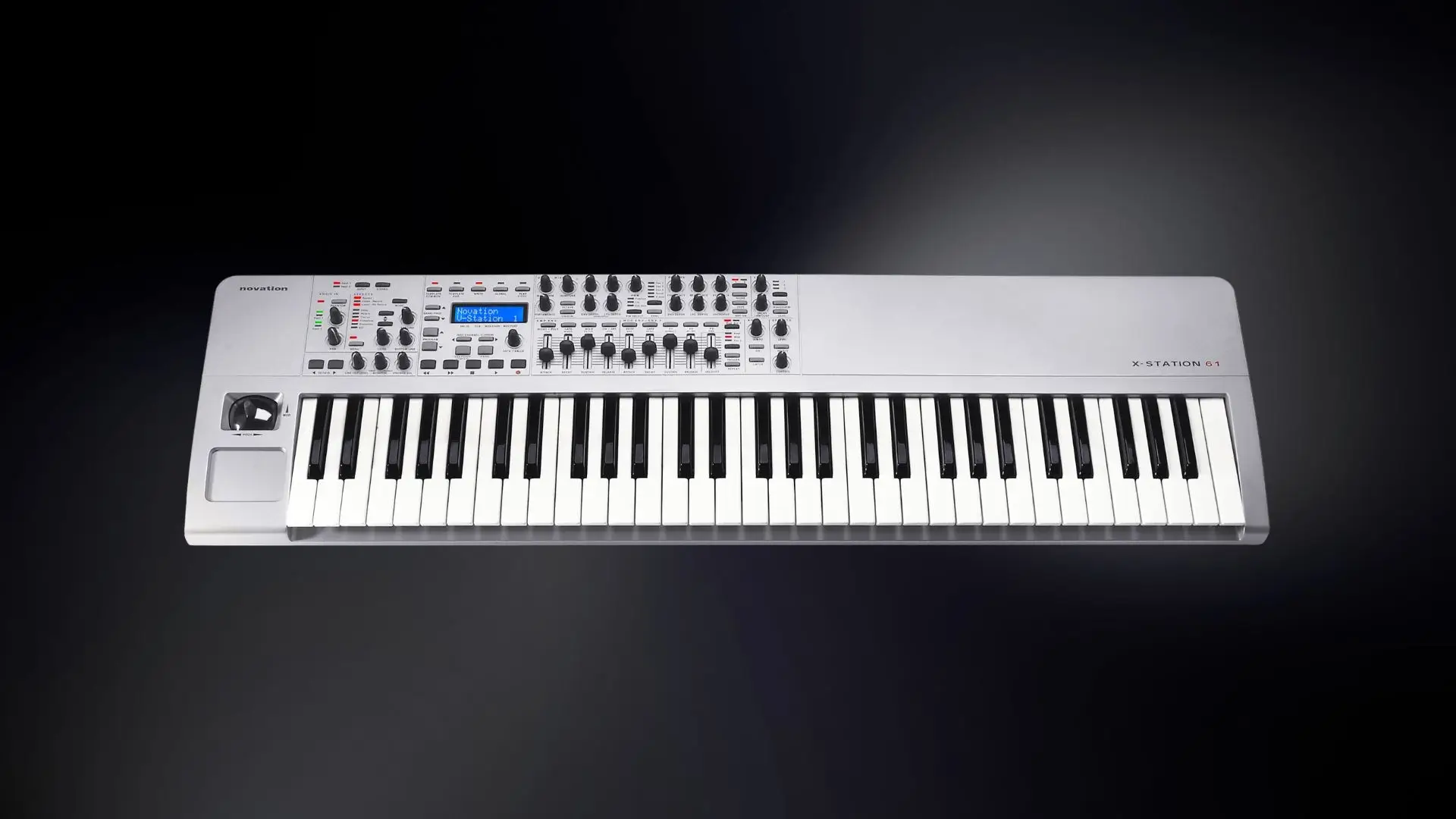
The Novation X-Station 61 is a 61-key hybrid keyboard introduced in 2004 that combines an 8-voice virtual analog synthesizer, a USB MIDI controller, a 24-bit two-channel audio interface, onboard effects, and a semi-weighted keyboard with aftertouch. It belongs to a very specific moment in music technology: the early laptop-studio era, when hardware makers were trying to collapse the distance between the Novation X-Station 61, the MIDI controller, the audio interface, and the computer. The Novation X-Station 61 matters because it was not simply a synth with USB added. It was an attempt to make one keyboard the center of a compact electronic-music setup.
Table of Contents
Novation X-Station 61 sound and character
The X-Station 61 has the sharp, immediate character of early-2000s virtual analog synthesis rather than the weight or instability of a true analog polysynth. Its sound engine is derived from Novation’s KS-series lineage, and that matters: it gives the Novation X-Station 61 a more serious synthesis core than many controller keyboards of its period. It is not just a controller with a token sound module inside.
Its three-oscillator structure allows thick detuned basses, animated leads, wide synthetic strings, brassy stabs, sync-like cutting tones, and rhythmic arpeggiated patches. The waveform set moves beyond basic analog shapes into noise and digital sampled sources, which means the Novation X-Station 61 can move from classic subtractive sounds into more glassy, hybrid timbres. The result is not “vintage” in the modern analog-revival sense. It is cleaner, brighter, and more explicitly digital, but not sterile when programmed with care.
The filter is central to its personality. With low-pass, high-pass, and band-pass modes, selectable 12 dB or 24 dB slopes, resonance, and overdrive, it can move from polite subtractive shaping to harder, more pointed sounds. The overdrive is especially important because it gives the engine a way to escape the flatness that can affect some virtual analog instruments when they are heard dry.
The Novation X-Station 61 is also a performance synth. The aftertouch keyboard, pitch/mod joystick, and X/Y touchpad encourage real-time movement. That is one reason the Novation X-Station 61 can feel more expressive than its specifications suggest. It is not the most luxurious-sounding digital polysynth of its generation, and its 8-voice ceiling is modest, but its immediacy gives it a practical musical identity: compact, tweakable, somewhat bright, rhythmically useful, and capable of strong leads, animated pads, and synthetic textures that sit well in electronic arrangements.
Features and architecture
- Manufacturer: Novation.
- Year: 2004.
- Production years: A verified production end year was not confirmed from primary sources. Novation now lists the X-Station 61 under its legacy synthesizer downloads.
- Synthesis type: Digital virtual analog subtractive synthesis with FM capabilities.
- Category: Hybrid keyboard synthesizer, MIDI/USB controller, audio interface, and effects-equipped production keyboard.
- Polyphony: 8 voices.
- Original price: Not confidently verified from a primary source. Historical retailer traces exist, but no confirmed launch MSRP is used here.
- Current market price: Used-market signals in 2026 place the Novation X-Station 61 roughly in the low-to-mid hundreds of dollars or euros, depending on region and condition.
- Oscillators: Three independent oscillators, plus a noise generator and ring modulator. The engine includes traditional analog-style waveforms, noise types, and digital/sample-derived waves, with oscillator sync and FM-related functions.
- Filter: Single multimode resonant filter with low-pass, high-pass, and band-pass operation, 12 dB or 24 dB slope selection, key tracking, envelope and LFO modulation, and overdrive.
- LFOs: Two LFOs with multiple waveform types, including standard shapes, sample-and-hold-style behavior, envelope-like shapes, and pattern-style waves.
- Envelopes: Amp envelope, modulation envelope, and an additional AD envelope used for FM-related shaping.
- Modulation system: Front-panel modulation controls, velocity response, aftertouch routing, LFO synchronization, joystick control, and a programmable X/Y touchpad.
- Sequencer / arpeggiator: Built-in arpeggiator with multiple modes, octave range, pattern selection, gate time, latch, key sync, and routing to internal, external, or combined destinations. No full onboard sequencer is documented.
- Effects: Onboard multi-effects including reverb, chorus/phaser, delay, compressor, distortion, and EQ, with effects also relevant to the X-Station’s audio-interface role.
- Memory: 200 factory sound programs for the Novation X-Station 61 engine and 40 editable template memories for controller assignments.
- Keyboard: 61-note, five-octave, semi-weighted, velocity-sensitive keyboard with aftertouch.
- Inputs / outputs: Two combo XLR/quarter-inch audio inputs, two quarter-inch audio outputs, stereo headphone output, S/PDIF digital output, sustain pedal input, and expression pedal input.
- MIDI / USB: USB for audio and MIDI, MIDI input, and dual MIDI outputs.
- Display: Two-line, 16-character blue backlit LCD.
- Dimensions / weight: 973 x 278 x 68 mm; approximately 5.6 kg.
- Power: USB power, 9V DC adapter, or six C-cell batteries.
Strengths
- It is a genuine synth, not merely a controller with presets attached. The KS-derived 8-voice engine gives it a programmable sound identity with three oscillators, a multimode filter, FM-related movement, ring modulation, and rhythmic modulation options.
- The workflow is unusually integrated. One keyboard can handle synthesis, MIDI control, audio input, monitoring, and USB connection to a computer, which made practical sense in the early laptop-production era.
- The front panel encourages synthesis rather than menu-only editing. Oscillator, filter, envelope, LFO, arpeggiator, and effects sections are physically represented, which makes the X-Station more educational and immediate than many compact digital synths.
- The 61-key version gives the architecture a more serious performance frame. A five-octave aftertouch keyboard makes the Novation X-Station 61 more viable as a main live or studio controller than the smaller X-Station versions.
- The X/Y pad and joystick give it a distinct performance feel. These controls support expressive filter sweeps, bends, modulation changes, and controller assignments that are more fluid than simple knob turns.
- The audio-interface section is historically important. The two-channel 24-bit USB audio design reflects a period when musicians wanted fewer boxes, fewer cables, and a more portable writing setup.
- The support archive remains useful. Novation still hosts the user guide, template editor, OS update, factory presets, templates, and additional soundbanks, which helps keep the Novation X-Station 61 usable despite its age.
Limitations
- Eight voices can run out quickly. Pads, long releases, layered unison sounds, and sustained playing can expose the modest polyphony.
- It is not multitimbral in the way a workstation or larger performance synth would be. The X-Station 61 is best understood as one internal synth part plus controller/audio-interface functions, not as a complete multi-part arrangement machine.
- There is no full onboard sequencer. The arpeggiator is useful, but anyone expecting workstation-style sequencing will need external hardware or a DAW.
- The audio-interface side is dated by modern standards. Its 24-bit, 44.1/48 kHz specification was meaningful in context, but modern interfaces offer better driver support, higher channel counts, and simpler compatibility.
- Driver compatibility requires caution. Novation’s current support archive is valuable, but the X-Station belongs to an older USB-driver generation, so buyers should check operating-system compatibility before relying on it as their main audio interface.
- Build perception is mixed. The Novation X-Station 61 is feature-rich and light, but some long-term user commentary has treated construction quality as less robust than the Novation X-Station 61 engine itself.
- Its sound is not universally loved. It has the recognizable Novation virtual analog character: bright, digital, flexible, and usable, but not the organic depth some players seek from analog VCO polysynths.
- Used units need careful inspection. The Novation X-Station 61 combines keyboard, controls, audio inputs, USB, display, power options, and effects, so there are more failure points than on a simpler synth module.
Historical context
The Novation X-Station 61 appeared at a turning point for Novation. The company had already built credibility with instruments such as the Bass Station, Supernova, Nova, K-Station, and KS series, while also becoming strongly associated with MIDI controller design. The X-Station fused those two sides of Novation: the synth company and the controller company.
Its timing is crucial. By 2004, computer-based music production was no longer a niche studio method. DAWs, soft synths, USB MIDI, and compact audio interfaces were becoming normal parts of the musician’s workflow. The X-Station responded to that shift by proposing a single hardware center for a small production rig. With a computer, microphone, and monitors, it could serve as a synth, controller, input device, and monitoring hub.
That explains why the Novation X-Station 61 feels historically different from a conventional polysynth. It was not designed only to compete with other sound engines. It was designed to compete with clutter. Its real proposition was practical: reduce the number of boxes needed to write, record, control software, and perform.
The Novation X-Station 61 also arrived in the same year that Focusrite acquired Novation, a corporate shift that makes the X-Station feel like a bridge between eras. It belongs to the late phase of Novation’s early virtual analog/controller identity, just before the company’s later controller ecosystem and Automap-era products would deepen its reputation in computer-centered production.