

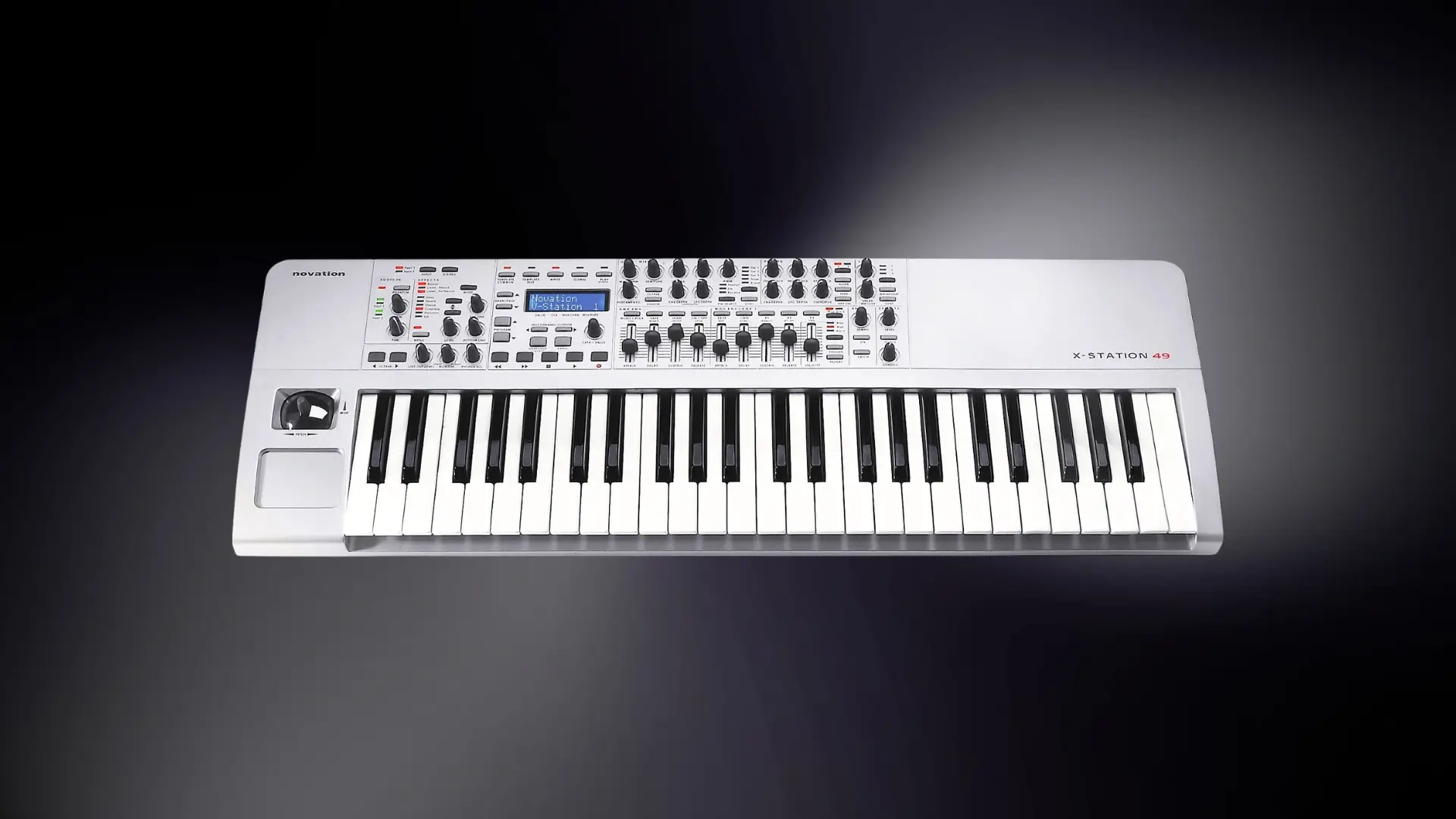
The Novation X-Station 49 is a 49-key virtual analog synthesizer, MIDI controller, USB audio interface, MIDI interface, and effects processor introduced in 2004 and commonly documented as part of Novation’s 2004–2009 X-Station period. Built around an 8-voice KS-series-derived synth engine, it belongs to a very specific early-2000s moment: the point at which hardware synthesizers, software instruments, laptop recording, and portable home studios were beginning to merge into a single working method.
Table of Contents
Novation X-Station 49 sound and character
The Novation X-Station 49 sounds unmistakably like a 2000s British virtual analog instrument rather than a disguised vintage analog machine. Its tone is clean, bright, flexible, and somewhat glossy, with enough oscillator density and onboard effects to sound larger than its modest eight voices suggest. It does not have the weight, saturation, or component-level unpredictability of a true analog polysynth, but it was not designed around that premise. Its identity comes from immediacy, control, and a wide digital-analog vocabulary.
The Novation X-Station 49 engine is based on Novation’s KS architecture, with three oscillators, noise, oscillator sync, ring modulation, digital waveforms, pulse-width modulation, FM between oscillators, a multimode resonant filter, and extensive LFO shapes. That gives it a broader range than a basic subtractive VA. It can cover bright leads, trance-era basses, sync sweeps, animated pads, synthetic EP-like FM tones, metallic attack sounds, and rhythmically modulated textures.
Its strongest musical personality appears when the oscillator section, arpeggiator, filter modulation, and effects are treated as one performance system. The filter can operate as low-pass, high-pass, or band-pass, and the Novation X-Station 49 includes a VCO drift parameter, which means “analog instability” exists here as a controllable behavior rather than a physical condition. That distinction matters: the Novation X-Station 49 does not sound old by accident; it lets the player add controlled movement inside a fundamentally digital, polished instrument.
The effects are part of the sound, not just decoration. Delay, reverb, chorus/phaser, distortion, compressor, and EQ help the Novation X-Station 49 produce the wide, finished textures associated with early computer-based electronic production. Dry, it can sound thinner than later high-resolution virtual analog instruments. With motion, detune, resonance, and effects, it becomes more convincing as a compact performance synth.
Features and architecture
- Manufacturer: Novation.
- Year introduced: 2004.
- Production years: commonly documented as 2004–2009.
- Synthesis type: digital virtual analog subtractive synthesis with FM features.
- Category: keyboard synthesizer, MIDI controller, USB audio interface, MIDI interface, and effects processor.
- Polyphony: 8 voices.
- Timbrality: monotimbral synth engine.
- Original price signal: contemporary US retail listings placed the Novation X-Station 49 around the $599–$649 range; an official launch MSRP could not be confidently verified.
- Current market price signal: used prices are inconsistent because availability is sporadic; examples in recent marketplace data tend to sit in the low-to-mid hundreds of US dollars depending on condition and region.
- Oscillators: three oscillators per voice, plus noise; oscillator sync, ring modulation, pulse-width modulation, digital waveforms, and FM functionality.
- Filter: resonant multimode filter with low-pass, high-pass, and band-pass operation; 12 dB/oct and 24 dB/oct modes are documented in common specifications.
- LFOs: two LFOs with 32 waveforms each.
- Envelopes: amp envelope, modulation envelope, and an additional AD envelope used for FM-related shaping.
- Modulation system: joystick, aftertouch, velocity, X/Y touchpad, LFOs, envelopes, oscillator drift, sync, FM, filter modulation, and programmable MIDI control assignments.
- Sequencer / arpeggiator: no full onboard sequencer; built-in arpeggiator with multiple modes and tempo control.
- Effects: delay, reverb, chorus/phaser, compressor, distortion, and EQ; the effects system can also be used with incoming audio in the X-Station’s interface role.
- Memory: 200 synth sound programs and 40 editable controller template memories.
- Keyboard: 49 full-size semi-weighted keys with velocity and channel aftertouch.
- Inputs / outputs: two audio inputs, stereo outputs, headphone output, S/PDIF digital output, sustain pedal input, expression pedal input, MIDI In, and two MIDI Out ports.
- MIDI / USB: USB MIDI/audio plus standard MIDI connections.
- Display: 2-line, 16-character blue backlit LCD.
- Dimensions / weight: approximately 31.4 x 10.9 x 2.7 inches and 9.3 lb according to retailer specifications.
- Power: USB, external 9V DC power supply, or C-cell batteries.
Strengths
- A genuinely integrated design: The Novation X-Station 49 is not merely a synth with a USB port. It combines a playable keyboard, a hardware synth engine, audio I/O, MIDI control, and onboard effects in a way that made practical sense for laptop-based production.
- Strong hands-on workflow: Its front panel follows a subtractive synth layout, with knobs, sliders, buttons, joystick, and X/Y pad making the Novation X-Station 49 feel more immediate than many menu-driven digital synths of the same era.
- Good expressive control for its class: A semi-weighted 49-key keyboard with aftertouch, joystick, and touchpad gave it more performance depth than many inexpensive controllers and compact synths.
- Useful KS-based sound engine: The 8-voice virtual analog engine is limited by modern standards, but the combination of three oscillators, digital waves, sync, FM, filter modulation, and effects gives it a wide usable range.
- Portable self-contained studio logic: USB power, battery operation, audio interface capability, MIDI control, and onboard effects made it unusually practical for small studios, mobile setups, and early DAW-centered production.
- Still valuable as a controller: Even when the Novation X-Station 49 engine is not the main attraction, the physical layout remains musically useful because it is organized like a synthesizer rather than like a generic bank of anonymous knobs.
Limitations
- Only 8 voices: The polyphony is enough for leads, basses, arpeggios, and moderate pads, but it can run out quickly with sustained chords, layered effects, or unison-style programming.
- Monotimbral synth engine: It cannot function as a multitimbral workstation. It is one synth part at a time, not a compact arrangement machine.
- No full sequencer: The arpeggiator is useful, but the absence of a proper onboard sequencer limits standalone composition.
- Aging USB/audio support: The X-Station belongs to an older USB-driver era. It remains supportable in some contexts, but buyers should not assume modern plug-and-play behavior across every current operating system.
- Build and condition matter: Older units may show wear in encoders, pots, joystick behavior, display brightness, jacks, or general casing condition. This is a used-market instrument now, so individual condition matters more than the spec sheet.
- Not a substitute for a modern flagship VA: Later digital synths and plug-ins offer more voices, deeper modulation, higher-resolution effects, and more advanced integration. The Novation X-Station 49 wins on concept and immediacy, not on raw modern synthesis power.
Historical context
The Novation X-Station 49 appeared at a moment when the center of electronic music production was moving from rack-based studios toward laptops, software instruments, and portable project rooms. In the late 1990s and early 2000s, virtual analog synthesis had already become familiar through instruments from Novation, Access, Clavia, Roland, Korg, and others. By 2004, the question was no longer simply whether digital could imitate analog well enough. The question was how hardware should behave in a computer-centered studio.
Novation’s answer was unusually pragmatic. Instead of making only a dedicated synthesizer or only a MIDI controller, the X-Station fused several studio roles into one keyboard. Its KS-derived synth engine gave it standalone musical value. Its controller templates addressed the growing world of VST instruments and DAWs. Its audio interface made it useful as a recording hub. Its effects meant that vocals, guitars, and synth patches could be monitored or recorded with processing.
That hybrid logic is historically important. The Novation X-Station 49 belongs to the same cultural shift that made “bedroom producer” a serious creative category. It was not a luxury studio centerpiece. It was an attempt to compress the essential electronic music workstation into a single portable object: keys, knobs, synth engine, interface, effects, and computer connection.